All species › Passerines › Chats and flycatchers › Karoo Scrub Robin
Karoo Scrub Robin | Tychaedon coryphoeus
Karoowaaierstaart | Alzacola del Karoo
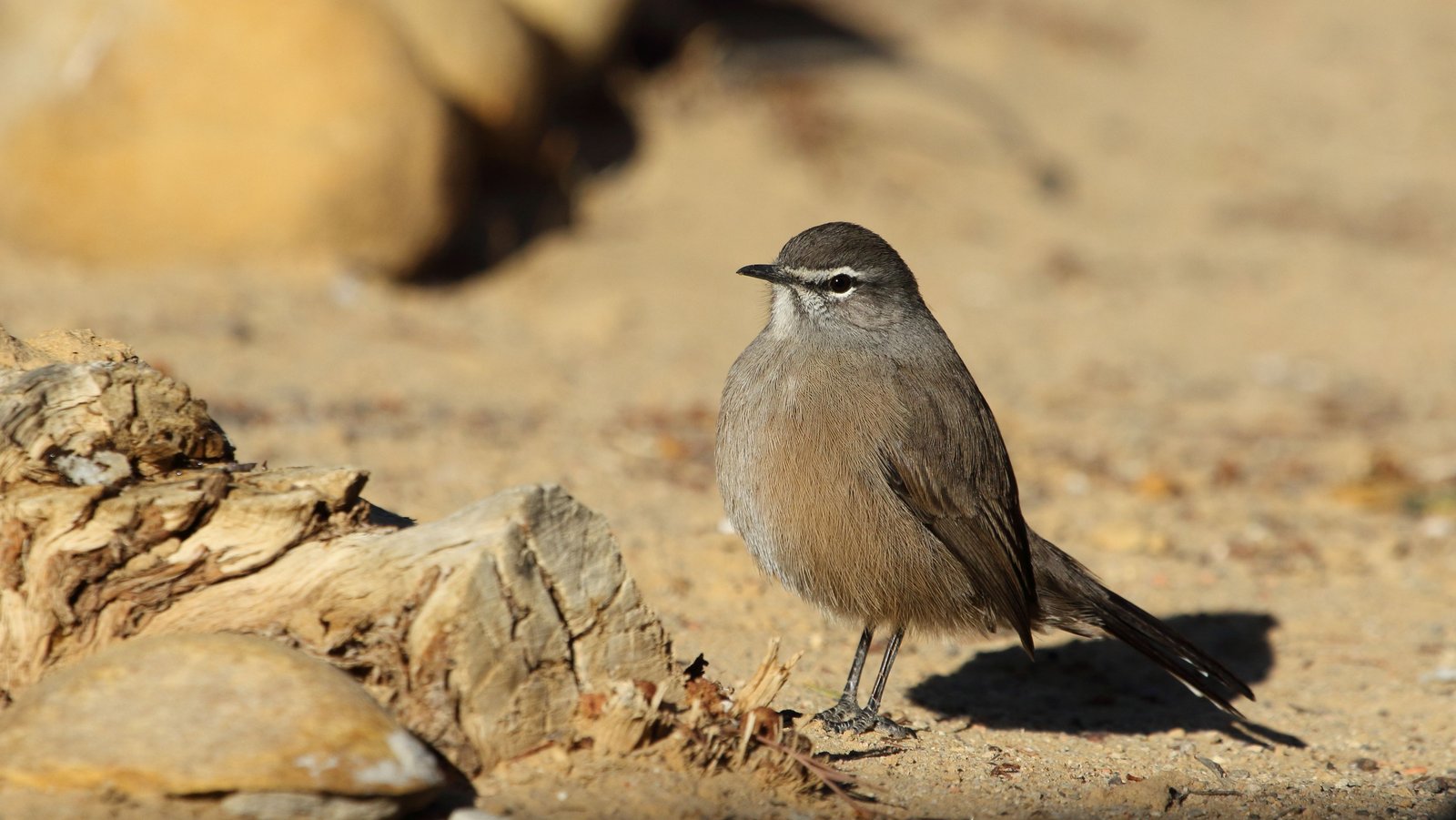
The Karoo Scrub Robin is the grey-brown scrub robin of the karoo and the dry west, running across the ground between the bushes with its tail cocked high and fanned. It sings from the top of a bush and is one of the first birds heard at dawn.
Voice
The song is a varied, scratchy series of rapid whistles, chattering phrases and imitations of other karoo birds, often from a bush top in the early morning. The alarm call is a harsh, dry chrr-chrr or tchik-tchik-tchik, accompanied by tail-fanning.
No recording with a suitable Creative Commons licence is available for this species yet.
Identification
A slender scrub robin of 17 cm. The upperparts are plain grey-brown without a rufous rump. A narrow white supercilium, white throat and black malar stripe give the head a striped pattern; the breast is grey and the belly paler. The long tail is blackish-brown with broad white tips to the outer feathers, obvious when the bird fans it. The wing shows at most a narrow white line. The sexes are alike; juveniles are spotted.
Confusion species
Kalahari Scrub Robin (Cercotrichas paena) is sandy with a rufous tail with a black subterminal band and white tips, and lives on red Kalahari sand and in thornveld. White-Browed Scrub Robin (Cercotrichas leucophrys) has a streaked breast, rufous rump and white wing bars. Karoo Chat (Emarginata schlegelii) and Tractrac Chat (Emarginata tractrac) lack the head stripes and show a black-and-white inverted-T tail pattern; they perch on a lookout rather than running through the bushes. Layard's Warbler (Curruca layardi) is smaller, with a pale eye and streaked throat.
Habitat
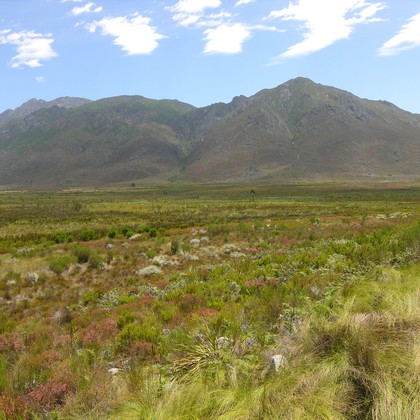
Karoo scrub plains, succulent karoo, renosterveld, dry fynbos and strandveld, and small ravines and dry riverbeds with dense scrub. Forages on the ground between the shrubs for insects, spiders and small fruits. The nest is a cup of fine material deep inside a low bush or against a grass tuft.
Where the bird is most at home, classified by the vegetation units of southern Africa.


Range and movements
Almost endemic to South Africa: the Northern, Western and Eastern Cape, the western Free State and western Lesotho, and on into southern Namibia to about Windhoek. Scarce and irregular in the extreme south-west of Botswana. The species occurs nowhere outside southern Africa.
- Resident
- Winter visitor (c. Apr–Sep)
- Passage (Mar–Apr, Oct–Nov)
- dark = core range, pale = thinly spread
How and when to look
Look for it in Karoo National Park, at Tankwa and in Namaqualand, early in the morning when it sings. It gives itself away by the rattling alarm and the flicking tail with white corners. In the eastern Karoo it overlaps with Kalahari Scrub Robin: check the tail colour, grey-black in this species, rufous in Kalahari.
Conservation status
Not threatened. The species is common within its fairly restricted but little-changed habitat, and the population is considered stable. Overgrazing and conversion of renosterveld to cropland locally reduce the cover it needs.
Scientific name
Tychaedon coryphoeus | (Vieillot, 1817)
Vieillot described the species in 1817 as Sylvia coryphaeus; because it was later moved to another genus, the author and year stand in brackets. The genus Tychaedon was introduced in 1917 by Richmond. Tychaedon combines the Greek tukhē, 'chance, luck', with aēdōn, 'nightingale, songstress'; the name replaced the preoccupied Aedonopsis in 1917. coryphoeus comes from the Greek koruphaios, 'leader of the chorus' — after Levaillant's name 'Le Coryphée' for this vocal bird. The specimen the first description was based on came from Uitenhage on the Sundays River, Eastern Cape, South Africa.