All species › Gamebirds › Pheasants and partridges › Indian Peafowl
Indian Peafowl | Pavo cristatus
Blauwe pauw | Pavo Real Común
The Indian Peafowl is a large gamebird from southern Asia that occurs in southern Africa only as an introduced, locally feral bird. The male, with its metallic blue neck and enormous train of eye-feathers, is unmistakable; the species is included in this guide because free-ranging populations maintain themselves at a number of sites.

Click a thumbnail to switch the photo above.
Voice
A loud, piercing, cat-like scream, may-aaw or kee-ow, often repeated and audible far away, especially at dusk and in the breeding season. In alarm a fast, harsh ka-aan ka-aan. In display a rustling rattle from the shivering train feathers.
Recording: Uku Paal — CC BY-NC-SA 4.0 · converted to mono · xeno-canto
Identification
The male is 180–230 cm including the 100–150 cm train, the female 90–100 cm. The male has a glossy cobalt-blue head, neck and breast, a fan-shaped crest of bare shafts tipped with blue flags, white stripes above and below the eye, a bronze-green scaled back and a train of elongated uppertail-coverts with iridescent eye-spots, raised as a fan in display. In flight the chestnut primaries stand out. The female is grey-brown with a white throat and belly, a metallic green lower neck and the same crest, but no train. Young males resemble the female and do not acquire the train until their third year.
Confusion species
No confusion with native species is possible in the region. Females and young birds may suggest a large gamebird at a distance, such as Helmeted Guineafowl Numida meleagris, but that is stocky, slate-grey with white spots, and has a bare head with a casque instead of a crest.
Habitat
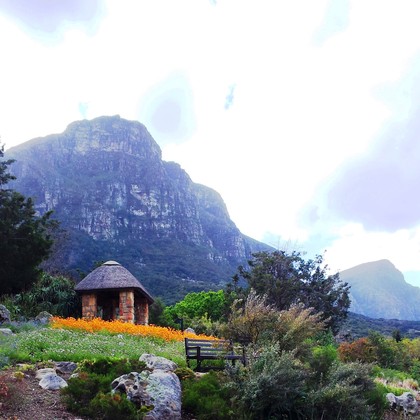
In the region mainly on farms, estates, vineyards, parks and large gardens, and on Robben Island in open scrub around the buildings. In its native range in open deciduous forest, riverine forest and cultivated land with trees. It feeds on the ground on seeds, fruit, insects, small reptiles and young plant shoots, and roosts high in trees or on roofs.
Where the bird is most at home, classified by the vegetation units of southern Africa.

Range and movements
Feral on Robben Island off Cape Town and locally on farms and estates in South Africa, mainly in the Western and Eastern Cape and KwaZulu-Natal; elsewhere in the region only as a kept or semi-wild bird. Native to India, Sri Lanka, Nepal, Bangladesh and Pakistan; introduced worldwide and feral in many places.
- Resident
- Summer visitor (c. Oct–Mar)
- Winter visitor (c. Apr–Sep)
- Passage (Mar–Apr, Oct–Nov)
- dark = core range, pale = thinly spread
How and when to look
Free-ranging peafowl can be seen on estates and wine farms in the Cape region and on Robben Island during the boat tour. Anyone reporting feral birds should note whether young birds are roaming freely, since this indicates whether a population is self-sustaining.
Conservation status
Not globally threatened and common in its native range, where it is protected as the national bird of India. In southern Africa an alien species; feral populations on islands can affect native fauna and are monitored there.
Scientific name
Pavo cristatus | Linnaeus, 1758
Linnaeus described the species in 1758 and placed it straight away in the genus where it still stands. He introduced the genus Pavo in that same work. Pavo is the Latin word for 'peafowl'. cristatus is Latin for 'crested', from crista 'crest', for the fan-shaped crest. The specimen the first description was based on came from India.