All species › Passerines › Laughingthrushes › Hartlaub's Babbler
Hartlaub's Babbler | Turdoides hartlaubii
Hartlaubs babbelaar | Turdoide de Hartlaub
Hartlaub's Babbler is the babbler of reedbeds, papyrus and riverine forest in the north-west of the region. It closely resembles the Arrow-Marked Babbler, but the white rump, which flashes as the bird flies off, and its attachment to water make it recognisable.

Voice
Groups give a loud, hoarse, fast chorus of cackling, kweh-kweh-kweh-kweh-kweh, lower and rawer than that of Arrow-Marked Babbler, with the birds calling over one another. Also a hoarse cherr as contact and alarm call.
Recording: Ehren Eksteen — CC BY-NC-SA 4.0 · converted to mono · xeno-canto
Identification
24–26 cm. A robust, greyish-brown babbler with a long tail. Head, throat and breast are greyish-brown with pale, whitish feather edges, creating a scaly pattern, especially on the crown and breast. The belly is paler, greyish-white. The rump, uppertail-coverts and undertail-coverts are white; the white rump is best seen in flight. Wings and tail are dark brown. The eye is orange-red. Bill and legs are black. The sexes are alike; juveniles have a brown eye and a less distinct rump.
Confusion species
Arrow-Marked Babbler Turdoides jardineii has a brown rump and undertail-coverts and white arrowhead-shaped rather than scaly markings; where both occur together, as in the Okavango and along the Chobe, Arrow-marked lives more in dry bush and Hartlaub's in reeds and waterside tangles. Black-Faced Babbler Turdoides melanops has black lores, a yellow eye and no white rump.
Habitat
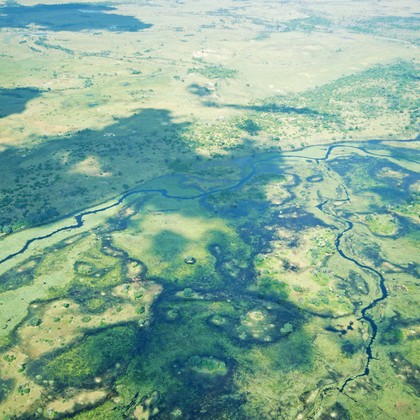
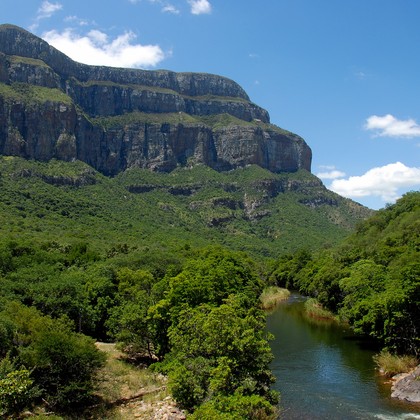
Reedbeds, papyrus, rank growth and dense bush along rivers and floodplains, riverine forest, bushy islands in swamps and dense vegetation around dambos; locally also in gardens and plantations near water. It lives in permanent groups of four to ten birds that breed cooperatively and forage mainly on the ground and in low vegetation for insects and other invertebrates.
Where the bird is most at home, classified by the vegetation units of southern Africa.
Range and movements
Within the region in northern Botswana (Okavango Delta, Linyanti and Chobe), north-eastern Namibia (Kavango and Zambezi Region), extreme north-western Zimbabwe (around Victoria Falls and Kazungula), much of Zambia (especially in the west, along the Zambezi and Kafue and in the north) and in central, northern and eastern Angola. Beyond the region in southern DR Congo and south-western Tanzania.
- Resident
- Summer visitor (c. Oct–Mar)
- Winter visitor (c. Apr–Sep)
- Passage (Mar–Apr, Oct–Nov)
- dark = core range, pale = thinly spread
How and when to look
All year. Best seen from a boat or along the banks in the Okavango Delta and along the Chobe and Kwando: the groups fly one by one across the water from reed fringe to reed fringe, flashing the white rump. Note the lower, rawer chorus.
Conservation status
Not threatened; common in suitable habitat. Locally sensitive to the drying out or burning of reedbeds and the clearing of riverside vegetation.
Scientific name
Turdoides hartlaubii | (Bocage, 1868)
Bocage described the species in 1868 as Crateropus Hartlaubii; because it was later moved to another genus, the author and year stand in brackets. The genus Turdoides was introduced in 1826 by Cretzschmar. Turdoides comes from the Latin turdus, 'thrush', with the Greek suffix -oidēs, 'resembling' — for the thrush-like build of the babblers. hartlaubii honours the German physician and ornithologist Gustav Hartlaub (1814–1900), an authority on African birds. The specimen the first description was based on came from Biballa, Namibe Province, Angola.