All species › Kingfishers, bee-eaters and rollers › Kingfishers › Half-Collared Kingfisher
Half-Collared Kingfisher | Alcedo semitorquata
Kobaltijsvogel | Martín Pescador Cobalto
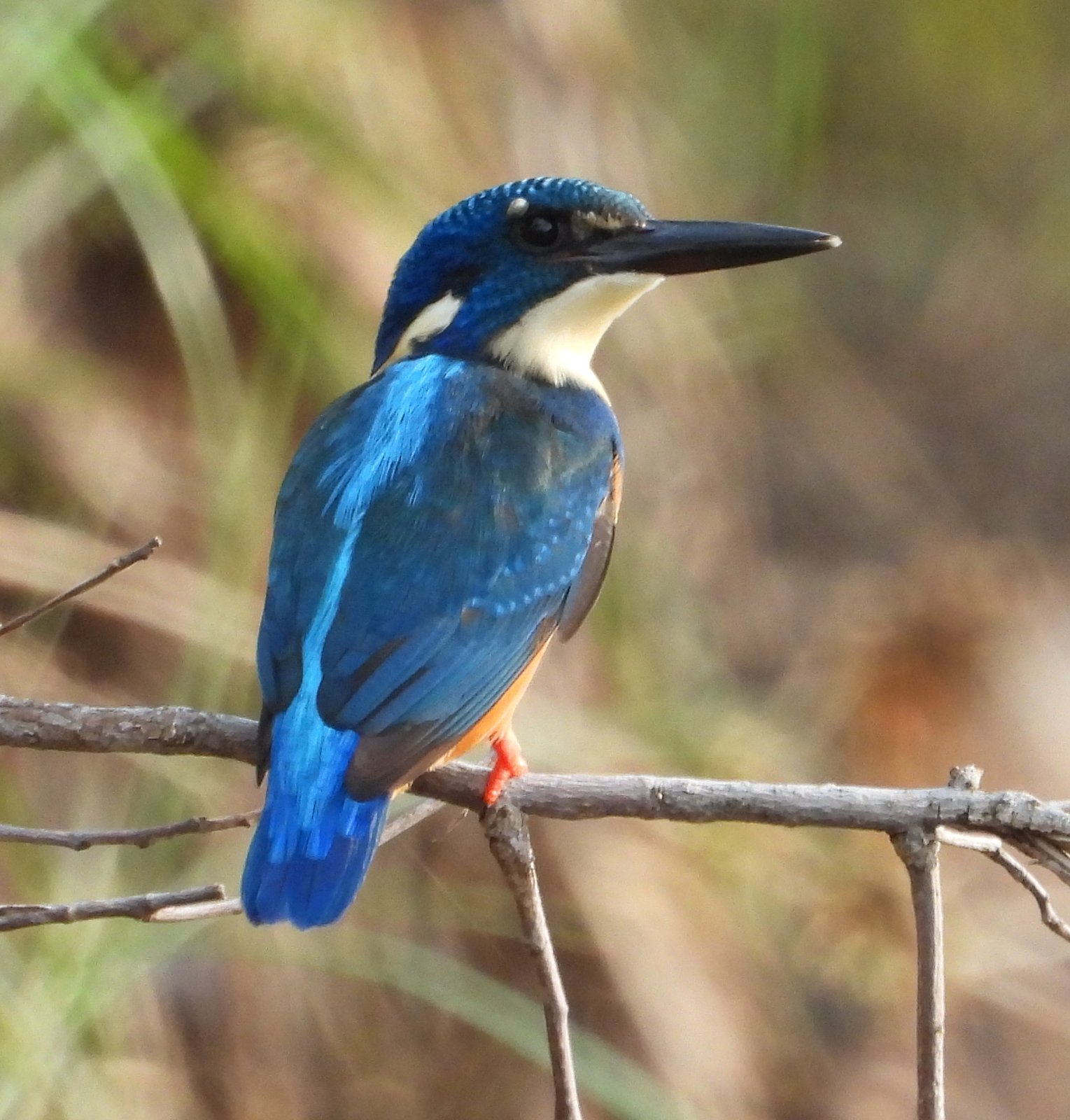
The Half-Collared Kingfisher is a medium-sized, dark blue kingfisher with a black bill that lives on clear rivers and streams with wooded banks. It is shy and tied to clean water, and is more often seen as a blue streak flying low over the water than on a perch.
Voice
A high chreep or tseeet, often repeated in flight low over the water, and sharper chip-chip calls during chases.
Recording: Magnus Wadstein — CC BY-NC-SA 4.0 · converted to mono · xeno-canto
Identification
About 19 cm. The upperparts are dark cobalt blue, with a glossy pale blue stripe down the back and rump that shows mainly in flight. The throat and a spot behind the eye are white to pale buff, the underparts warm cinnamon, paler towards the belly. On each side of the breast a blue bar runs forward from the shoulder, the 'half collar'. The bill is long and black, the legs red. The sexes are alike; juveniles are duller, with dark scalloping on the breast.
Confusion species
Shining-Blue Kingfisher (Alcedo quadribrachys), in northern Zambia and Angola, is darker and more purplish blue, with deep chestnut underparts and no blue breast patches. Malachite Kingfisher (Corythornis cristatus) is much smaller, with a red bill and a barred crest. African Pygmy Kingfisher (Ispidina picta) is smaller still, with a red bill and violet cheeks.
Habitat
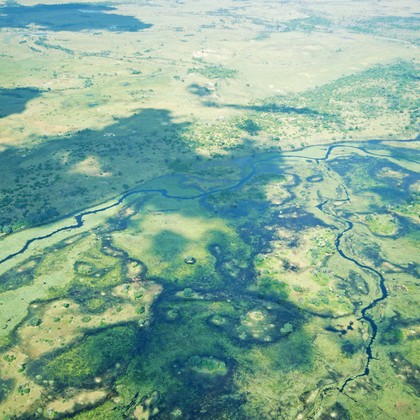
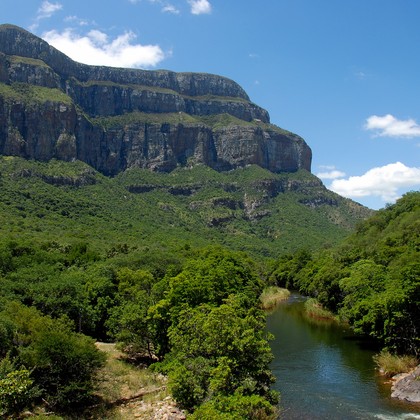
Fast-flowing, clear rivers and streams with dense bankside vegetation, also along quiet river stretches, dams, lagoons and estuaries with wooded margins. It sits on a low branch over the water and dives steeply for small fish, crabs, frogs and aquatic insects. The nest is in a tunnel in a steep bank, usually just above the water.
Where the bird is most at home, classified by the vegetation units of southern Africa.
Range and movements
In the region mainly in the east and south: in South Africa from the Western Cape along the south and east coasts and through KwaZulu-Natal to Mpumalanga and Limpopo, with outliers along the Orange River, also in Eswatini, locally in Lesotho, in eastern Zimbabwe and along the Zambezi, in Mozambique, Malawi, Zambia, western and central Angola, and very scarce in northern Botswana and Namibia. Beyond the region in Tanzania, Kenya and, isolated, in Ethiopia.
- Resident
- Summer visitor (c. Oct–Mar)
- Winter visitor (c. Apr–Sep)
- Passage (Mar–Apr, Oct–Nov)
- dark = core range, pale = thinly spread
How and when to look
Best found by walking quietly along a clear stream with overhanging trees, or by sitting at a rapid and listening for the high call. The bird often returns to the same perches. Good areas are the rivers of the Garden Route, the streams of the low eastern mountains and the montane forest of eastern Zimbabwe.
Conservation status
Globally not threatened, but in South Africa listed as Near Threatened on the 2015 regional Red List. Threats are pollution and siltation of rivers from erosion, agriculture and forestry, loss of riparian forest and streams drying out through water abstraction.
Scientific name
Alcedo semitorquata | Swainson, 1823
Swainson described the species in 1823 and placed it straight away in the genus where it still stands. The genus Alcedo was introduced in 1758 by Linnaeus. Alcedo is the Latin word for 'kingfisher'. semitorquata is Latin for 'half-collared' — for the blue patches on either side of the breast. The specimen the first description was based on came from Great Fish River, South Africa.