All species › Woodpeckers and allies › African barbets › Hairy-Breasted Barbet
Hairy-Breasted Barbet | Tricholaema hirsuta
Geelparelbaardvogel | Barbudo Hirsuto
The Hairy-Breasted Barbet is a medium-sized forest barbet of the Central and West African rainforest, occurring in the region only in northern Angola. It owes its name to the hair-like feather shafts on the breast and flanks, and it is further marked by yellow spots on the dark upperparts.

Voice
A series of low, hollow hoots, oop-oop-oop-oop, often long sustained and suggesting a hoopoe or a dove, and a frog-like oork. While calling, the bird puffs out its throat and swings its head from side to side.
Recording: Bram Piot — CC BY-NC-SA 4.0 · converted to mono · xeno-canto
Identification
About 17–18 cm, sturdily built with a heavy black bill. Head black with a yellow or white supercilium and a pale stripe below the eye. Upperparts blackish brown with numerous yellow drop-shaped spots, rump and wing edges yellow. Underparts yellow to pale yellow with heavy black spots and drops on the breast and flanks; the elongated, hair-like flank feathers are visible only at close range. The sexes differ little; the female often has a somewhat more heavily spotted breast.
Confusion species
Naked-Faced Barbet (Gymnobucco calvus) and Bristle-Nosed Barbet (Gymnobucco peli) are plain brown without yellow or spots. Anchieta's Barbet (Stactolaema anchietae) has a yellow head and an unspotted belly. Tinkerbirds of the genus Pogoniulus are much smaller. Yellow spots on the back combined with a heavily spotted yellow belly are distinctive within the region.
Habitat
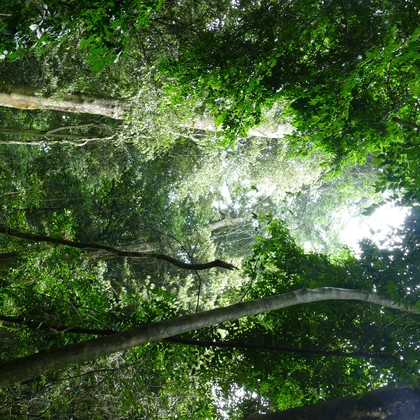
Humid lowland rainforest, old secondary forest, gallery forest and forest edges, into plantations with shade trees. It forages in the middle and upper strata on fruit, especially figs, supplemented with insects. It nests in a self-excavated hole in dead wood.
Where the bird is most at home, classified by the vegetation units of southern Africa.
Range and movements
Within the region only in northern Angola: Cabinda and the forests of the north-west and north-east of the country. Beyond the region from Sierra Leone through the Gulf of Guinea and the Congo Basin to Uganda, western Kenya and north-western Tanzania.
- Resident
- dark = core range, pale = thinly spread
How and when to look
Most often recorded in the forests of Cabinda and around Uíge; follow the far-carrying hooting series. A fruiting fig often attracts several barbet species at once and is the best place to wait.
Conservation status
Not threatened and common in the Central African rainforest. Within the region it is peripheral and depends on the rainforest of northern Angola, which is declining through logging and agriculture.
Scientific name
Tricholaema hirsuta | (Swainson, 1821)
Swainson described the species in 1821 as Pogonias hirsutus; because it was later moved to another genus, the author and year stand in brackets. The genus Tricholaema was introduced in 1855 by Verreaux & Verreaux. Tricholaema comes from the Greek thrix (trichos), 'hair', and laimos, 'throat' — for the bristly hair-like feathers around the throat and bill base. hirsuta is Latin for 'hairy, shaggy' — for the hair-like feathers on breast and flanks. The specimen the first description was based on came from Gold Coast (Ghana), designated later.