All species › Waders, gulls and terns › Gulls and terns › Gull-Billed Tern
Gull-Billed Tern | Gelochelidon nilotica
Lachstern | Pagaza Piconegra
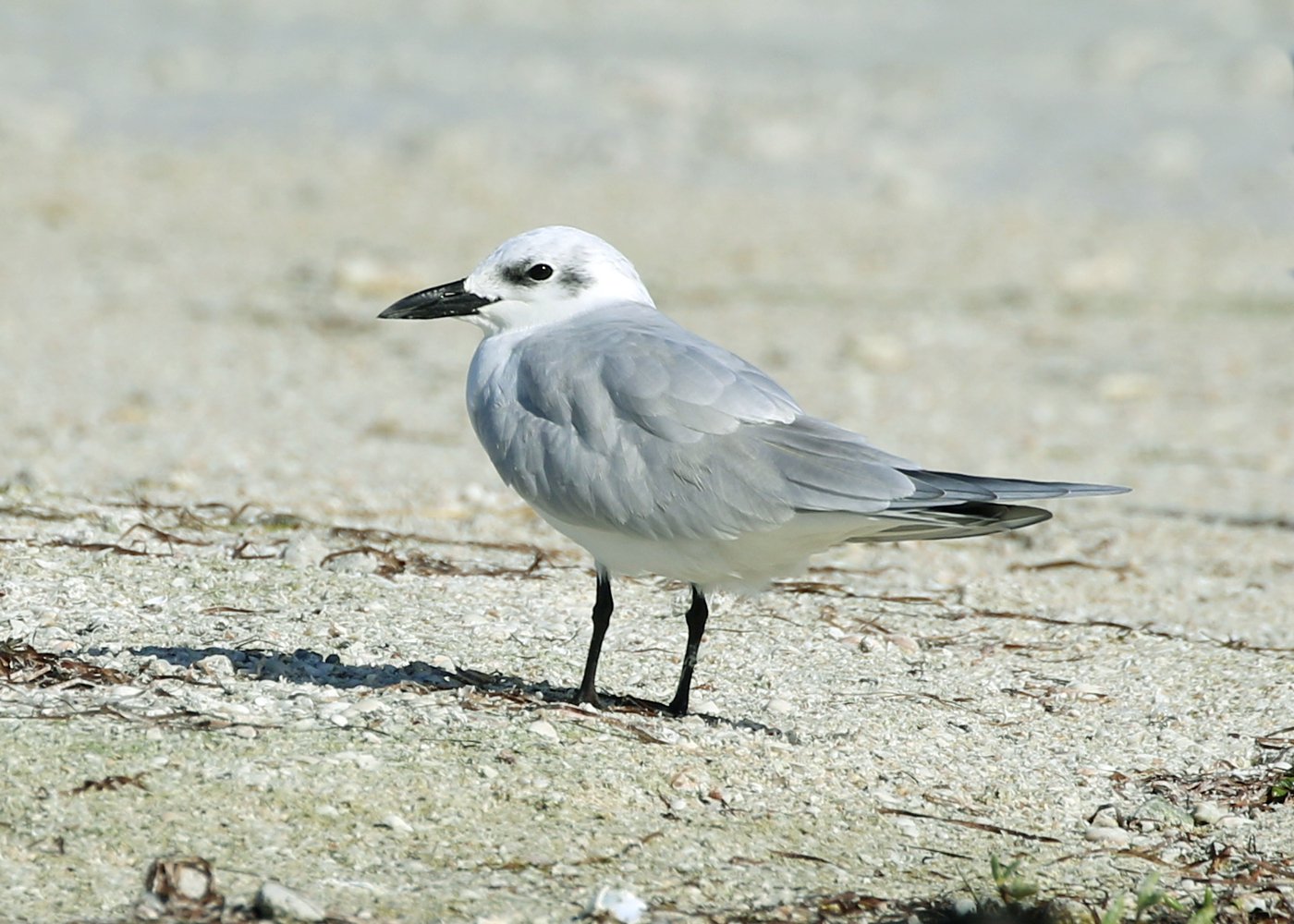
The Gull-Billed Tern is a stocky, pale tern with a short, thick, gull-like black bill, which hunts more like a gull or a large swallow than a typical tern. It breeds patchily across the temperate and warm parts of the world and reaches the region as a scarce non-breeding visitor, mainly in the north.
Voice
A nasal, laughing ger-vik or kay-vik, and a dry kak-kak in alarm. Mostly in flight, especially when small groups forage together.
Recording: Walter Wallner — CC BY-NC-SA 4.0 · converted to mono · xeno-canto
Identification
About 36 cm, with broad, fairly long wings and a short, shallowly forked tail. The bill is short, deep and all black, clearly thicker than in other terns of similar size. In non-breeding plumage, as usually seen here, the head is white with a small dark patch behind the eye and a finely streaked rear crown; in breeding plumage the bird has a full black cap. The upperparts, rump and tail are pale grey with little contrast, the underparts white. The legs are black and fairly long. In flight a dark trailing edge to the outer primaries is visible. Juveniles have a brownish wash to the crown and mantle.
Confusion species
Sandwich Tern Thalasseus sandvicensis has a long, slender black bill with a yellow tip, a white rump and tail and a shaggy crest, and plunge-dives at sea. Caspian Tern Hydroprogne caspia is much larger, with a red bill. Whiskered Tern Chlidonias hybrida in non-breeding plumage is much smaller, with a fine bill, and has a broader dark ear patch that joins the crown.
Habitat
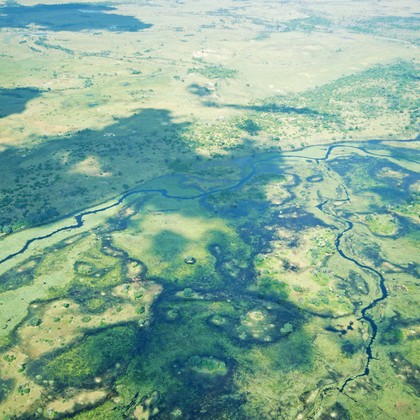
Pans, marshes, flooded grasslands, the shores of lakes and dams, and sometimes coastal lagoons. It hunts low, gliding over both water and land, and picks prey from the surface or the ground rather than diving: insects, crabs, frogs, lizards and occasionally small fish. It readily follows fires and ploughing to catch flushed insects.
Where the bird is most at home, classified by the vegetation units of southern Africa.

Range and movements
Scarce and irregular, mainly in the north of the region: Zambia, Malawi, including Lake Chilwa and Lake Malawi, northern Botswana with the Okavango and the Makgadikgadi Pans, Zimbabwe and Mozambique. A rare visitor to South Africa and Namibia. It breeds patchily in southern Europe, North Africa, western and central Asia, North and South America and Australia; European birds winter mainly in Africa north of the equator.
- Resident
- Summer visitor (c. Oct–Mar)
- Passage (Mar–Apr, Oct–Nov)
- dark = core range, pale = thinly spread
How and when to look
Look for large, pale terns patrolling low over drying pans or flooded grassland and picking prey off the ground instead of diving. The short black bill and the white head with a dark eye patch are then decisive. Most records fall between November and March.
Conservation status
Not threatened. The world population is large but fragmented, and many breeding populations in Europe and North America are small and sensitive to disturbance, water abstraction and the loss of coastal wetlands.
Scientific name
Gelochelidon nilotica | (Gmelin, 1789)
Gmelin described the species in 1789 as Sterna nilotica; because it was later moved to another genus, the author and year stand in brackets. The genus Gelochelidon was introduced in 1830 by Brehm. Gelochelidon is Greek, from gelaō 'to laugh' and khelidōn 'swallow'. nilotica is Latin for 'of the River Nile', after the region the described bird came from. The specimen the first description was based on came from Egypt.