All species › Parrots › Parrots › Grey Parrot
Grey Parrot | Psittacus erithacus
Grijze roodstaartpapegaai | Loro Yaco
The Grey Parrot is a medium-sized, short-tailed parrot of the Central African rainforest, able to mimic sounds and words. Within the area of this guide it occurs only in the far north of Angola, on the southern edge of the Congo Basin.
Voice
Highly varied: high whistles, screeches, crowing and gurgling notes and imitations of other birds. In flight a piercing kweeeee and a hard chak. Flocks are noisiest at the roost around sunrise and sunset.
Recording: Jaap van der Waarde — CC BY-NC-SA 4.0 · converted to mono · xeno-canto
Identification
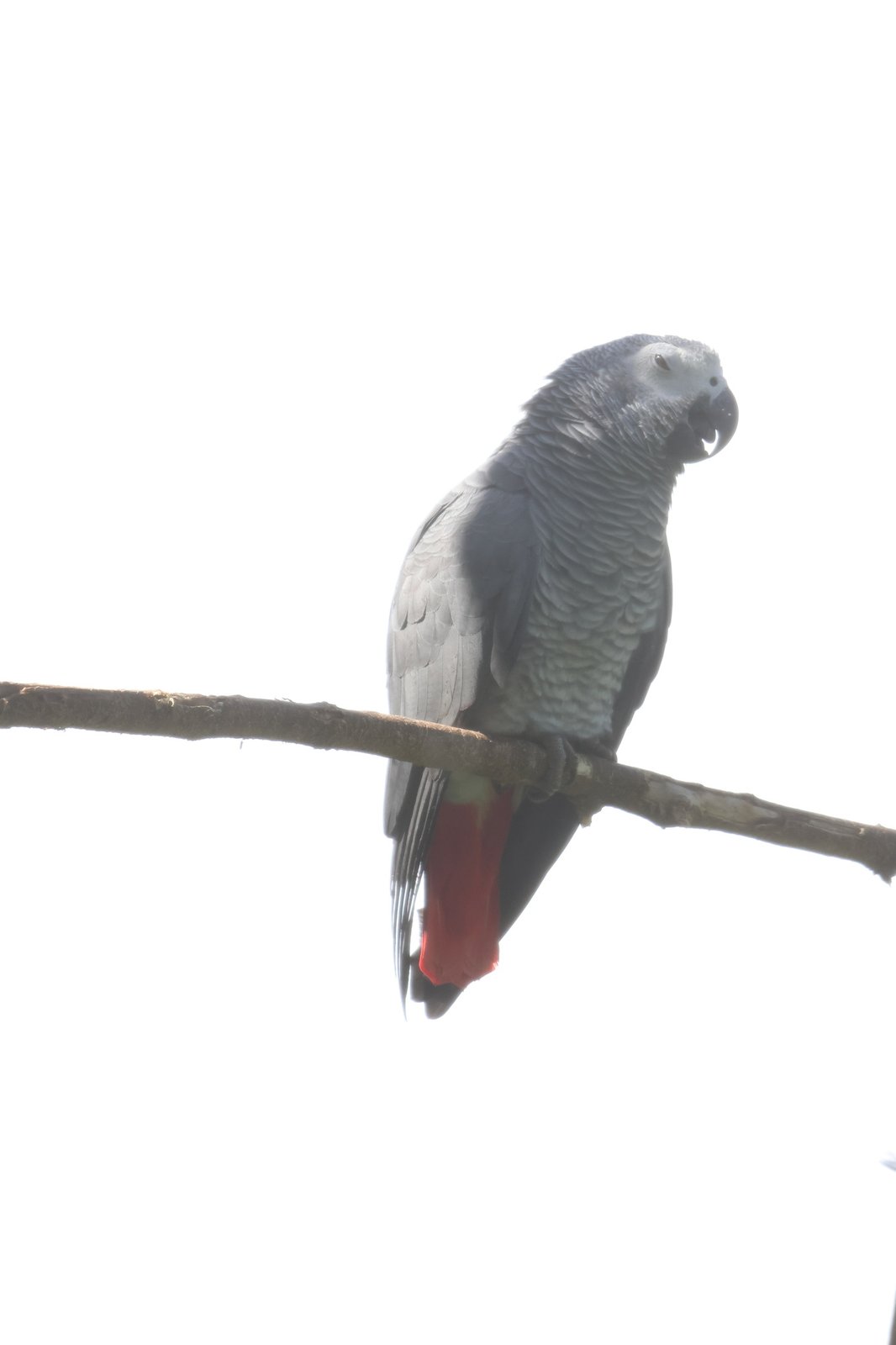
About 30 cm, stocky, with a large head and a short, square tail. The plumage is entirely grey, paler on the head and rump and darker on the wings; the feathers of the head and neck have pale fringes, giving a scaled pattern. A bare, whitish patch of skin surrounds the eye and the iris is pale yellow. The bill is black and strongly hooked. The tail and undertail coverts are bright scarlet, a colour most obvious in flight. The sexes are alike; juveniles have a dark iris and a duller, darker red tail. The flight is fast and direct, on rapid shallow beats of the wings below the body.
Confusion species
Not to be confused with any other bird in the region: Red-Fronted Parrot (Poicephalus gulielmi), which shares the same forests, is smaller and green with an orange-red forehead. At a distance a passing flock may suggest pigeons, but the short tail, large head and high calls make it clear. The closely related Timneh Parrot (Psittacus timneh) of West Africa has a maroon tail and does not occur in the region.
Habitat
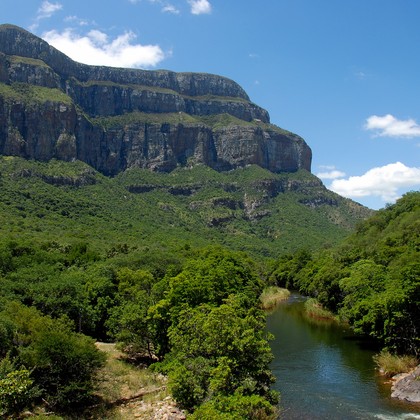
Humid lowland rainforest, gallery forest along rivers, forest edges, mangroves and clearings with tall trees, as well as oil-palm plantations and farmland mosaic with forest remnants. It eats seeds, nuts and fruit, especially of oil palm, and visits forest clearings to eat clay and minerals. It nests in holes high in old trees and roosts communally, sometimes in hundreds, in tall trees or on river islands.
Where the bird is most at home, classified by the vegetation units of southern Africa.

Range and movements
Within the region only in northern Angola: in the Maiombe forests of Cabinda and locally in the forests of the north, such as in the provinces of Uíge, Zaire and Lunda Norte. Beyond the region it ranges across the Central African rainforest, from Nigeria and Cameroon through Gabon and both Congos to Uganda and western Kenya and Tanzania.
- Resident
- dark = core range, pale = thinly spread
How and when to look
In Cabinda look for flocks flying high over the forest between roost and feeding trees in the early morning and late afternoon; the high calls give them away well before they come into view. Forest clearings with clay banks, where birds eat minerals, give the best chance of perched birds. Birds in towns elsewhere in the region are escaped cage birds.
Conservation status
Endangered on the global list. The species has declined steeply across much of its range through mass trapping for the international cage-bird trade and the felling of old trees with nest holes. Since 2016 it has been listed on CITES Appendix I, banning trade in wild birds, but illegal trapping continues. Numbers have also fallen sharply in parts of Angola.
Scientific name
Psittacus erithacus | Linnaeus, 1758
Linnaeus described the species in 1758 and placed it straight away in the genus where it still stands. He introduced the genus Psittacus in that same work. Psittacus is the Latin word for 'parrot', borrowed from the Greek psittakos. erithacus is the Greek erithakos, a bird mentioned by Aristotle that cannot be identified with certainty (often taken as the robin); Linnaeus applied it to this parrot. The specimen the first description was based on came from Ghana (designated; originally ‘Guinea’).