All species › Passerines › Cuckooshrikes › Grey Cuckooshrike
Grey Cuckooshrike | Ceblepyris caesius
Bosrupsvogel | Oruguero Gris
The Grey Cuckooshrike is a plain blue-grey, slender bird of the canopy of montane and coastal forest. It moves slowly and deliberately through the treetops and is less conspicuous than its size suggests; often only a thin, high whistle betrays its presence.

Voice
A thin, high, drawn-out tseeeeeeuu, slightly descending and so faint that it is often missed; sometimes a soft squeaky series. Generally a quiet bird.
Recording: James Bradley — CC BY-NC-SA 4.0 · converted to mono · xeno-canto
Identification
26–28 cm, slender with a long, rounded tail. Wholly soft blue-grey, slightly paler on the belly and undertail coverts; flight feathers and tail are darker slate. The lores are black and contrast with a narrow white eye-ring, giving a 'spectacled' face. Bill and legs are black and the eye dark. The female has greyer, less black lores. Juveniles are finely barred white and dark below and show white edges to the wing coverts.
Confusion species
White-Breasted Cuckooshrike Ceblepyris pectoralis has a white belly and breast and lives in open woodland rather than closed forest. Ashy Flycatcher Fraseria caerulescens is much smaller, with a shorter tail and an active flycatching style. Grey Tit-Flycatcher Fraseria plumbea is also smaller and constantly fans its white-edged tail.
Habitat
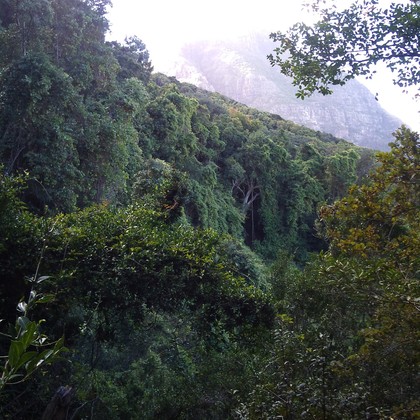
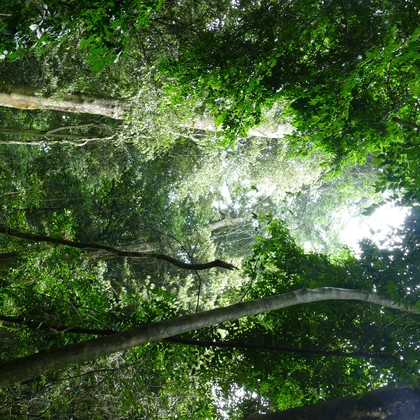
The canopy and mid-stratum of Afromontane forest, mistbelt forest and evergreen coastal forest, also tall riverine forest and old plantings of indigenous trees. It searches slowly among the leaves for caterpillars, especially hairy ones, and other large insects. It readily joins mixed foraging flocks. In winter some move to lower-lying forest.
Where the bird is most at home, classified by the vegetation units of southern Africa.
Range and movements
In South Africa from the Eastern Cape through KwaZulu-Natal and Eswatini to the escarpment forests of Mpumalanga and Limpopo; further in eastern Zimbabwe (Nyanga, Vumba, Chimanimani), the highlands of Mozambique (Gorongosa, Chimanimani), the mountains of Malawi and north-eastern Zambia (Nyika, Mafinga), and in the escarpment forests and highlands of western Angola. Beyond the region in the montane forests of East Africa to Ethiopia and in Cameroon.
- Resident
- Summer visitor (c. Oct–Mar)
- Winter visitor (c. Apr–Sep)
- Passage (Mar–Apr, Oct–Nov)
- dark = core range, pale = thinly spread
How and when to look
Year-round in forests such as Karkloof, Woodbush or the Vumba. At a mixed foraging flock in the canopy, look for a grey bird shuffling slowly from branch to branch and sitting still for long spells. In winter it is more often found in coastal forest in KwaZulu-Natal.
Conservation status
Not threatened and fairly common in suitable habitat. The species depends on indigenous forest and disappears where it is replaced by alien plantations; fragmentation of the small forest patches is a local risk.
Scientific name
Ceblepyris caesius | Lichtenstein, 1823 (GBIF: Coracina caesia)
Lichtenstein described the species in 1823 and placed it straight away in the genus where it still stands. The genus Ceblepyris was introduced in 1816 by Cuvier, GLCFD. Ceblepyris goes back to the Greek keblēpuris, an unidentified bird in classical literature (Aristophanes); literally perhaps 'fire-head'. caesius is Latin for 'bluish grey' — for the uniform blue-grey plumage. The specimen the first description was based on came from Eastern Cape, South Africa.