All species › Woodpeckers and allies › African barbets › Green Tinkerbird
Green Tinkerbird | Pogoniulus simplex
Groene ketellapper | Barbudito Sencillo
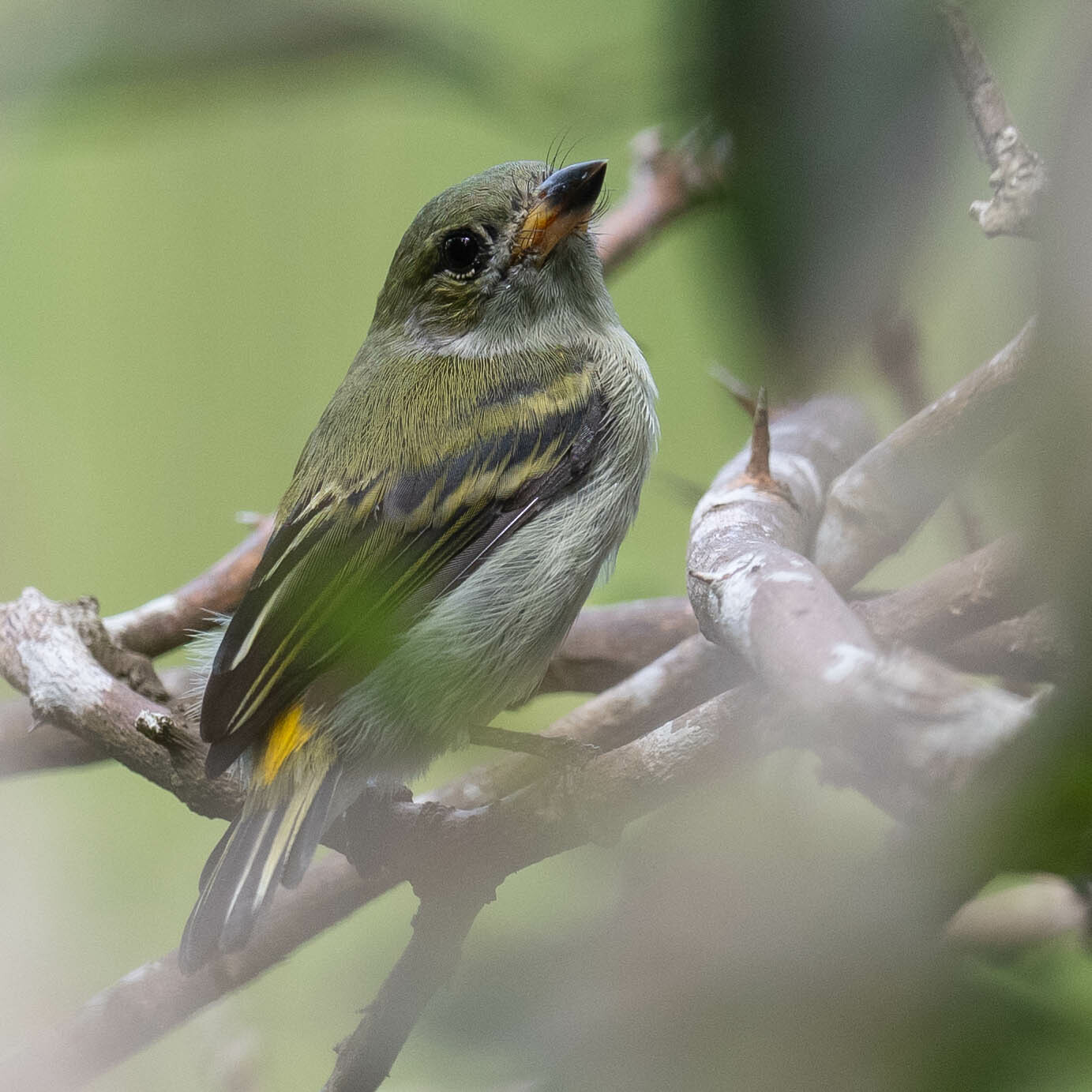
The Green Tinkerbird is the plainest of the tinkerbirds: a small olive-green bird with a yellow rump, living sparsely and rarely in the coastal forests of East Africa. Within the region it occurs only very locally in Mozambique and southern Malawi.
Voice
Accelerating trilled phrases, pu-pu-pu-prrrrr, repeated at length, plus a slower series of whistled too-too-too notes; short soft calls at the nest.
Recording: Louis A. Hansen — CC BY-NC-SA 4.0 · shortened to the first 60 s, mono · xeno-canto
Identification
About 9–10 cm, small and compact, with a short, pointed bill that is black with a paler base. The upperparts are plain olive-green, with a bright golden-yellow rump and two narrow yellow wing bars; the flight feathers have yellowish edges. The underparts are pale greyish olive, slightly yellower on the belly. The face has no stripes or spots. The sexes are alike; juveniles are duller with a paler bill.
Confusion species
Moustached Tinkerbird (Pogoniulus leucomystax) has an obvious white moustachial stripe and lives in montane forest, not in the lowlands. Yellow-Rumped Tinkerbird (Pogoniulus bilineatus) has a black back and head with two white face stripes. Small greenish warblers can look similar but lack the stout tinkerbird bill and the yellow rump. The absence of any head or back pattern is the best feature.
Habitat
Dense tangled understorey and canopy of coastal and lowland forest, secondary forest, degraded forest remnants and dense thickets, from sea level to about 1,700 m; at times in adjacent open woodland. It eats berries, especially of mistletoes, and insects. It nests in a self-excavated cavity in a dead branch.
Where the bird is most at home, classified by the vegetation units of southern Africa.

Range and movements
Very local: the northern coastal lowlands of Mozambique, an isolated population in southern Mozambique rediscovered in 2013 after more than fifty years, and a few forest patches in south-eastern Malawi east of the Rift. Beyond the region in the coastal zone of Kenya and Tanzania, including Zanzibar.
- Resident
- Summer visitor (c. Oct–Mar)
- Winter visitor (c. Apr–Sep)
- dark = core range, pale = thinly spread
How and when to look
One of the least observed tinkerbirds in the region. Learn the accelerating trill beforehand, since the bird sits hidden in dense foliage; search coastal forest in northern Mozambique or known sites in southern Malawi. Check every tinkerbird without face stripes carefully.
Conservation status
Not globally threatened, but rare and poorly known within the region. The coastal forests it inhabits are heavily fragmented by logging and farming, and the southern Mozambique population is small and vulnerable.
Scientific name
Pogoniulus simplex | (Fischer & Reichenow, 1884)
Fischer & Reichenow described the species in 1884 as Barbatula simplex; because it was later moved to another genus, the author and year stand in brackets. The genus Pogoniulus was introduced in 1842 by De Lafresnaye. Pogoniulus is a diminutive of Pogonias, from the Greek pōgōnias, 'bearded' — thus 'little barbet', fitting for these smallest barbets. simplex is Latin for 'plain, simple' — for the rather unmarked greenish plumage. The specimen the first description was based on came from Pangani River, Tanzania.