All species › Passerines › Orioles › Green-Headed Oriole
Green-Headed Oriole | Oriolus chlorocephalus
Groenkopwielewaal | Oropéndola Cabeciverde
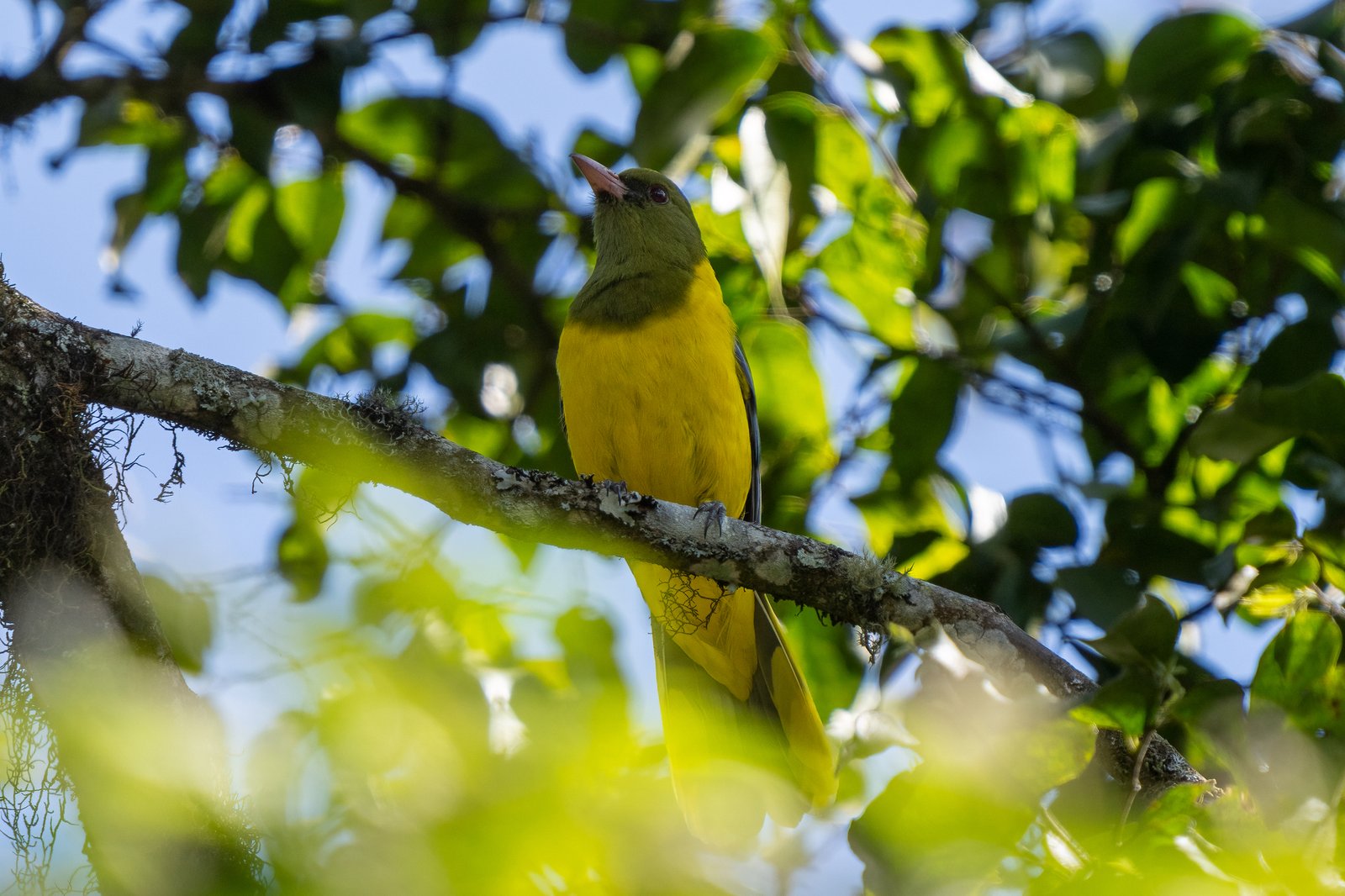
Green-Headed Oriole is the most sought-after oriole in southern Africa: a yellow-and-green canopy bird with a moss-green head and blue-grey wings which, within the region, occurs only on a handful of isolated mountains in Mozambique. Anyone climbing to the montane forest on Mount Gorongosa will hear it before seeing it.
Voice
Clear, liquid whistles like other orioles, but often somewhat higher and more varied: a melodious hoo-wee-oo or chew-lee-oo, alternating with short fluty phrases. Also a harsh, nasal kweer as a contact or alarm call.
Recording: isaac kilusu — CC BY-NC-SA 4.0 · converted to mono · xeno-canto
Identification
23–24 cm. Head, throat and upper breast are olive to moss green, with no black. The mantle is yellowish green, the underparts and a narrow nape collar bright golden yellow. The wings are blue-grey with a conspicuous white patch on the primary coverts; the tail is green with yellow tips to the outer feathers. The bill is coral pink and the eye red. The sexes are alike. Juveniles are duller, with fine dark streaks on throat and breast and a dark bill. It keeps mostly high in the canopy, often in mixed flocks.
Confusion species
Black-Headed Oriole Oriolus larvatus has a black head and throat and black wings with white edgings; on Mount Gorongosa it lives mainly lower down, in woodland and at the forest edge, but the two meet at the lower margin of the montane forest. Singing in dense foliage they are very alike; look for the head colour and the grey wing. African Golden Oriole Oriolus auratus is almost entirely golden yellow with a black eye-stripe and does not enter montane forest.
Habitat
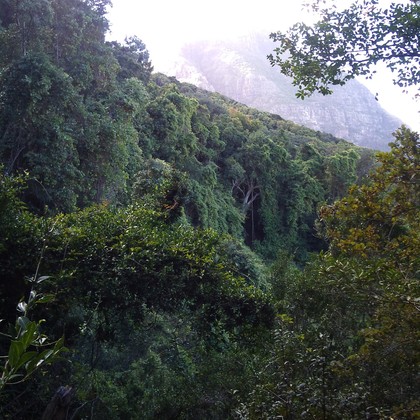
Evergreen montane and mid-altitude forest, in Mozambique mainly between about 900 and 1,900 m, with a preference for the high canopy and forest edges with fruiting trees. It takes large insects, caterpillars and fruit, and joins mixed foraging flocks.
Where the bird is most at home, classified by the vegetation units of southern Africa.
Range and movements
Within the region only in Mozambique, on isolated mountains with montane forest: Mount Gorongosa (which holds its own subspecies) and, further north, the Namuli, Mabu and Chiperone massifs. Beyond the region it occurs in montane forests of Tanzania, mainly in the Eastern Arc mountains, extending into south-eastern Kenya.
- Resident
- Winter visitor (c. Apr–Sep)
- Passage (Mar–Apr, Oct–Nov)
- dark = core range, pale = thinly spread
How and when to look
Mount Gorongosa is the classic site: set out early with a guide from the national park and listen in the forest above the coffee plantings for the whistles. Then look up among fruiting trees; the white wing patch is the best feature in flight.
Conservation status
Not globally threatened, but very local and vulnerable in southern Africa. The montane forests of Mozambique are small and fragmented and are shrinking through clearance, fire and logging; protecting the forest on Mount Gorongosa and on Namuli and Mabu is decisive for the survival of the populations in the region.
Scientific name
Oriolus chlorocephalus | Shelley, 1896
Shelley described the species in 1896 and placed it straight away in the genus where it still stands. The genus Oriolus was introduced in 1766 by Linnaeus. Oriolus is medieval Latin for the Golden Oriole; the name is onomatopoeic, echoing the Eurasian Golden Oriole's melodious calls. chlorocephalus comes from the Greek khlōros, 'green', and kephalē, 'head' — for the green head. The specimen the first description was based on came from Mount Chiradzulu, Malawi.