All species › Passerines › Sunbirds › Greater Double-Collared Sunbird
Greater Double-Collared Sunbird | Cinnyris afer
Grote kraaghoningzuiger | Suimanga Bicollar
The Greater Double-Collared Sunbird is the largest and heaviest-billed of southern Africa's double-collared sunbirds, with a broad scarlet breast band. It is endemic to South Africa, Lesotho and Eswatini and is a common bird of forest edge and gardens in the east of the country.

Voice
A hard, metallic tchik or tchuk, often in series. The song is a fast, loud and rattling twitter, louder, lower and scratchier than that of Southern Double-Collared Sunbird.
Recording: Walter Wallner — CC BY-NC-SA 4.0 · converted to mono · xeno-canto
Identification
13 to 15 cm, with a long, clearly decurved bill. The male has the head, throat and upperparts metallic green and the uppertail coverts blue-violet; below the throat come a narrow blue line and a broad scarlet breast band of about two centimetres, below that a grey-olive belly. Yellow pectoral tufts are shown in display. The female is plain olive-grey above and paler grey-buff below, larger and longer-billed than the female Southern Double-Collared Sunbird. Juveniles resemble the female.
Confusion species
Southern Double-Collared Sunbird (Cinnyris chalybeus) is smaller, with a shorter bill and a red band about half as broad; the two occur together over a wide area. Eastern Miombo Sunbird (Cinnyris manoensis) of Zimbabwe and Mozambique is very similar, but its range barely touches that of this species. Neergaard's Sunbird (Cinnyris neergaardi) is much smaller, with a blackish belly. Females are best separated by size and bill length, ideally alongside a male.
Habitat
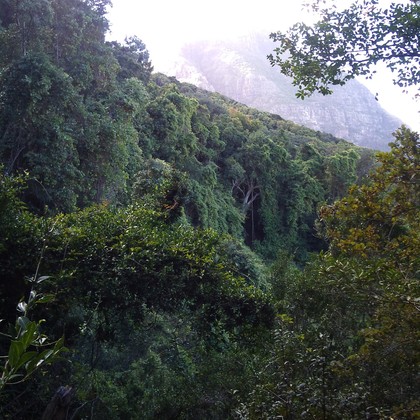
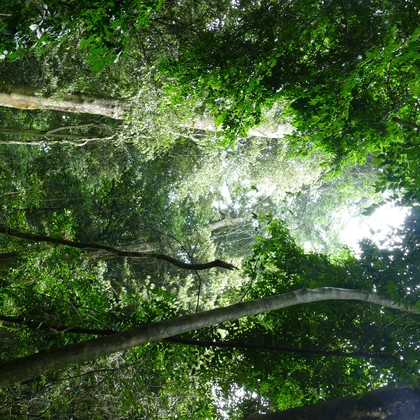
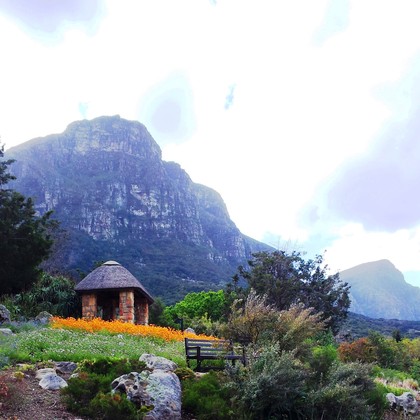
Edges of montane and coastal forest, forest clearings, scrub on sheltered slopes, moist woodland with aloes, plantations and gardens. Locally also on fynbos margins in the Eastern Cape. It visits aloes, coral trees, Leonotis and garden plants and takes many insects.
Where the bird is most at home, classified by the vegetation units of southern Africa.
Range and movements
Endemic to the region: from the south coast of the Western Cape at about Riversdale east through the Eastern Cape and KwaZulu-Natal, north across Eswatini, Mpumalanga and Limpopo to the Soutpansberg, and inland in the eastern Free State, Lesotho and parts of Gauteng. Nowhere beyond; reports from Zimbabwe and Mozambique refer to Eastern Miombo Sunbird.
- Resident
- dark = core range, pale = thinly spread
How and when to look
In the Eastern Cape and KwaZulu-Natal in almost any wooded garden and at every patch of forest edge, and at Magoebaskloof and around Graskop in Limpopo and Mpumalanga. In winter birds gather at flowering Aloe arborescens. When in doubt, always compare the width of the red band and the bill length with those of Southern Double-Collared Sunbird.
Conservation status
Not threatened. Common and stable, and well adapted to gardens and plantations with nectar plants. Local loss of forest edge and scrub is largely offset by gardens in urban areas.
Scientific name
Cinnyris afer | (Linnaeus, 1766)
Linnaeus described the species in 1766 as Certhia afra; because it was later moved to another genus, the author and year stand in brackets. The genus Cinnyris was introduced in 1816 by Cuvier, GLCFD. Cinnyris derives from the Greek kinnuris, the name of a small bird mentioned by the lexicographer Hesychius that cannot be identified further. afer is Latin for 'African', for the continent where the species occurs. The specimen the first description was based on came from Cape of Good Hope.