All species › Pelicans, herons and ibises › Herons and bitterns › Great Egret
Great Egret | Ardea alba
Grote zilverreiger | Garceta Grande
The Great Egret is the largest white egret of the region, almost as big as a Grey Heron. It hunts in a stately and patient manner, with the long neck sharply kinked, and stands out in any wetland from far away.

Voice
Usually silent. When disturbed or on take-off a low, hoarse, rattling kraa or krrrak; deep croaking and gargling sounds at the colony.
Recording: Esperanza Poveda — CC BY-NC-SA 4.0 · converted to mono · xeno-canto
Identification
About 95 cm, wholly white, with a very long, thin neck that shows a distinct kink at rest and when hunting. The bill is usually yellow, long and dagger-shaped; a black gape line extends behind the eye, the best feature. In the breeding season the bill turns black, the lores flush emerald-green, the upper legs turn pink to yellow and long filmy plumes grow on the back, reaching beyond the tail. The legs and feet are black. The sexes are alike. It flies on slow, deep wingbeats, with the neck in a deep S and the long legs projecting well beyond the tail.
Confusion species
Yellow-Billed Egret Ardea brachyrhyncha is clearly smaller, with a shorter neck lacking the sharp kink, a shorter bill and a gape that does not extend behind the eye; the upper legs are often yellowish. Little Egret Egretta garzetta is much smaller, with a black bill and yellow feet. Western Cattle Egret Ardea ibis is small and stocky, with a short, thick yellow bill.
Habitat
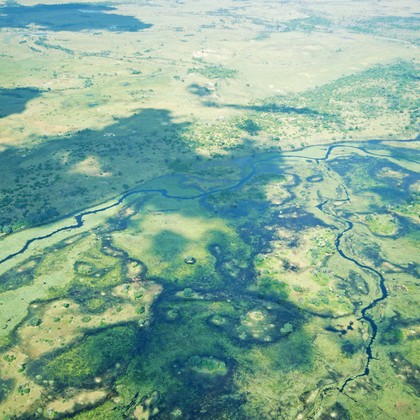
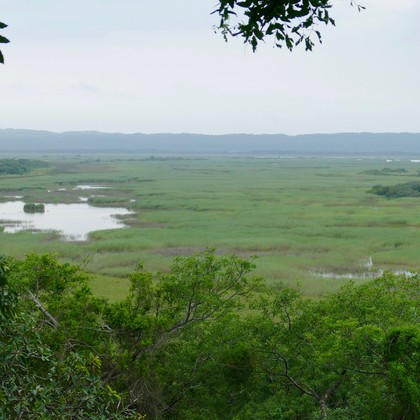
Shallow water of all kinds: rivers, dams, pans, marshes, flooded grassland, estuaries and tidal mudflats, usually with open margins. It hunts standing or stalking slowly for fish, frogs and insects, sometimes also small rodents. It breeds in mixed colonies in reeds or trees over water.
Where the bird is most at home, classified by the vegetation units of southern Africa.
Range and movements
Distributed over most of the region, most numerous in northern Botswana, Zambia, Malawi, Zimbabwe, Mozambique and eastern and northern South Africa; scattered as far as the Cape provinces; scarce in the driest parts of Namibia and the Karoo. Beyond the region it occurs across almost all of sub-Saharan Africa, Madagascar and the temperate and tropical parts of Europe, Asia, Australasia and the Americas.
- Resident
- Summer visitor (c. Oct–Mar)
- Winter visitor (c. Apr–Sep)
- Passage (Mar–Apr, Oct–Nov)
- dark = core range, pale = thinly spread
How and when to look
Present all year at larger wetlands such as the Okavango Delta, the Chobe, the Kafue Flats, Nylsvley and the estuaries of KwaZulu-Natal. With white egrets, check the proportion of bill to head and the gape line: if it extends behind the eye, it is this species.
Conservation status
Not threatened and widespread. Locally dependent on the condition of large wetlands; drainage, pollution and disturbance of colonies play a role.
Scientific name
Ardea alba | Linnaeus, 1758
Linnaeus described the species in 1758 and placed it straight away in the genus where it still stands. He introduced the genus Ardea in that same work. Ardea is the Latin word for 'heron'. alba is Latin for 'white'. The specimen the first description was based on came from Europe.