All species › Gannets and cormorants › Cormorants › Great Cormorant
Great Cormorant | Phalacrocorax carbo
Aalscholver | Cormorán Grande
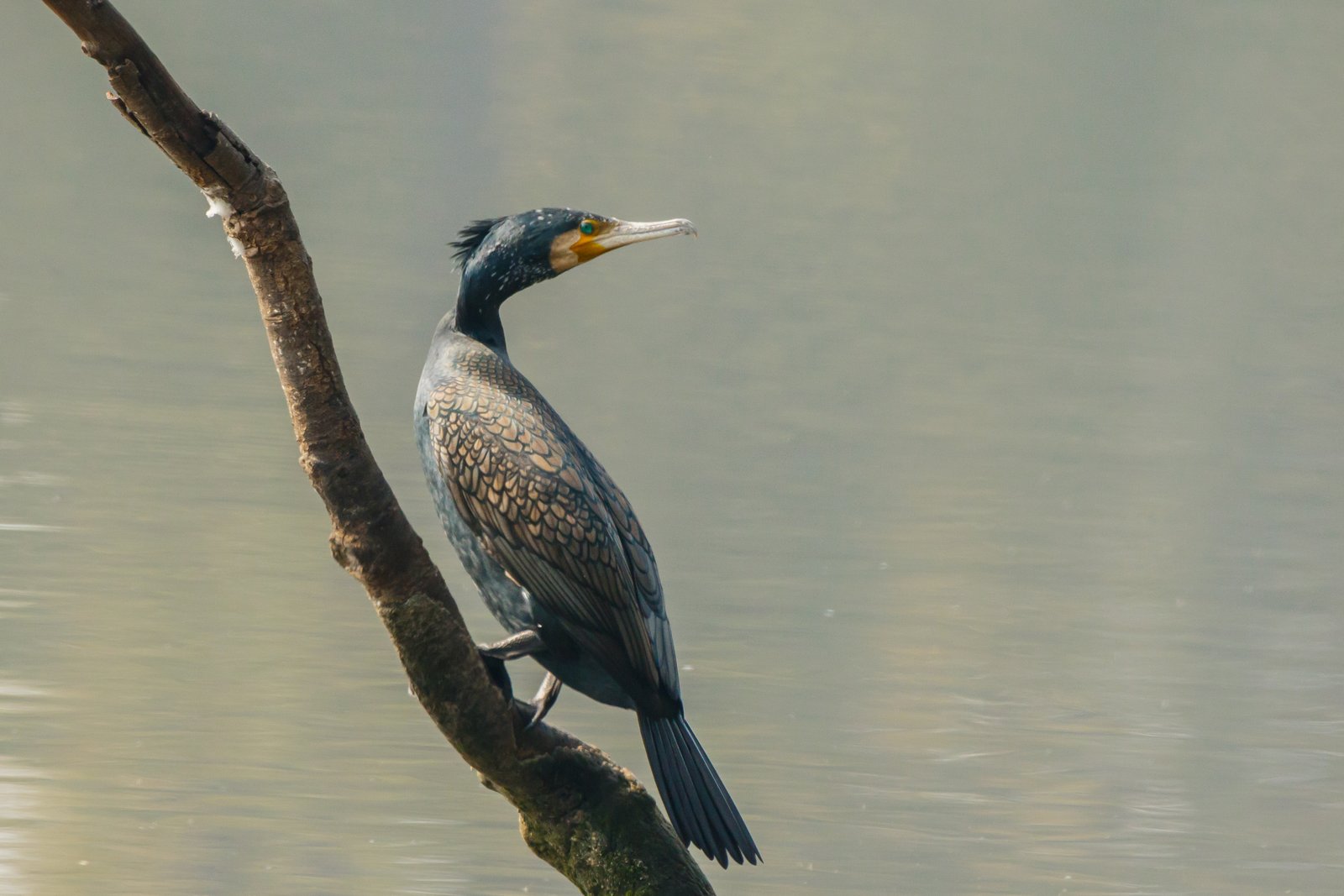
The Great Cormorant is the largest cormorant in the region and the only one common both on the coast and on large inland waters. In southern Africa it occurs as the White-Breasted Cormorant (P. c. lucidus), a form with a strikingly white throat and breast that is sometimes treated as a separate species.
Voice
Silent away from the colony. In the colony deep gurgling and croaking sounds, a low korrr-korrr, and hissing in threat.
Recording: Sunny Tseng — CC BY-NC-SA 4.0 · shortened to the first 60 s, mono · xeno-canto
Identification
About 90 cm, large and heavy, with a thick neck, a stout hooked bill and a medium-length, wedge-shaped tail. Adults are black with a green-bronze gloss and a white throat, foreneck and breast; the extent of white varies and is greatest on the west coast. In the breeding season a white thigh patch and white filoplumes on the head and neck appear. The facial skin is yellow and the eye green. The sexes are alike. Juveniles are brown above and dirty white below, sometimes wholly white underneath. It flies with the neck extended on powerful wingbeats, at times in V-formation or long lines.
Confusion species
The Cape Cormorant (Phalacrocorax capensis) is smaller and slimmer, wholly blue-black with orange-yellow gular skin; the Bank Cormorant (Phalacrocorax neglectus) is dull blackish-brown without a white breast. The Reed Cormorant (Microcarbo africanus) is much smaller, with a long tail and a short bill. The African Darter (Anhinga rufa) has a thin, kinked neck and a dagger bill without a hook.
Habitat
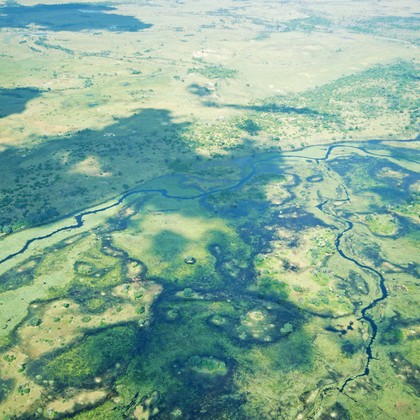
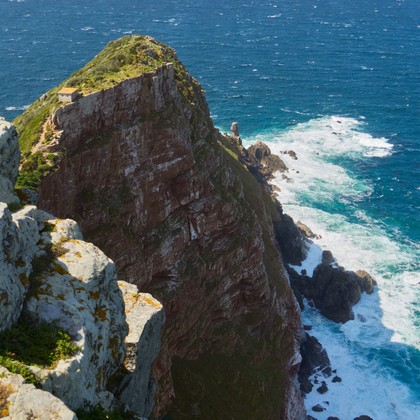
Rocky shores, islands, estuaries and lagoons, and inland large lakes, reservoirs, rivers and dams with fish of sufficient size. It dives for fish of up to a few hundred grams, alone or in small groups. It breeds in colonies on coastal rocks and islands, in trees beside or in water, on dead trees in reservoirs and on power pylons; the nest is a large heap of sticks or seaweed.
Where the bird is most at home, classified by the vegetation units of southern Africa.
Range and movements
Distributed across the whole region, along the entire coast from Angola through Namibia and South Africa to Mozambique, and inland on large waters in South Africa, Lesotho, Eswatini, Zimbabwe, Botswana, Zambia and Malawi, such as Lake Kariba, the Okavango Delta and Lake Malawi. Absent from the driest parts without permanent water. Beyond the region from eastern Africa to Europe, Asia, Australia and New Zealand and the north-east coast of North America.
- Resident
- Summer visitor (c. Oct–Mar)
- Winter visitor (c. Apr–Sep)
- Passage (Mar–Apr, Oct–Nov)
- dark = core range, pale = thinly spread
How and when to look
On the coast most often seen on rocks and jetties at Walvis Bay, Langebaan and the Cape Peninsula; at Stony Point it breeds beside the Cape’s three other marine cormorants. Inland on reservoirs, where it breeds and roosts on dead tree trunks standing in the water. Look for the white breast and the stout bill.
Conservation status
Not threatened and widespread. The building of reservoirs and fish farming have increased the inland population in parts of the region. Locally threatened by disturbance of colonies, oil pollution on the coast, drowning in fishing nets and persecution by fishers and fish farmers.
Scientific name
Phalacrocorax carbo | (Linnaeus, 1758)
Linnaeus described the species in 1758 as Pelecanus Carbo; because it was later moved to another genus, the author and year stand in brackets. The genus Phalacrocorax was introduced in 1760 by Brisson. Phalacrocorax is the Latinised form of Greek phalakrokorax, from phalakros 'bald' and korax 'raven'. carbo is Latin for 'charcoal', after the black plumage. The specimen the first description was based on came from the North Atlantic.