All species › Passerines › Wagtails and pipits › Golden Pipit
Golden Pipit | Tmetothylacus tenellus
Gouden pieper | Bisbita Dorado
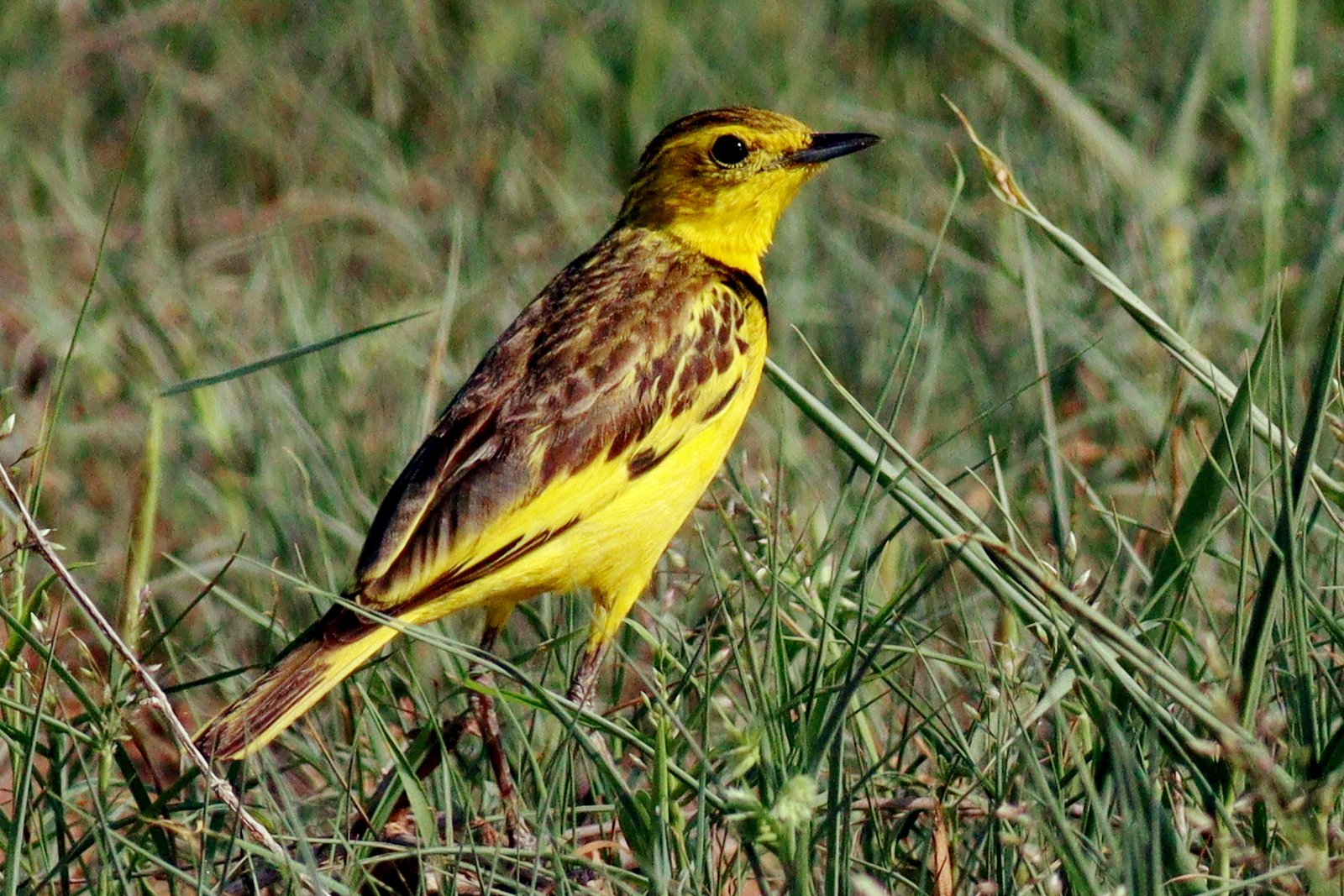
The Golden Pipit is a pipit of the dry thornbush of north-eastern Africa, whose male, with its golden-yellow wings and breast, looks more like a longclaw or a weaver than a pipit. In southern Africa it is an extremely rare vagrant, with only a handful of accepted records.
Voice
The song is a thin, squeaky twitter, tsee-tsee-tsiew-tsiew, given by the male from a bush top or in a song flight in which it parachutes down on raised, quivering wings, showing off the yellow. The call is a short, sharp tsip.
No recording with a suitable Creative Commons licence is available for this species yet.
Identification
A slender pipit of 15 to 16 cm with a relatively short tail and long legs; part of the lower leg is unfeathered, which gives the genus its name. The male has a bright yellow throat and underparts with a narrow black breast band, streaked greenish-brown upperparts and wings in which the secondaries and inner primaries are almost wholly yellow, so the wing flashes as a golden panel in flight; the outer tail feathers are yellow too. The female is a pale, sandy-brown pipit with a weak or absent breast band, but with yellow edges to the flight feathers and yellowish underwings that show in flight. Juveniles resemble the female.
Confusion species
Yellow-Throated Longclaw (Macronyx croceus) also has yellow underparts and a black necklace, but is a third larger, heavier in build and lacks the golden wing panel; it lives in moist grassland rather than dry thornbush. A female or young Golden Pipit can be confused on the ground with other pale pipits such as Buffy Pipit (Anthus vaalensis); look for the yellow wing edges, the yellow wash on the underwing and the short tail. Western Yellow Wagtail (Motacilla flava) has a much longer, wagging tail and an unstreaked back.
Habitat
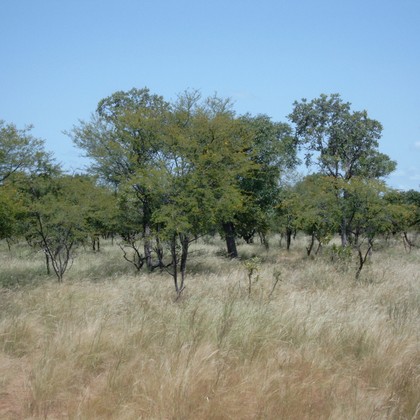
Dry to semi-arid open thornbush and scrub plains with short grass, scattered acacias and Commiphora bushes, mostly below 1000 m. It forages on foot for insects and perches on bush tops and low branches more than other pipits. Within its own range it wanders widely with the rains.
Where the bird is most at home, classified by the vegetation units of southern Africa.
Range and movements
In the region only as a vagrant: there are some five accepted records from the Kruger National Park and Gauteng in South Africa and one from eastern Zimbabwe. The breeding range lies in north-eastern Africa, from South Sudan and Ethiopia through Somalia and north-eastern Uganda to Kenya and northern and central Tanzania.
How and when to look
A Golden Pipit in southern Africa is always a lucky find; keep it in mind in wet summers, when the species wanders far in East Africa, and above all in dry, open parts of the Kruger National Park and the eastern lowveld. Any pipit-like bird that shows golden-yellow wings on take-off deserves photographs of both upper- and underside; report a sighting to the national rarities committee.
Conservation status
Not threatened. The species is common in its East African range, although local numbers fluctuate strongly with rainfall. It benefits from grazed, open thornbush; the main threat is local conversion of savanna to cropland.
Scientific name
Tmetothylacus tenellus | (Cabanis, 1878)
Cabanis described the species in 1878 as Macronix tenellus; because it was later moved to another genus, the author and year stand in brackets. The genus Tmetothylacus was introduced in 1879 by Cabanis. Tmetothylacus comes from the Greek tmētos, 'cut', and thulakos, 'pantaloons' — for the bare lower legs, unusual among passerines, as if its 'trousers' had been cut short. tenellus is a Latin diminutive of tener, 'delicate' — 'dainty, somewhat tender'. The specimen the first description was based on came from Taita, Kenya.