All species › Passerines › Finches › Forest Canary
Forest Canary | Crithagra scotops
Boskanarie | Serín Forestal
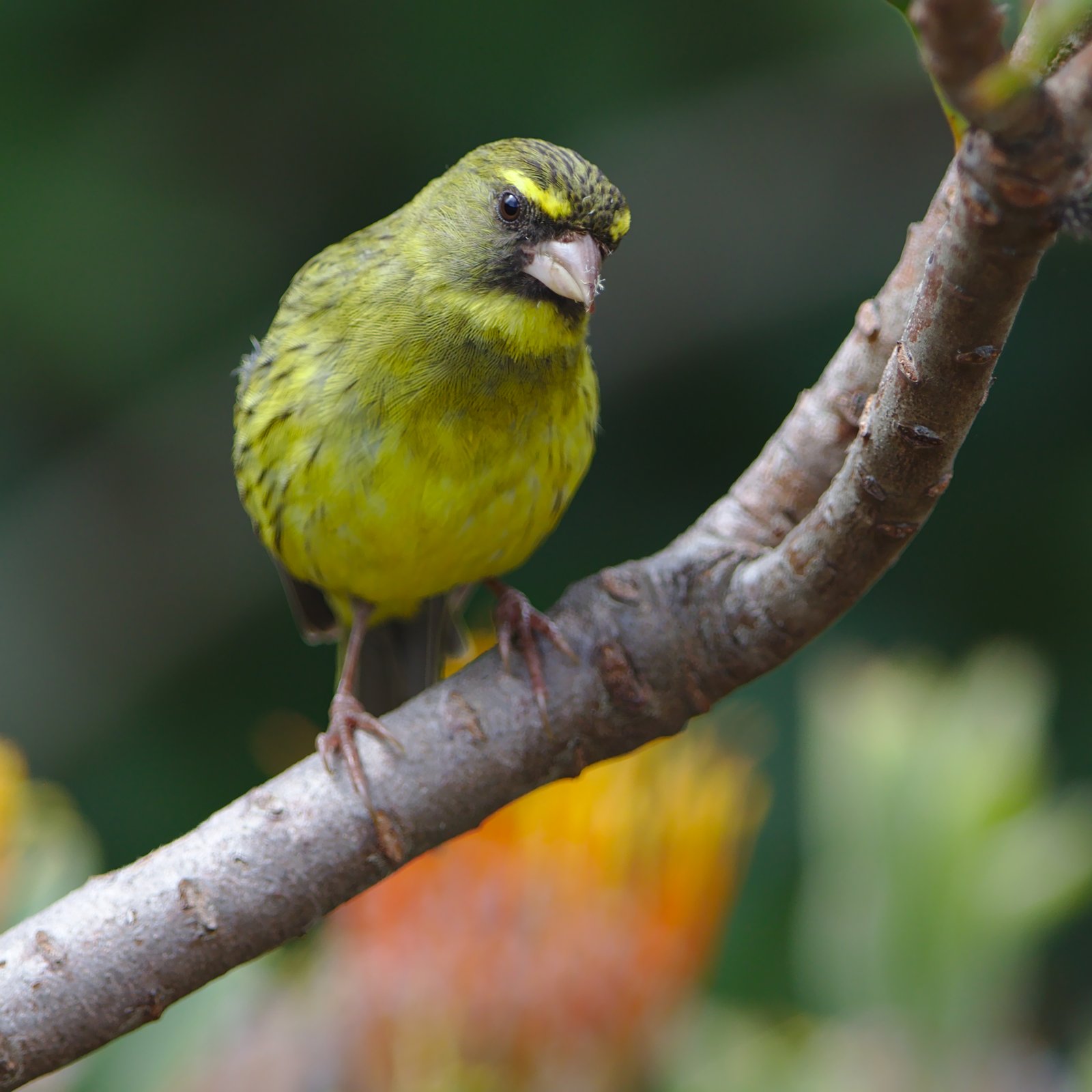
The Forest Canary is a dark, heavily streaked canary of the indigenous forests of eastern South Africa and Eswatini, and so one of the region's endemics. It lives in the understorey and along forest edges and draws attention by its soft call rather than its plumage.
Click a thumbnail to switch the photo above.
Voice
A soft, thin, irregular twittering song of high notes, often sustained at length from cover. The call is a high, descending tsseeu or tsweee, the sound most often heard.
Recording: African Bioacoustics Community — CC BY-NC-SA 4.0 · shortened to the first 60 s, mono · xeno-canto
Identification
12–13 cm, with a short, stout conical bill. The male is dark olive-green above with heavy black streaks, has a black chin and throat patch, dark lores and a narrow yellow eyebrow. The underparts are yellow with dense dark green streaks on breast and flanks; the belly is paler yellow. The female is duller, with less black on the chin and even more heavily streaked underparts. Juveniles are browner and streaked throughout. The tail is dark, without white tips.
Confusion species
Yellow-Fronted Canary (Crithagra mozambica) is paler and yellower, with an unstreaked yellow belly, a yellow cheek and a bright yellow rump; it lives in open country. Cape Siskin (Crithagra totta) of Cape fynbos is unstreaked below and has white tips to tail and wings. Cape Canary (Serinus canicollis) has a grey nape and unstreaked yellow underparts. Streaky-Headed Seedeater (Crithagra gularis) is brown without yellow.
Habitat
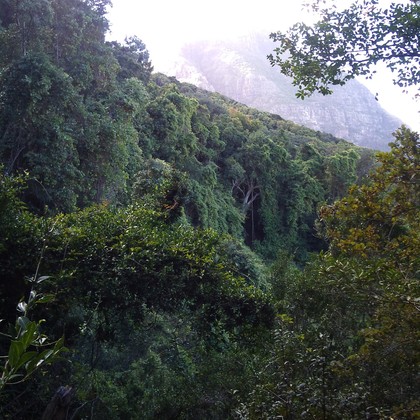
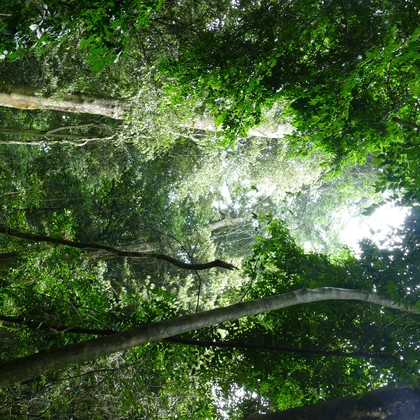
Edges, clearings and understorey of Afromontane and temperate forest, also coastal forest, plantation margins and wooded ravines with brambles and scrub. It feeds in pairs or small groups low in the vegetation and on the ground on seeds, buds and small fruits. It avoids open grassland and dry scrub.
Where the bird is most at home, classified by the vegetation units of southern Africa.
Range and movements
Endemic to South Africa and Eswatini: from the Garden Route forests (Knysna, Tsitsikamma) east through the Eastern Cape (Amatola) and KwaZulu-Natal to Eswatini, Mpumalanga and the north-eastern escarpment in Limpopo (Wolkberg, Magoebaskloof, Soutpansberg). It occurs nowhere outside this area.
- Resident
- Winter visitor (c. Apr–Sep)
- Passage (Mar–Apr, Oct–Nov)
- dark = core range, pale = thinly spread
How and when to look
Best in the forest reserves of Hogsback, Karkloof, Magoebaskloof and the Knysna forests, along trails with brambles and clearings. Listen for the thin tsseeu from the understorey and wait for the bird to come up; pairs often stay long in one spot. Do not mistake the heavily streaked juveniles for pipits or buntings.
Conservation status
Not threatened. An endemic with a limited but fairly stable range, dependent on indigenous forest and forest edge; locally vulnerable to logging and the loss of forest margins.
Scientific name
Crithagra scotops | Sundevall, 1850
Sundevall described the species in 1850 and placed it straight away in the genus where it still stands. The genus Crithagra was introduced in 1827 by Swainson. Crithagra comes from the Greek krithē, 'barley', and agra, 'hunting' — a 'barley hunter', for the seed-eating diet of these canaries and seedeaters. scotops comes from the Greek skotos, 'darkness', and ōps, 'face' — for the dark face and black chin. The specimen the first description was based on came from Pietermaritzburg, KwaZulu-Natal, South Africa.