All species › Waders, gulls and terns › Plovers and lapwings › Forbes's Plover
Forbes's Plover | Thinornis forbesi
Forbes' plevier | Chorlitejo de Forbes
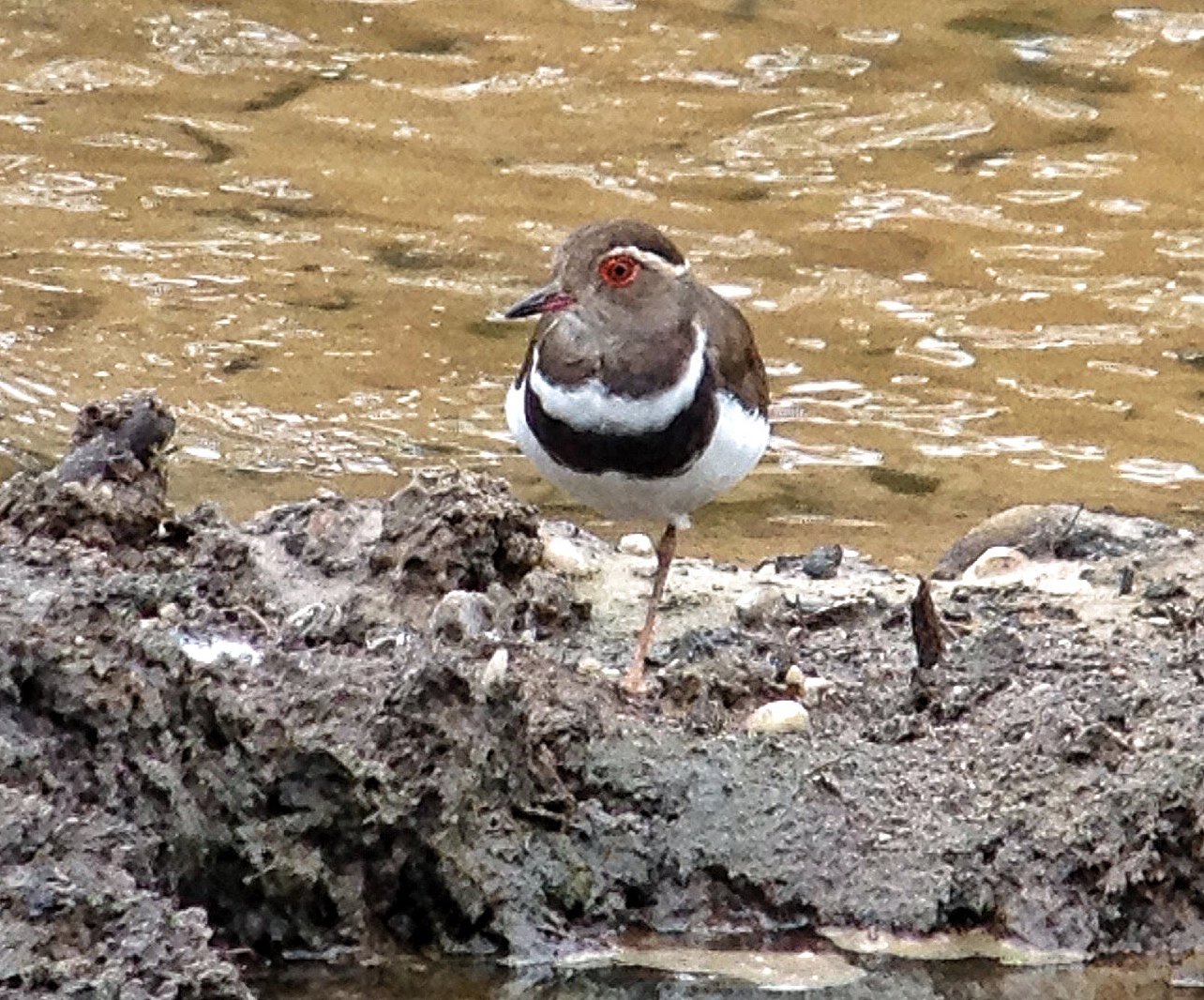
Forbes's Plover is the dark, northern counterpart of Three-Banded Plover: a slim plover with two black breast bands that is not tied to water but lives on burnt grassland, rock slabs and dry fields. In the region it is scarce and confined to the north.
Voice
A plaintive, whistled tree-oo, sometimes repeated in a rolling series; in flight also a soft weet.
No recording with a suitable Creative Commons licence is available for this species yet.
Identification
19–21 cm, slightly larger and longer-tailed than Three-Banded Plover. The upperparts are dark brown, the forehead and face brownish grey, with a white stripe that starts only behind the eye and runs to the nape. Two black breast bands separated by a white band; the lower band is broad. Red eye-ring, bill with a red base and black tip, legs yellowish. The sexes are alike. Juveniles are duller, with brownish breast bands and pale feather edges on the upperparts.
Confusion species
Three-Banded Plover Thinornis tricollaris has a white forehead, a grey face and a white supercilium that encircles the crown, and a narrower lower breast band; it almost always lives beside water. Kittlitz's Plover Anarhynchus pecuarius has no breast bands and a buff breast.
Habitat
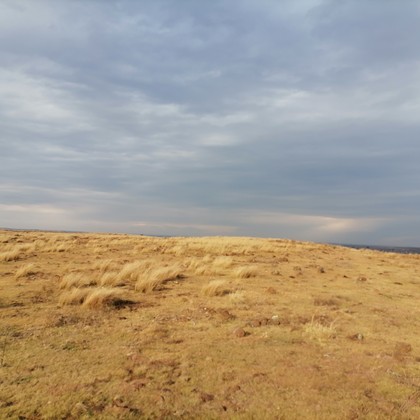
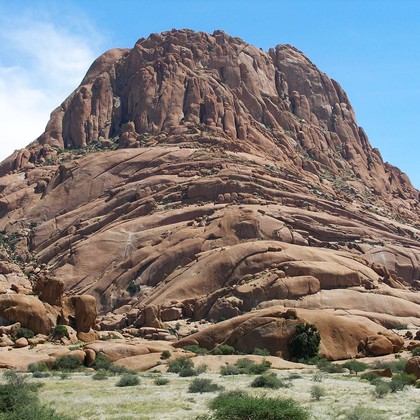
Recently burnt or closely grazed grassland, rock slabs and inselbergs, dambos and dried-out shores, cultivated fields and fallow land. It often keeps far from open water and forages by running and pecking for insects, like other small plovers.
Where the bird is most at home, classified by the vegetation units of southern Africa.

Range and movements
In the region mainly in Zambia and northern and central Angola, scarcer in Malawi and northern Mozambique; further south there are only a few records. Beyond the region it occurs in West and Central Africa, from Senegal and Nigeria to the Central African Republic, DR Congo and western Tanzania. Its movements are poorly understood.
How and when to look
The best chance is in northern and north-western Zambia in the dry season, on recently burnt grassland and open dambos, and on rock slabs near inselbergs. Do not search by water: a plover with two breast bands on a blackened plain is more likely Forbes's than Three-banded. Look for the brown forehead and the white stripe that starts only behind the eye.
Conservation status
Not threatened, but poorly known. The species benefits from grassland fires and does not appear to be declining strongly anywhere. Breeding data from the region are scarce.
Scientific name
Thinornis forbesi | (Shelley, 1883)
Shelley described the species in 1883 as AEgialitis forbesi; because it was later moved to another genus, the author and year stand in brackets. The genus Thinornis was introduced in 1845 by Gray. Thinornis is Greek, from this, thinos 'beach, sandbank' and ornis 'bird'. forbesi honours the English zoologist William Alexander Forbes (1855–1883), who died on an expedition up the Niger, at Shonga where the first specimen was collected. The specimen the first description was based on came from Shonga on the Niger River, Nigeria.