All species › Passerines › Larks › Flappet Lark
Flappet Lark | Amirafra rufocinnamomea
Ratelleeuwerik | Alondra Aplaudidora Canela
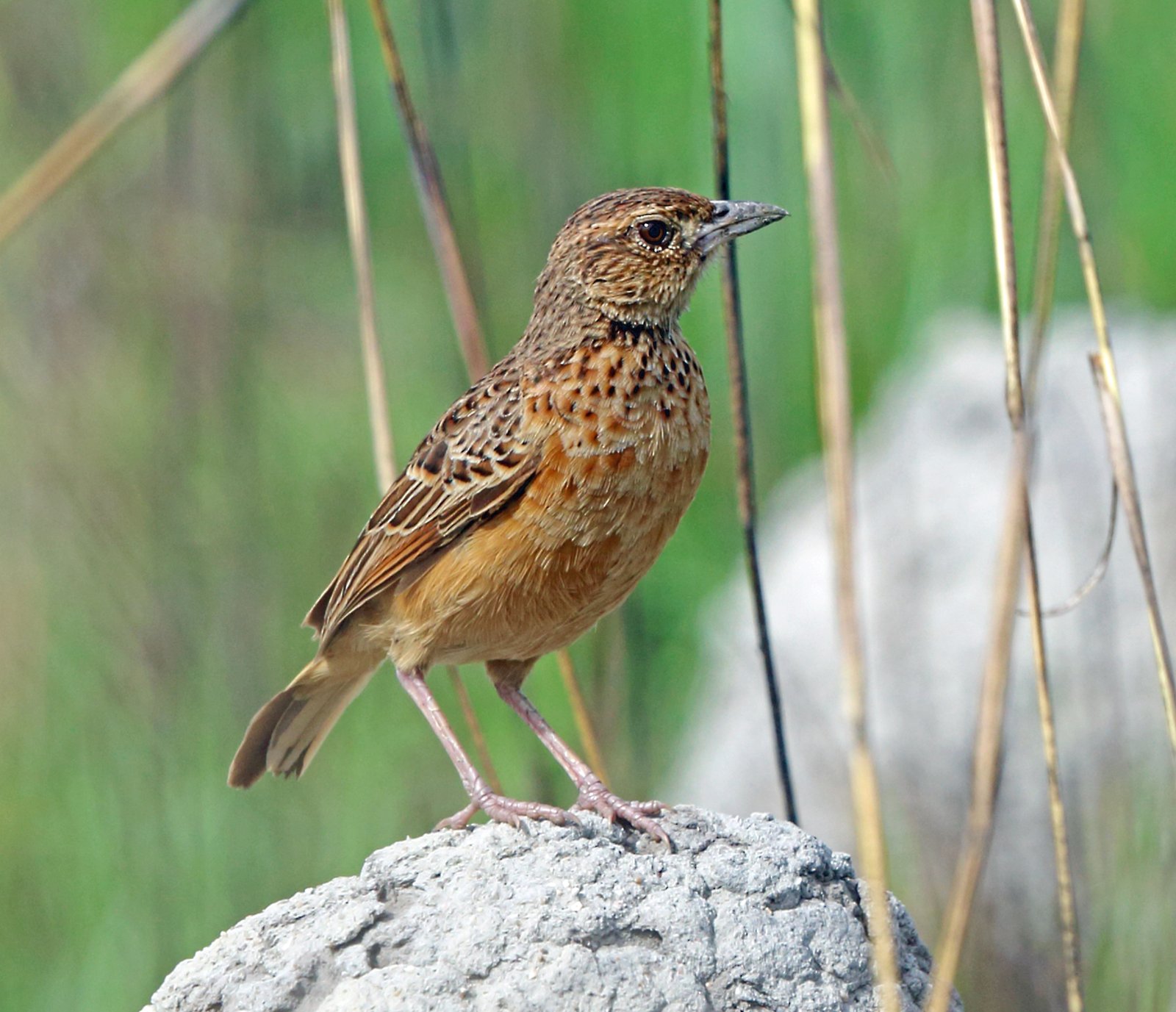
Flappet Lark is a dark, rufous lark of open patches in woodland. It is named for its display flight: high in the sky the male claps its wings in short bursts, a dry rattle that carries further than its song. It is the most widespread of Africa's 'clapping' larks.
Voice
The male rises high and claps its wings in short, rapid bursts, roughly prrrrrt or prrt-prrrrrrt, often two or three in succession, sometimes with a few high whistled notes in between; the rhythm differs regionally. It rarely sings from the ground. The call is a short tseep.
No recording with a suitable Creative Commons licence is available for this species yet.
Identification
15 cm. A medium-sized, compact lark with a short, stout bill and a fairly short tail. The upperparts are dark rufous-brown with heavy black streaking and pale scaling; a crest is absent or barely visible. The supercilium is buff, the throat white. The underparts are warm cinnamon to rufous-buff, with dark spots on the breast. In flight the rufous wing panel is obvious. Colour varies regionally; northern birds are darker. The sexes are alike.
Confusion species
Rufous-Naped Lark Corypha africana is clearly larger, has an erectile crest and sings a whistled tsee-tseeoo from a bush or post. Eastern Clapper Lark Corypha fasciolata also claps, but rises clapping and then drops with a long, rising whistle; it lives in drier, more open grass. Monotonous Lark Mirafra passerina is greyer and sings a monotonous ditty. Angola Lark Amirafra angolensis is larger and more heavily streaked on the breast.
Habitat
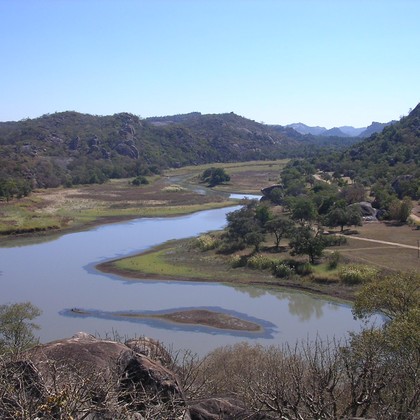
Open patches and small grasslands in miombo and mixed woodland, woodland edge, open savanna with short grass and bare patches, abandoned fields and burnt areas. Often on sandy or stony soil with a sparse grass cover.
Where the bird is most at home, classified by the vegetation units of southern Africa.

Range and movements
In the region: Angola, Zambia, Malawi, Mozambique, Zimbabwe, northern Botswana, the Zambezi Region of Namibia, north-eastern South Africa (the lowveld of Limpopo and Mpumalanga, northern KwaZulu-Natal) and Eswatini. Beyond, widespread in sub-Saharan Africa, north to the Sahel and Ethiopia.
- Resident
- Summer visitor (c. Oct–Mar)
- dark = core range, pale = thinly spread
How and when to look
Best in the first weeks of the rainy season, from October to December, when the males display in earnest. Listen in open woodland for the dry rattle overhead and then scan the sky. Clapping without the long whistle separates it from Eastern Clapper Lark. On the ground it often sits still in the grass and is then often overlooked.
Conservation status
Not threatened. The species has a very large range and is common in suitable habitat. Openings in woodland created by clearing and farming even provide new habitat locally.
Scientific name
Amirafra rufocinnamomea | (Salvadori, 1866)
Salvadori described the species in 1866 as Megalophonus rufo-cinnamomeus; because it was later moved to another genus, the author and year stand in brackets. The genus Amirafra was introduced in 1906 by Bianchi. Amirafra combines the Greek negative prefix a-, 'not', with the genus Mirafra — larks no longer placed in Mirafra. rufocinnamomea comes from the Latin rufus, 'rufous', and cinnamomeus, 'cinnamon-coloured' — for the warm-toned plumage and rufous wings. The specimen the first description was based on came from Ethiopia; later restricted to northern Ethiopia.