All species › Passerines › Waxbills › Fawn-Breasted Waxbill
Fawn-Breasted Waxbill | Estrilda paludicola
Moerasastrild | Estrilda Pechiparda
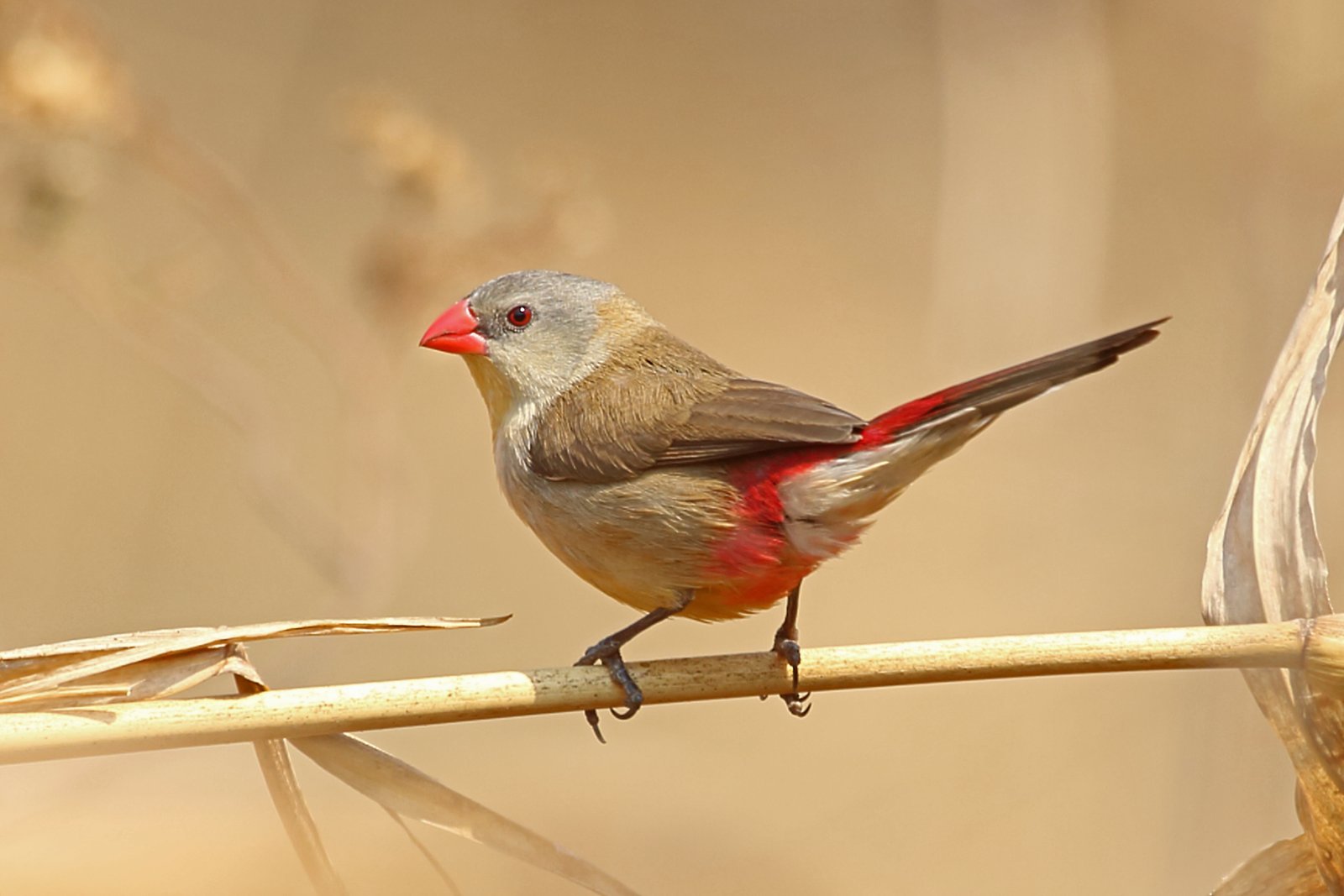
The Fawn-Breasted Waxbill is a modestly coloured waxbill with a grey head, a red bill and a fawn breast, which within the region occurs only in Angola and northern and north-western Zambia. It lives in groups in wet, rank grass around marshes and dambos.
Voice
A dry, sharp tsip or tcheep, repeated by foraging groups, and a short, high song, tsee-tsee-tseee-tsip, similar to that of Common Waxbill.
Recording: Dries Van de Loock — CC BY-NC-SA 4.0 · converted to mono · xeno-canto
Identification
10 to 11 cm. The head is grey, without eye-stripe or cheek patch; back and wings are brown, sometimes with a hint of very fine barring. Rump and uppertail coverts are bright red, the tail dark brown to blackish. The throat is whitish, breast and flanks fawn to sandy, the belly paler, in many birds with a pink or red wash in the centre and on the undertail coverts. The bill is red. The female is slightly duller, with less pink on the belly. Juveniles are plainer brown, with a black bill.
Confusion species
Orange-Cheeked Waxbill (Estrilda melpoda) also has a grey head and a red bill and rump, but a large orange cheek patch. Common Waxbill (Estrilda astrild) is larger and longer-tailed, finely barred throughout and has a red eye-stripe. Swee Waxbill (Coccopygia melanotis) and Angola Waxbill (Coccopygia bocagei) have an olive-green back, a yellowish or barred belly and a two-toned bill, and live at forest edges rather than in marsh grass.
Habitat
Rank, tall grass and reeds along marshes, rivers and dambos, the edges of wet grasslands in miombo, and fallow land and cultivation close to water. It forages in groups on grass seeds, usually low in the vegetation, and flies a short way into cover when disturbed.
Where the bird is most at home, classified by the vegetation units of southern Africa.


Range and movements
Within the region in northern, central and eastern Angola and in northern and north-western Zambia, mainly in North-Western Province (Mwinilunga, Zambezi District) and in Luapula and Northern Province. Beyond the region from South Sudan and Ethiopia to Uganda, Kenya, Tanzania and the DR Congo.
- Resident
- dark = core range, pale = thinly spread
How and when to look
In Zambia's North-Western Province search the edges of dambos and streams with tall grass, for example around Mwinilunga and in the Zambezi District; it is also locally common in Angola. Watch for groups of small brown birds with red bills and red rumps, and always check for an eye-stripe or an orange cheek.
Conservation status
Not threatened. Locally common in suitable habitat. The draining and cultivation of dambos and marsh edges can cause local declines, but the species also benefits from fallow land.
Scientific name
Estrilda paludicola | Heuglin, 1863
Heuglin described the species in 1863 and placed it straight away in the genus where it still stands. The genus Estrilda was introduced in 1827 by Swainson. Estrilda was formed from astrild, the epithet Linnaeus gave the common waxbill; the origin of that word is uncertain — perhaps a German or Dutch avicultural term for a waxbill, perhaps a misprint for Estrilda. paludicola comes from the Latin palus, 'marsh', and -cola, 'dweller' — for its habitat of wet grassland and marsh edges. The specimen the first description was based on came from Bahr el Ghazal, South Sudan.