All species › Passerines › Chats and flycatchers › Familiar Chat
Familiar Chat | Oenanthe familiaris
Roodstaartspekvreter | Colinegro Familiar
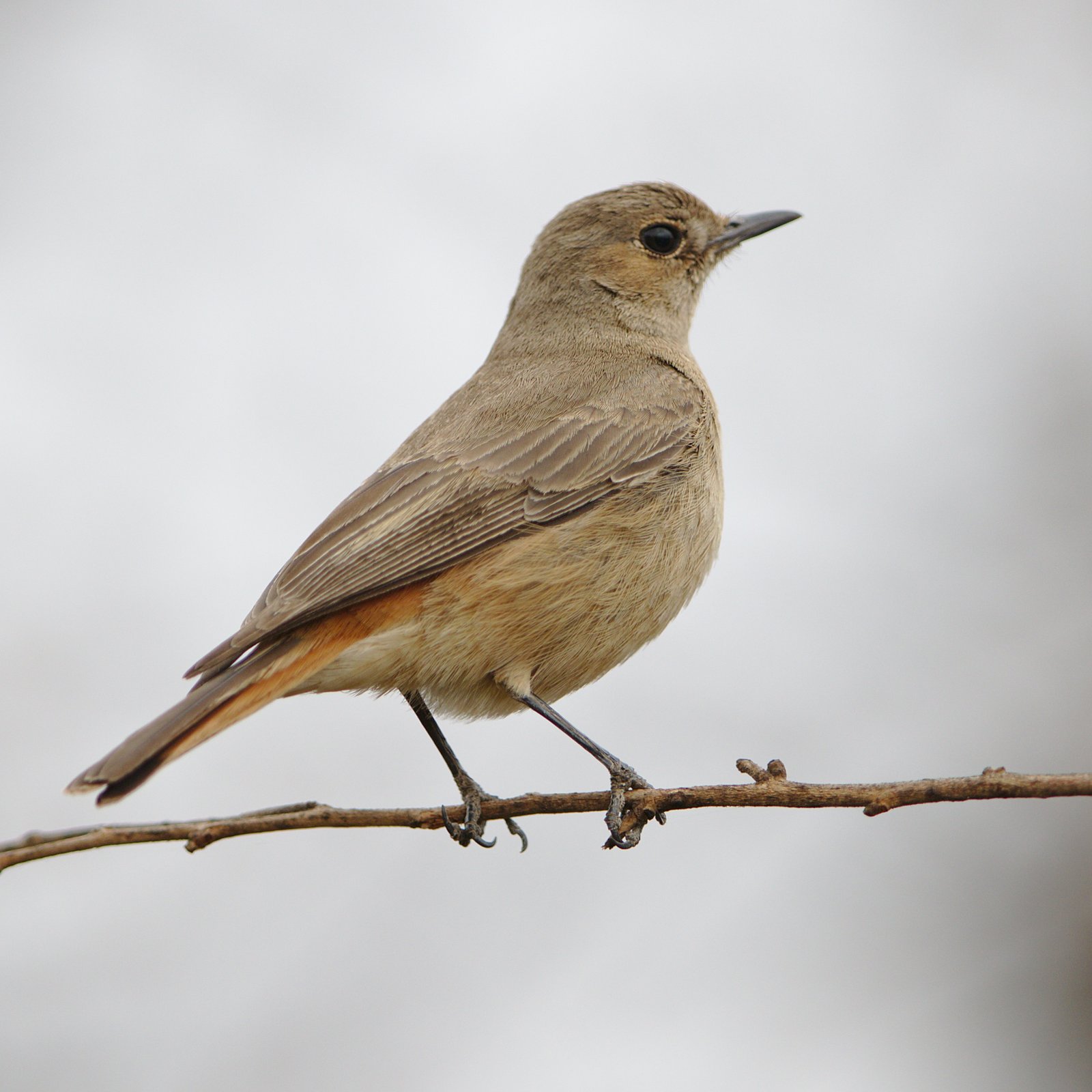
The Familiar Chat is the unobtrusive grey-brown chat with a rufous tail that lives around rocks, farms and camps almost everywhere in southern Africa. It is confiding, visits terraces and gardens and flicks its wings two or three times after every landing. Its Afrikaans name, spekvreter, refers to its habit of picking at fat and scraps around camps and slaughter sites.
Voice
A soft, harsh shek-shek or chack-chack as call and alarm, often accompanied by wing-flicking. The song is a subdued, chattering series of whistles and scratchy notes, shee-shee-chirrup, mainly in the early morning.
Recording: Walter Wallner — CC BY-NC-SA 4.0 · converted to mono · xeno-canto
Identification
A small chat of 14 to 15 cm. The upperparts are plain grey-brown and the underparts paler greyish-buff, with rufous ear coverts. The rump and tail are rufous, with dark brown central feathers and a dark terminal band, forming a dark T on an orange ground. The sexes are alike; juveniles are lightly spotted on breast and back. Bill and legs are black. Typical behaviour: after landing it rapidly flicks both wings two or three times, often followed by a slow movement of the tail.
Confusion species
Sickle-Winged Chat (Emarginata sinuata) is paler and longer-legged, with a rufous tail base but a broader black terminal band, no rufous ear coverts and a pale supercilium; it lives on open plains. Karoo Chat (Emarginata schlegelii) is larger and greyer, with white tail sides. Tractrac Chat (Emarginata tractrac) has a white rump and tail base. Herero Chat (Namibornis herero) of the Namibian escarpment has a supercilium, a streaked breast and a rufous rump with a dark tail. Female Sentinel Rock Thrush (Monticola explorator) is larger, with a scaly breast and a tail with rufous sides but no wing-flicking.
Habitat
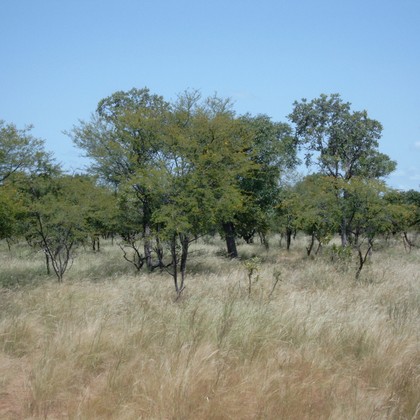
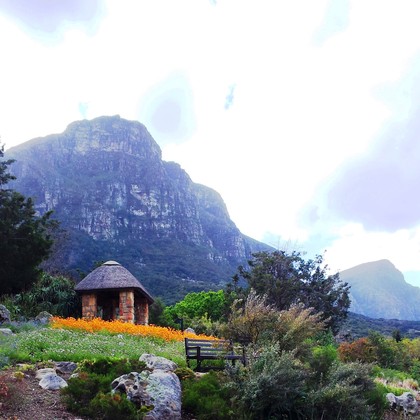
Rocky slopes, koppies and gorges, open thornveld and woodland with rocks and fallen trees, farmyards, campsites and gardens. It avoids dense forest and very open plains without lookout perches. Forages on the ground and from low branches for insects, spiders and fruit, and also takes fat and scraps. Nests in a rock crevice, wall cavity, nest box or old pot.
Where the bird is most at home, classified by the vegetation units of southern Africa.

Range and movements
Distributed across almost the entire region: from Angola, Zambia and Malawi through Zimbabwe and Mozambique to Namibia, Botswana, South Africa, Lesotho and Eswatini. Absent from the barren Namib Desert, from large rockless parts of the central Kalahari and from the humid coastal plain of Mozambique. Beyond the region locally in the savannas of West and East Africa, north to Ethiopia.
- Resident
- Summer visitor (c. Oct–Mar)
- Winter visitor (c. Apr–Sep)
- Passage (Mar–Apr, Oct–Nov)
- dark = core range, pale = thinly spread
How and when to look
It shows itself at almost every rest camp or campsite with rocks and bushes; the bird often comes to the picnic tables of its own accord. When in doubt with other brown chats, watch for the wing-flicking after landing and for the orange tail with a dark T as it flies off.
Conservation status
Not threatened. A common species with stable numbers, well adapted to farms, camps and gardens. No significant threats are known.
Scientific name
Oenanthe familiaris | (Wilkes, 1817)
Wilkes described the species in 1817 as Motacilla familiaris; because it was later moved to another genus, the author and year stand in brackets. The genus Oenanthe was introduced in 1816 by Vieillot. Oenanthe was used by Aristotle for a bird that can no longer be identified; the word comes from the Greek oinos, oinoē 'wine, vine' and anthos 'flower, bloom'. familiaris is Latin for 'familiar, domestic' — for this chat's tame behaviour around farms and houses. The specimen the first description was based on came from Table Mountain, Cape Town, South Africa.