All species › Passerines › Chats and flycatchers › European Pied Flycatcher
European Pied Flycatcher | Ficedula hypoleuca
Bonte vliegenvanger | Papamoscas Cerrojillo
The European Pied Flycatcher is a Palearctic migrant that winters in West Africa and does not normally reach southern Africa. There are only a few documented records in the region; any report deserves careful comparison with Collared Flycatcher, which is common here.

Click a thumbnail to switch the photo above.
Voice
The call is a sharp pik and a soft tek. The song, rarely heard in Africa, is a rhythmic, clear series like zee-tu zee-tu zee-tu with a variable ending.
Recording: Stanislas Wroza — CC BY-NC-SA 4.0 · shortened to the first 60 s, mono · xeno-canto
Identification
A compact flycatcher of 13 cm with a short black bill and black legs. The breeding male is black or blackish-brown above and white below, with a small white forehead patch, a broad white wing panel and white edges to the outer tail feathers, but no white collar and a dark rump. Females and non-breeding birds are grey-brown above and dirty white below, with a white wing panel and white fringes to the tertials. It flicks its wings and sallies from a branch after insects.
Confusion species
Collared Flycatcher (Ficedula albicollis) is a common winter visitor in the north and east of the region: the male has a complete white collar, a larger forehead patch and a white rump, and in all plumages the white patch at the primary bases is usually larger. Females and non-breeding birds often cannot be identified without good photographs of the wing. Spotted Flycatcher (Muscicapa striata) has no white in the wing and a streaked breast.
Habitat
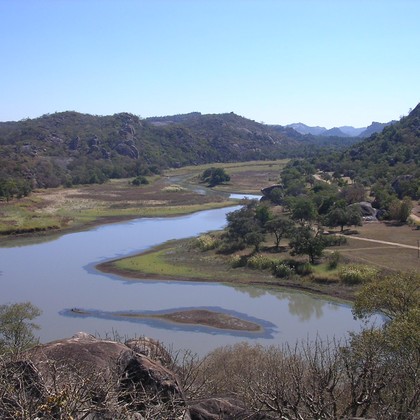
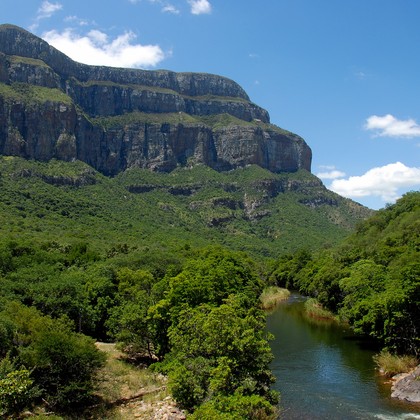
In the wintering area open woodland, woodland edges, riverine forest and savanna with large trees; also plantations and gardens. Hunts insects in the canopy and from low branches.
Where the bird is most at home, classified by the vegetation units of southern Africa.
Range and movements
In the region a very rare vagrant, with only a handful of accepted records, mainly in the summer months. Breeds in Europe and western Siberia and winters in West Africa, from Senegal and Guinea to Nigeria and Cameroon, in small numbers east to Uganda.
How and when to look
Assume that a pied Ficedula in the region is a Collared Flycatcher unless proven otherwise. If in doubt, photograph the spread wing, the rump and the nape, and submit the record to the national rarities committee.
Conservation status
Not threatened. The world population is large, although the species has declined in parts of western Europe, partly because its return date no longer matches the earlier caterpillar peak in its breeding woods.
Scientific name
Ficedula hypoleuca | (Pallas, 1764)
Pallas described the species in 1764 as Motacilla hypoleuca; because it was later moved to another genus, the author and year stand in brackets. The genus Ficedula was introduced in 1760 by Brisson. Ficedula is Latin for a small fig-eating bird, from ficus 'fig'; it was believed to turn into the blackcap in winter. hypoleuca is Greek, from hupo 'beneath' and leukos 'white': white below. The specimen the first description was based on came from Holland.