All species › Passerines › Sylvia warblers › Eurasian Blackcap
Eurasian Blackcap | Sylvia atricapilla
Zwartkop | Curruca Capirotada
The Eurasian Blackcap is a Palearctic warbler that winters in small numbers in the montane forests of northern Malawi and adjacent areas, at the southern limit of its East African wintering range. Further south it is a rare vagrant that sometimes stays for weeks at the same site.
Voice
The call is a hard, dry tek or tak, often repeated and the sound most often heard in winter. The song starts with a soft, fast warble and ends in a loud, clear fluting phrase, chew-chew-tee-teewu. In Africa the species sings mainly shortly before departure in March, often in subdued form.
Recording: David Darrell-Lambert — CC BY-NC 4.0 · converted to mono · xeno-canto
Identification
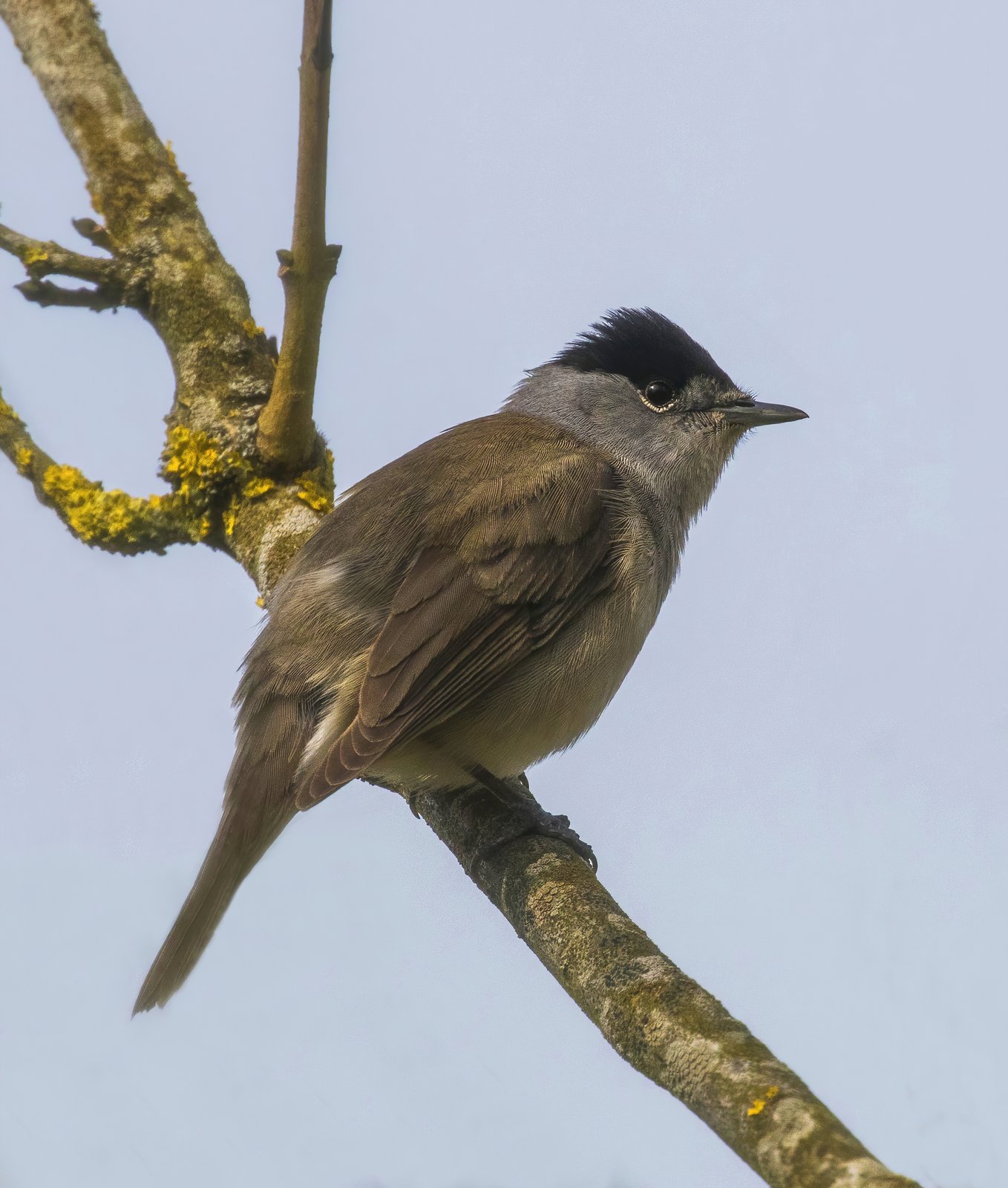
13–15 cm, a grey-brown warbler with a sharply defined cap reaching to the eye. In the male the cap is black, in the female and juvenile red-brown. The upperparts are grey-brown with an olive tinge, the nape and sides of the neck greyer, the underparts pale grey, with a browner tone in the female. The bill is rather short and dark grey, the legs grey. It moves fairly deliberately in dense scrub and eats many berries.
Confusion species
Bush Blackcap Sylvia nigricapillus is larger, with a pink to red bill, pink legs and a black cap extending below the eye, and occurs only in South Africa and Eswatini. Garden Warbler Sylvia borin lacks a cap and has a shorter, thicker bill. African Hill Babbler Sylvia abyssinica, in the same montane forests, has a grey head without a sharp cap edge and a rufous-brown back. A black cap on a small warbler on the Nyika virtually rules out confusion with the other species.
Habitat
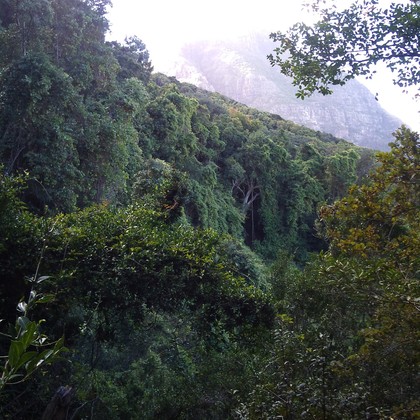
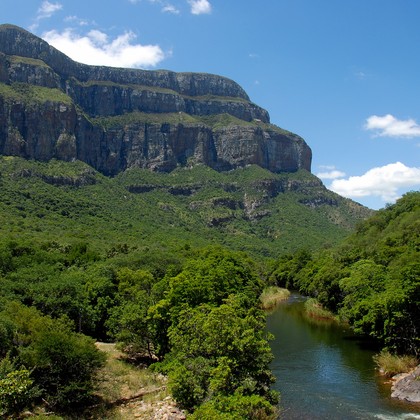
Edges of montane evergreen forest, scrub with bramble and other berry-bearing bushes, wooded ravines and gardens with fruit trees near forest, mostly above 1500 m. Vagrants further south often stay in gardens with fruiting shrubs. In winter it eats mainly berries and fruit, with insects.
Where the bird is most at home, classified by the vegetation units of southern Africa.
Range and movements
A scarce but regular winter visitor to northern and central Malawi, including the Nyika, Luwawa on the Viphya Plateau and Dzalanyama, and further south on Zomba and Mulanje; also on the Zambian side of the Nyika and on the Njesi Plateau in northern Mozambique. Rare in the Eastern Highlands of Zimbabwe. A vagrant to northern Botswana, Namibia and South Africa, including a long-staying bird in a garden in Durbanville in the Western Cape in 2017. It breeds in Europe, north-west Africa and western Asia and winters around the Mediterranean, in West Africa and in East Africa south to Tanzania and Malawi.
- Winter visitor (c. Apr–Sep)
- dark = core range, pale = thinly spread
How and when to look
From November to March; the forest edges around Chelinda on the Nyika and the scrub at Luwawa are the best sites. Listen for the dry tek from a berry bush at the forest edge. A Eurasian Blackcap further south is a notable record and deserves good documentation with photographs.
Conservation status
Not threatened. The European breeding population is very large and increasing; the species also winters more and more in Europe itself. The small numbers in the region lie at the extreme edge of the wintering range.
Scientific name
Sylvia atricapilla | (Linnaeus, 1758)
Linnaeus described the species in 1758 as Motacilla Atricapilla; because it was later moved to another genus, the author and year stand in brackets. The genus Sylvia was introduced in 1769 by Scopoli. Sylvia is Modern Latin silvia, a woodland nymph, related to silva 'wood'; the name passed to small songbirds of scrub and undergrowth. atricapilla is Latin, from ater 'black' and capillus 'hair of the head', after the male's black crown. The specimen the first description was based on came from Sweden.