All species › Birds of prey › Hawks, eagles and kites › Egyptian Vulture
Egyptian Vulture | Neophron percnopterus
Aasgier | Alimoche Común
The Egyptian Vulture is a small, white vulture with a bare yellow face, a slender bill and a wedge-shaped tail. It formerly bred in the south and east of South Africa but disappeared there in the first half of the twentieth century; today it is a rare vagrant to the region.

Voice
Usually silent. Soft mewing, hissing and grunting notes at the nest or at a carcass.
Recording: Mischa Keijmel — CC BY-NC-SA 4.0 · converted to mono · xeno-canto
Identification
58–71 cm, wingspan 155–170 cm. Adults are dirty white, often stained yellowish brown, with black primaries and greyish-black secondaries. The face is bare and bright yellow to orange, and the neck bears a shaggy ruff of long, pointed feathers. The bill is long and slender with a black hooked tip. In flight the white wing coverts contrasting with black flight feathers and the white, strongly wedge-shaped tail stand out. Juveniles are dark chocolate brown with grey facial skin and gradually whiten over four to five years.
Confusion species
Palm-Nut Vulture Gypohierax angolensis has a heavy bill, black secondaries and a black tail with a white tip. White Stork Ciconia ciconia shows a similar black-and-white wing pattern in flight, but has a long neck, long legs and a red bill. Young Egyptian Vultures resemble Hooded Vulture Necrosyrtes monachus, which, however, has a short, rounded tail and broad wings.
Habitat
Open, dry country: savanna, semi-desert and mountains with cliffs, also around villages and rubbish dumps. It eats carrion, refuse, dung and eggs; it is known for breaking ostrich eggs with stones. In its breeding range it nests in rock crevices and on ledges.
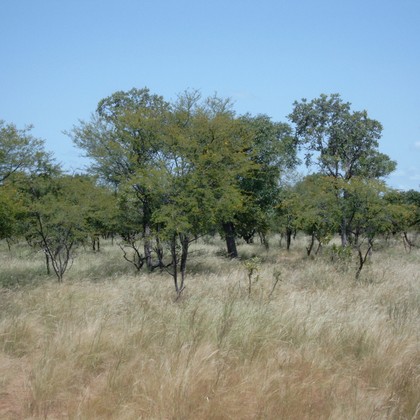
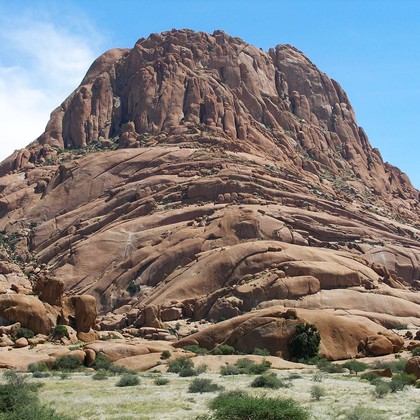
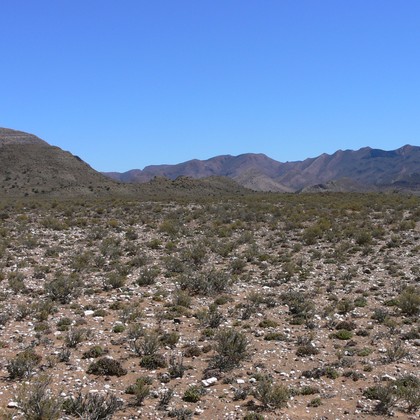
Where the bird is most at home, classified by the vegetation units of southern Africa.
Range and movements
It bred in the Eastern Cape and elsewhere in southern South Africa until the 1920s. There are now only a few records per decade, mainly from northern Namibia, Botswana, Zimbabwe, the Eastern Cape and southern Angola, sometimes among other vultures at a carcass. Beyond the region it occurs in North and East Africa, the Sahel, southern Europe, the Middle East and Central Asia to India.
How and when to look
A sighting is a matter of luck: scan groups of vultures at a carcass or feeding site for a smaller white bird with a yellow face, and check circling vultures for a white wedge-shaped tail. Any record in the region is worth careful documentation with photographs.
Conservation status
Endangered on the Red List; the world population has fallen sharply within a few decades, especially in India, Africa and the Middle East. Poisoning, including by diclofenac and baits, collisions with power lines, hunting and capture for traditional use, and reduced food supply are the main causes. In southern Africa it is extinct as a breeding bird.
Scientific name
Neophron percnopterus | (Linnaeus, 1758)
Linnaeus described the species in 1758 as Vultur Perenopterus; because it was later moved to another genus, the author and year stand in brackets. The genus Neophron was introduced in 1809 by De Savigny. Neophron is taken from Greek mythology: Neophron was turned into a vulture by Zeus. percnopterus is Greek, from perknos 'blue-black' and pteron 'wing': 'black-winged', after the black flight feathers in the otherwise white wing. The specimen the first description was based on came from Egypt.