All species › Passerines › Nicators › Eastern Nicator
Eastern Nicator | Nicator gularis
Bruinkopnicator | Conquistador Oriental
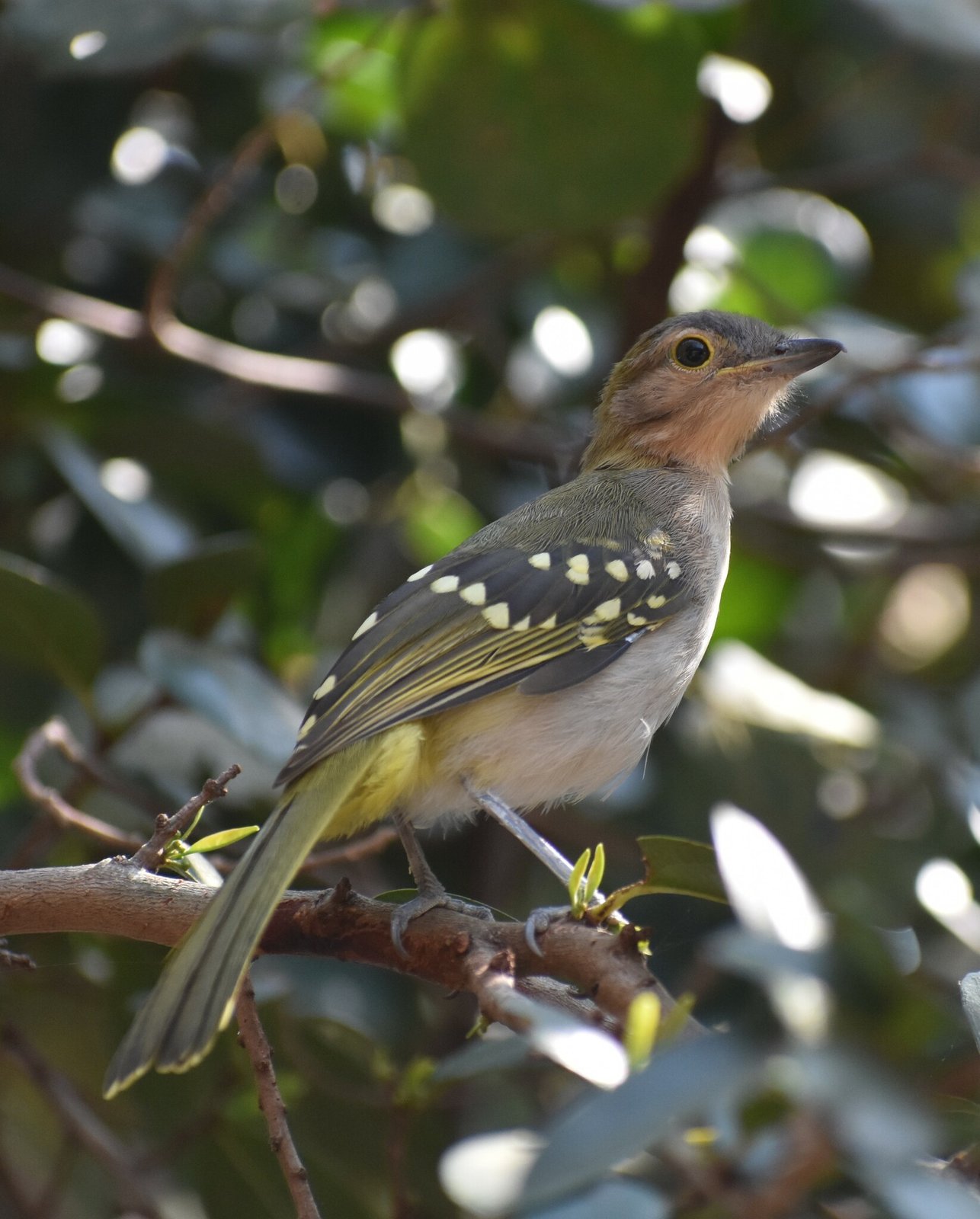
The Eastern Nicator is a bulky, olive-green thicket bird with conspicuous yellow spots on the wing, rarely seen well in dense cover. Its sudden, explosive song is one of the characteristic sounds of the coastal and riverine forests of the east of the region. Nicators form their own small African family; they were formerly placed with the bulbuls or the shrikes.
Voice
A sudden, loud, liquid burst of rich notes that starts hesitantly and then accelerates, such as chup… chup-churrup-churrup-chiwee-chiwee; the song often stops just as abruptly. The contact call is a sharp, dry tchak.
Recording: Louis A. Hansen — CC BY-NC-SA 4.0 · converted to mono · xeno-canto
Identification
20–23 cm; the male is noticeably larger than the female. The upperparts are olive-green, the head a slightly browner olive. The wing coverts and tertials carry large, round, pale yellow spots, the most striking feature. The underparts are dingy grey, turning yellowish on the undertail coverts; the throat is paler grey. The tail is long and rounded, with yellow tips to the outer feathers. The bill is heavy, slightly hooked and dark horn; the eye is dark. Juveniles are duller, with smaller wing spots.
Confusion species
Olive Bushshrike Chlorophoneus olivaceus is smaller, lacks the yellow wing spots and has (in most plumages) a grey head or a pinkish-buff breast. Sombre Greenbul Andropadus importunus is uniform olive with a pale eye and a thinner bill. Yellow-Bellied Greenbul Chlorocichla flaviventris has yellow underparts and a white eye-crescent above the eye. Terrestrial Brownbul Phyllastrephus terrestris is brown and forages on the ground. Grey-Headed Bushshrike Malaconotus blanchoti is much larger, with a grey head, a yellow eye and yellow underparts.
Habitat
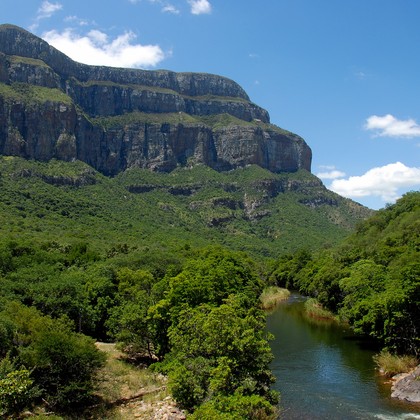
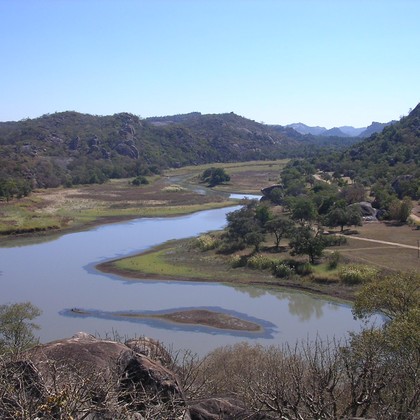
Dense, shady thicket and the understorey of coastal forest, sand forest, riverine forest and dense woodland clumps, mostly in lowlands below 1000 m. It searches for insects and other invertebrates in the middle and lower strata, slowly and often hidden among lianas.
Where the bird is most at home, classified by the vegetation units of southern Africa.

Range and movements
In South Africa in north-eastern KwaZulu-Natal (Zululand), in the Lowveld of Mpumalanga and Limpopo (including Kruger National Park) and along the Limpopo; also in eastern Eswatini. Widespread in the lowlands of Mozambique, in the Zambezi valley and the south-eastern Lowveld of Zimbabwe, in the lowlands of Malawi and in the Luangwa and Zambezi valleys in Zambia. Beyond the region north along the east coast to Kenya and Somalia.
- Resident
- Summer visitor (c. Oct–Mar)
- Winter visitor (c. Apr–Sep)
- Passage (Mar–Apr, Oct–Nov)
- dark = core range, pale = thinly spread
How and when to look
Year-round, but most often found in the breeding season (October–February), when males sing a lot. Listen for the explosive song in the sand forest and riverine forest of Zululand or northern Kruger, then search patiently for the bird in the dense understorey; the yellow wing spots are usually the first thing you see.
Conservation status
Not threatened; fairly common in suitable habitat. The species depends on dense thicket and suffers locally from clearance of coastal and sand forest, but is well represented in protected areas.
Scientific name
Nicator gularis | Hartlaub & Finsch, 1870
Hartlaub & Finsch described the species in 1870 and placed it straight away in the genus where it still stands. He introduced the genus Nicator in that same work. Nicator comes from the Greek nikatōr, 'conqueror'; why Hartlaub and Finsch chose this name is not known. gularis comes from the Latin gula, 'throat' — for the pale throat. The specimen the first description was based on came from Shupanga on the Zambezi, Mozambique.