All species › Passerines › Waxbills › Dusky Twinspot
Dusky Twinspot | Euschistospiza cinereovinacea
Leigrijze astrild | Estrilda Sombría
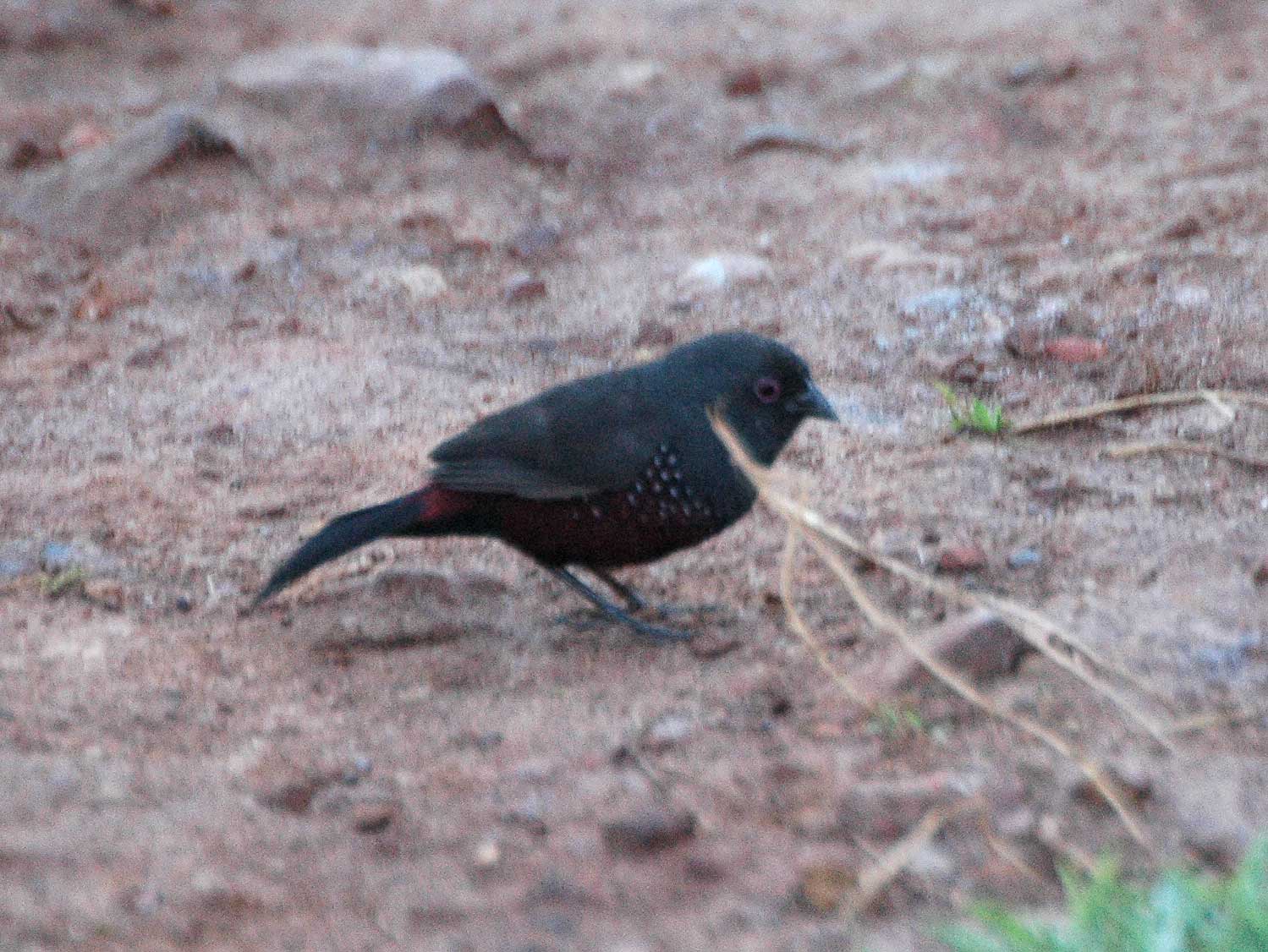
The Dusky Twinspot is a dark, inconspicuous highland waxbill: slate-grey, with a wine-red rump and finely white-spotted flanks. Within the region it occurs only in the western highlands of Angola, which together with the Albertine Rift mountains make up its entire range.
Voice
A high, pure tseet and a soft trill as contact calls. The song is a series of soft whistles rising and falling in pitch; poorly described and often missed.
Recording: Bram Piot — CC BY-NC-SA 4.0 · shortened to the first 60 s, mono · xeno-canto
Identification
11–12 cm, with a blackish bill. Head, breast and upperparts are dark slate-grey, the belly blackish. The flanks are wine-red to chestnut with small white spots, and rump and uppertail coverts are bright wine-red; the tail is black. The sexes are very similar; the female is duller with less red on the flanks. Juveniles are plain dark grey-brown without spots, with a dull red rump. It keeps low in rank growth and rarely strays far from cover.
Confusion species
Grey Waxbill (Glaucestrilda perreini) is also grey with a red rump and black tail, but paler blue-grey, with a black eye-stripe and no spotting on the flanks; it lives in lower-lying wooded country. African Firefinch (Lagonosticta rubricata) is reddish-brown with a red breast and a blue-grey bill. Brown Twinspot (Clytospiza monteiri) is warm brown, spotted white over the whole underparts, and lives in the northern lowlands.
Habitat
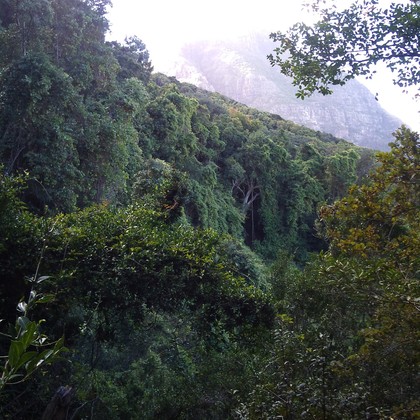
Grassland with scattered bushes, bracken and rank growth on slopes and in valleys of the highlands, the edges of Afromontane forest and overgrown field margins, mainly above about 1,300 m. It forages in pairs or small groups on the ground for grass seeds, usually a short distance from dense cover.
Where the bird is most at home, classified by the vegetation units of southern Africa.

Range and movements
Within the region only in Angola: the western highlands and escarpment zone of Huambo, Cuanza Sul, Bié and Benguela, with a few reports from Malanje. Beyond the region only in the Albertine Rift mountains (eastern DR Congo, south-western Uganda, Rwanda and Burundi), where a separate subspecies occurs.
- Resident
- dark = core range, pale = thinly spread
How and when to look
Mount Moco and the forest patches and rank valleys of the Huambo highlands are where birders most often find the species. Search along rough edges of scrub and forest patches early in the morning, when pairs feed on tracks. Because of the dark plumage, the wine-red rump is what stands out as a bird flies off.
Conservation status
Not threatened according to the IUCN, but in Angola confined to a small and fragmented highland range. Grassland burning, expansion of farming and the loss of the last forest patches on Mount Moco are a real threat there.
Scientific name
Euschistospiza cinereovinacea | (Sousa, 1889)
Sousa described the species in 1889 as Lagonosticta cinereo-vinacea; because it was later moved to another genus, the author and year stand in brackets. The genus Euschistospiza was introduced in 1943 by Wolters. Euschistospiza combines the Greek eu, 'fine', Late Latin schistus, 'slate', and Greek spiza, 'finch' — 'fine slate-grey finch'. cinereovinacea comes from the Latin cinereus, 'ash-grey', and vinaceus, 'wine-coloured' — for the grey plumage with wine-red flanks and rump. The specimen the first description was based on came from Quindumbo, Angolan highlands.