All species › Passerines › Larks › Dusky Lark
Dusky Lark | Pinarocorys nigricans
Lijsterleeuwerik | Alondra Oscura
The Dusky Lark is a large, dark lark with a boldly marked face that behaves more like a thrush than a lark. It is an intra-African migrant: it breeds in the dry season in the miombo belt of Zambia, Angola and Congo, and moves south into the bushveld during the rains.

Voice
Almost silent outside the breeding season; a soft chrrp or chip on flushing. On the breeding grounds a simple, repeated whistled phrase of a few notes, given in a high song flight.
No recording with a suitable Creative Commons licence is available for this species yet.
Identification
19–20 cm. Dark blackish-brown above with pale feather fringes that give the back a scaly look. The head is strongly patterned: a white supercilium, a dark eye-stripe, a pale cheek and a black patch behind the ear-coverts and at the gape. White below with large, round black spots on the breast and flanks. Legs pale pink, bill fairly short and pale. It stands upright, runs quickly and briefly flicks its wings on landing, an almost diagnostic habit.
Confusion species
Groundscraper Thrush Turdus litsitsirupa has a similar face and breast pattern but is greyer above, hops rather than walks, and shows rufous wings in flight. Sabota Lark Calendulauda sabota is much smaller, browner and streaked rather than spotted. Monotonous Lark Mirafra passerina is smaller, with rufous wings and a streaked breast.
Habitat
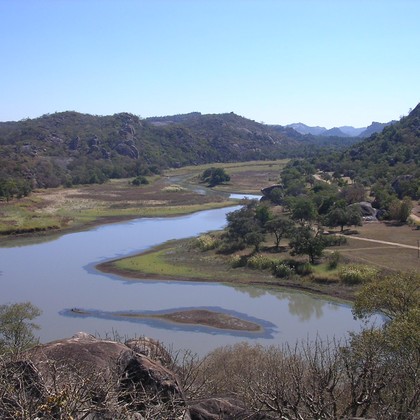
Open miombo and other broadleaved woodland with bare or recently burnt ground, clearings in mopane and short-grazed edges of dambos. It forages on the ground for insects, often in small, loose groups and regularly on freshly burnt areas.
Where the bird is most at home, classified by the vegetation units of southern Africa.

Range and movements
Breeds in the north of the region: northern and eastern Zambia and eastern Angola, and beyond in southern DR Congo and possibly south-western Tanzania. Outside the breeding season it moves south to Malawi, Zimbabwe, Mozambique, northern and eastern Botswana, north-eastern Namibia (Caprivi) and north-eastern South Africa (Limpopo, Mpumalanga, Kruger National Park); irregularly further south.
- Summer visitor (c. Oct–Mar)
- Passage (Mar–Apr, Oct–Nov)
- dark = core range, pale = thinly spread
How and when to look
In the south from November to March; numbers vary greatly from year to year. Search bare or recently burnt ground in open woodland and watch for the characteristic wing-flick on landing, which separates it at once from Groundscraper Thrush.
Conservation status
Not threatened; widespread but often scarce and unpredictable. Clearing of miombo for farming and charcoal reduces the breeding range, but the species benefits from open, burnt ground.
Scientific name
Pinarocorys nigricans | (Sundevall, 1850)
Sundevall described the species in 1850 as Alauda nigricans; because it was later moved to another genus, the author and year stand in brackets. The genus Pinarocorys was introduced in 1902 by Shelley. Pinarocorys comes from the Greek pinaros, 'dirty, squalid', and korus, 'lark' — for the dark, dingy plumage. nigricans is Latin for 'blackish' — for the dark upperparts. The specimen the first description was based on came from Apies River, Gauteng, South Africa.