All species › Woodpeckers and allies › African barbets › Double-Toothed Barbet
Double-Toothed Barbet | Pogonornis bidentatus
Dubbeltandbaardvogel | Barbudo Bidentado
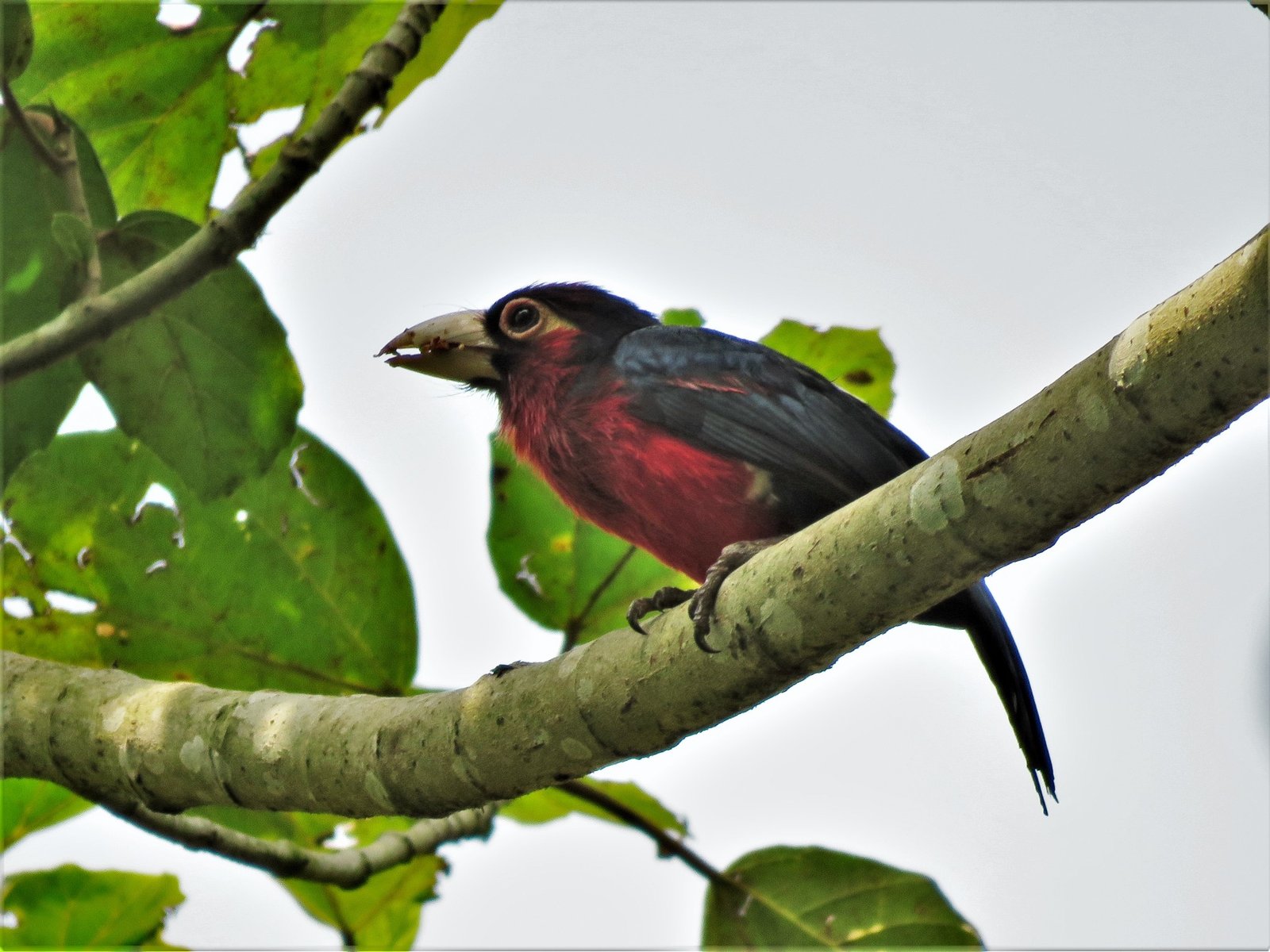
The Double-Toothed Barbet is a large, boldly coloured barbet of Central African forest edges, glossy black with a crimson face and breast. The name refers to the two teeth on each side of the ivory upper mandible; in the region it is a peripheral species of northern Angola.
Voice
Fairly quiet. A short nasal chek or kwek, a soft rolling growl and bill-snapping, sometimes as a brief duet by the pair.
No recording with a suitable Creative Commons licence is available for this species yet.
Identification
About 23 cm, with a heavy pale ivory bill bearing two distinct teeth along the cutting edge. Crown, nape, back, wings and tail are glossy blue-black; cheeks, throat, breast and belly deep crimson, with a narrow red bar across the wing coverts and a white patch on the flanks. A bare yellowish skin ring surrounds the eye. The female shows black flecks on the flanks; juveniles are duller, with brownish-black upperparts and less red.
Confusion species
Black-Backed Barbet (Pogonornis minor) is smaller, with red only on the forehead and forecrown and a white or brownish throat and breast. Black-Collared Barbet (Lybius torquatus) has a red face with a black collar, a black bill and a grey-brown back, and does not occur in northern Angola. The combination of black upperparts, red breast and white flank patch is distinctive within the region.
Habitat
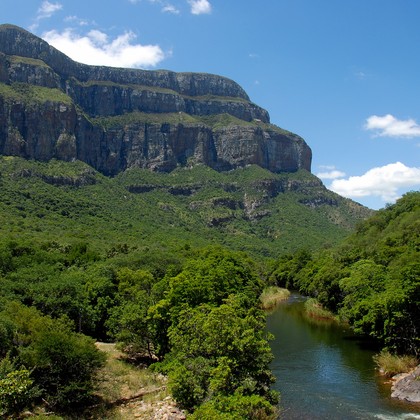
Forest edges, clearings in rainforest, gallery forest, secondary growth, plantations and village gardens with fruiting trees, from lowlands into the hills. It feeds mainly on fruit, especially figs, and insects. It nests in a self-excavated cavity in dead wood, often in a clearing or near habitation.
Where the bird is most at home, classified by the vegetation units of southern Africa.

Range and movements
Within the region only in northern Angola, from Cabinda and Uíge east to the Lunda provinces; in Zambia at most scarce in the extreme north-west. Beyond the region widespread from Guinea east through Central Africa to Ethiopia, Kenya and north-western Tanzania.
How and when to look
In northern Angola search forest edges and village gardens at fruiting figs and oil palms, where the bird often sits openly and calmly in the crown. The red breast shows from afar; look for the pale toothed bill.
Conservation status
Not threatened, and widespread and common outside the region. It benefits from clearings, secondary forest and gardens; within the region it is little known owing to the low observer coverage of northern Angola.
Scientific name
Pogonornis bidentatus | (Shaw, 1799) (GBIF: Lybius bidentatus)
Shaw described the species in 1799 as Bucco bidentatus; because it was later moved to another genus, the author and year stand in brackets. The genus Pogonornis was introduced in 1828 by Billberg. Pogonornis comes from the Greek pōgōn, 'beard', and ornis, 'bird' — 'bearded bird', for the bristles around the heavy bill. bidentatus is Latin for 'two-toothed' — for the two notches in the upper mandible. The specimen the first description was based on came from 'Barbary' (North Africa; probably erroneous).