All species › Bustards › Bustards and korhaans › Denham's Bustard
Denham's Bustard | Neotis denhami
Denhams trap | Avutarda Cafre
Denham's Bustard is a large bustard of open grassland with a pale grey neck, a rufous hindneck and a black-and-white head stripe. Displaying males turn into a white balloon: the neck is inflated and the undertail coverts are raised like a white banner.

Voice
Largely silent. In display a low, dull woomp, barely audible at distance; otherwise soft croaking sounds between birds.
No recording with a suitable Creative Commons licence is available for this species yet.
Identification
Strongly dimorphic: males 100–116 cm and 9–10 kg, females 80–87 cm and 3–4 kg. Foreneck and breast pale grey, hindneck bright rufous. The crown is black with a white central stripe and a white supercilium below it. The upperparts are brown and finely speckled; the wing coverts are strikingly black and white, visible as a contrasting panel even at rest. The belly is white and the legs long and pale yellow. In flight, large white patches on the wing.
Confusion species
Ludwig's Bustard (Neotis ludwigii) has a dark brownish-grey foreneck, no white head stripes and less black and white in the wing; it lives in the drier Karoo. The Kori Bustard (Ardeotis kori) is larger, with a finely barred grey neck lacking rufous and a black crest, and lacks the white head stripes.
Habitat
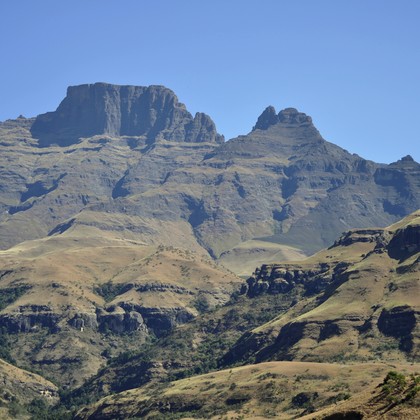
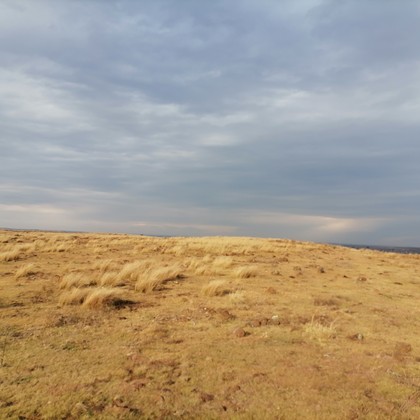
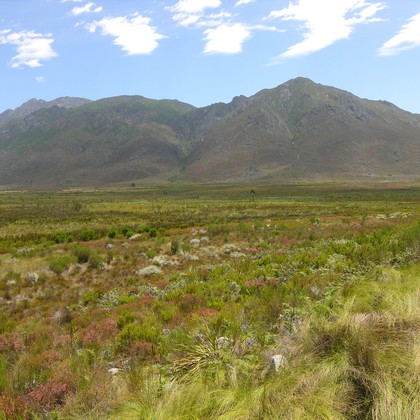
Open grassland and high grassland plateaus, montane meadows, renosterveld and the fields and pastures of the Overberg, often on gently rolling terrain with good visibility. It feeds on insects, especially grasshoppers and beetles, and also on small vertebrates, flowers and seeds. It readily appears on freshly burnt ground.
Where the bird is most at home, classified by the vegetation units of southern Africa.
Range and movements
Within the region mainly in South Africa: the grasslands of the Eastern Cape, KwaZulu-Natal, the eastern Free State and Mpumalanga, as well as Lesotho and Eswatini, with a separate population in the farmland of the Western Cape. Also locally in the highlands of Angola, Zambia and Malawi (Nyika). Beyond the region across the savanna belt of West and East Africa to Ethiopia and south-western Arabia.
- Resident
- Summer visitor (c. Oct–Mar)
- Winter visitor (c. Apr–Sep)
- Passage (Mar–Apr, Oct–Nov)
- dark = core range, pale = thinly spread
How and when to look
The Overberg around Bredasdorp and De Hoop and the high grasslands around Wakkerstroom and Dullstroom offer the best chances. Drive slowly and look for a grey neck rising above the grass. The male's display, a white ball on a hilltop, can be seen from September to December.
Conservation status
Near Threatened. Numbers are falling through loss of grassland to agriculture and forestry, collisions with power lines and fences, and hunting, especially outside South Africa. The Western Cape population benefits from the conversion of renosterveld into grain fields and pastures and is stable there.
Scientific name
Neotis denhami | (Children & Vigors, 1826)
Children & Vigors described the species in 1826 as Otis Denhami; because it was later moved to another genus, the author and year stand in brackets. The genus Neotis was introduced in 1893 by Sharpe. Neotis comes from the Greek neos, 'new', and ōtis, 'bustard' — a 'new bustard', split off from the old genus Otis. denhami honours the English explorer Dixon Denham (1786–1828), who explored the Lake Chad region. The specimen the first description was based on came from Lake Chad region.