All species › Passerines › Batises and wattle-eyes › Dark Batis
Dark Batis | Batis crypta
Donkere kortstaartvliegenvanger | Batis de Iringa
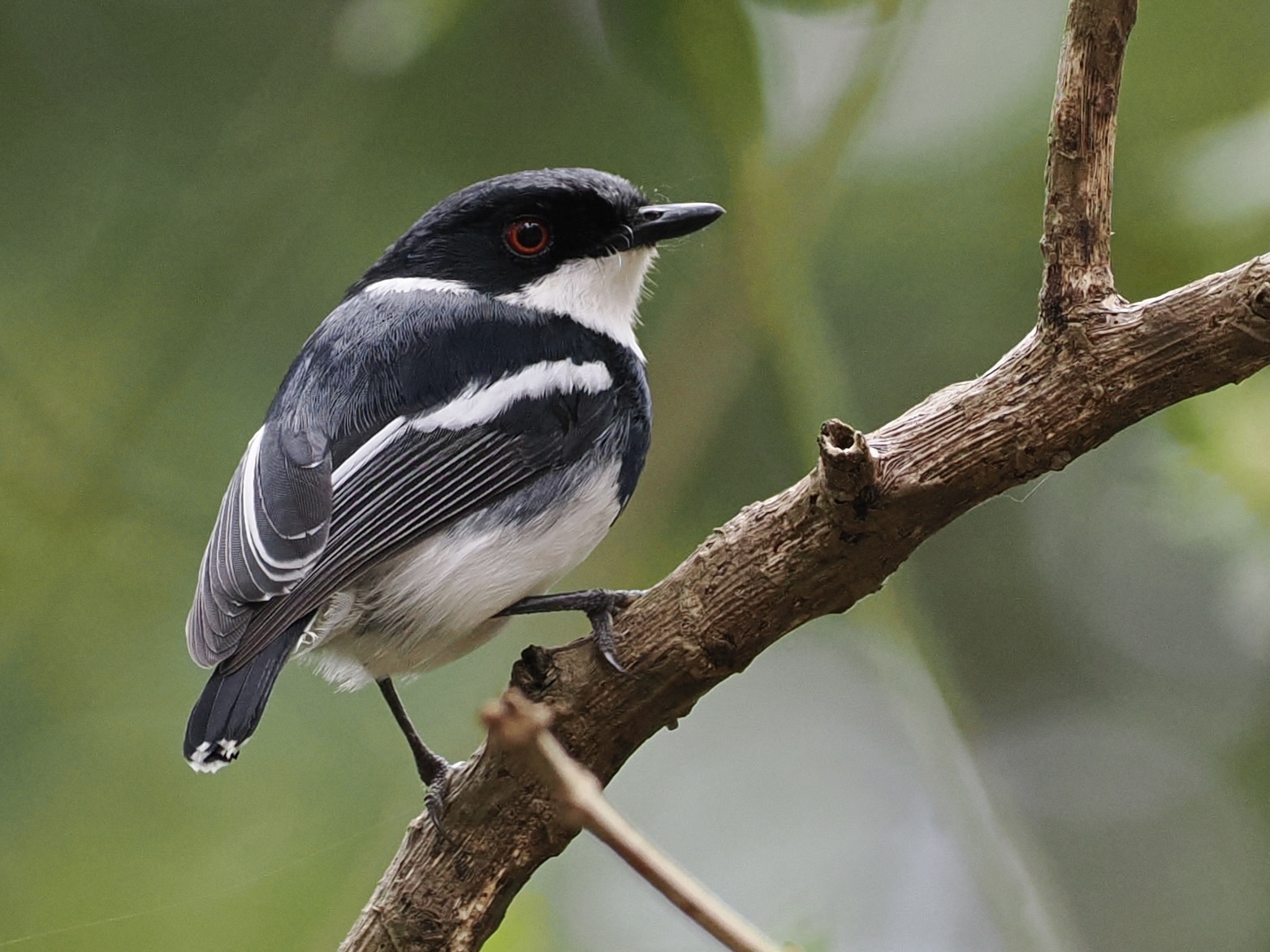
Dark Batis was described only in 2006, split from Short-Tailed Batis of Kenya and northern Tanzania. It is a small, dark, short-tailed batis with a red eye, living in the montane forest of the Eastern Arc and the southern highlands of Tanzania. It reaches the region only in the far north of Malawi and Mozambique.
Voice
A series of two or three pure, descending whistles, hoo-hoo-hoo, repeated at length from cover, and dry, chirping chip calls. When alarmed it gives a rasping chrr-chrr and audible wing-fripping.
Recording: isaac kilusu — CC BY-NC-SA 4.0 · converted to mono · xeno-canto
Identification
10–11 cm. The male has a dark slate-grey crown and back, a black mask with at most a short, faint white eyebrow, a white wing stripe and a broad black breast band on otherwise white underparts with grey-washed flanks. The female is browner above, with a rufous wing stripe, a rufous chin spot and a rufous-brown breast band. Both sexes have a bright red eye and a short tail, giving a compact silhouette. It forages in the lower and middle strata of the forest, often in mixed flocks.
Confusion species
Cape Batis Batis capensis, which occurs in the montane forests of Malawi, has a longer tail, rufous flanks and, in the male, a rufous wing stripe. Short-Tailed Batis Batis mixta of Kenya and northern Tanzania is almost identical but paler grey above, and the female has a paler, more orange-brown breast; the two are separated mainly by range. Chinspot Batis Batis molitor is paler grey, with a yellow eye and a distinct white eyebrow, and lives in open woodland.
Habitat
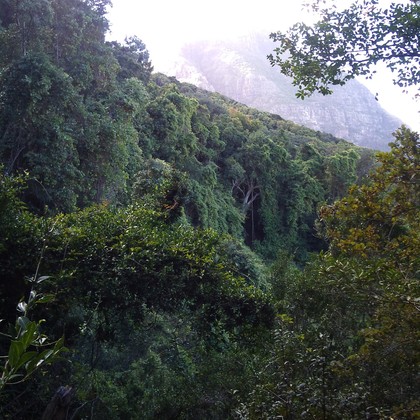
Moist evergreen montane forest and forest edge, roughly between 900 and 2100 m, with the highest densities around 1500 m. It hunts small insects in the lower and middle strata, gleaning them from leaves and twigs or taking them in short sallies.
Where the bird is most at home, classified by the vegetation units of southern Africa.
Range and movements
In the region only at the southern edge of its range: the Misuku Hills in the far north of Malawi and the Njesi Plateau in northern Mozambique. Beyond the region from the Ukaguru and Uluguru Mountains in central Tanzania through the southern Eastern Arc and the southern highlands of Tanzania.
- Resident
- Winter visitor (c. Apr–Sep)
- Passage (Mar–Apr, Oct–Nov)
- dark = core range, pale = thinly spread
How and when to look
Year-round. Mughesse Forest in the Misuku Hills is the most accessible site in the region. Listen for the whistled series in the early morning and search the middle stratum along the forest edge; the bird often joins mixed flocks of forest birds.
Conservation status
Not threatened; locally common within its limited range. In Malawi and Mozambique its habitat is small and fragmented and under pressure from logging, cultivation and fire; its survival here depends on protecting the last montane forest patches.
Scientific name
Batis crypta | Fjeldså, Bowie & Kiure, 2006
Fjeldså, Bowie & Kiure described the species in 2006 and placed it straight away in the genus where it still stands. The genus Batis was introduced in 1833 by Boie. Batis is a Greek word for an unidentified worm-eating bird mentioned by Aristotle; Boie applied the name to these small African flycatchers in 1833. crypta comes from the Greek kruptos, 'hidden' — this species long went unnoticed within Forest Batis and was only described as separate in 2006. The specimen the first description was based on came from Tanzania (type locality not given in the source data).