All species › Waders, gulls and terns › Gulls and terns › Damara Tern
Damara Tern | Sternula balaenarum
Damarastern | Charrancito de Damara
The Damara Tern is a small, pale tern whose breeding range is almost confined to the coasts of Namibia, southern Angola and western South Africa. It nests in scattered single pairs on bare gravel plains and among dunes, sometimes several kilometres inland in the Namib Desert, making it one of the most unusual terns in the world.

Voice
A high, sharp, rapid tsit-tsit and a high chattering kid-ick, often in flight over the breeding site. When a nest is disturbed the bird dives at the intruder, calling loudly and persistently.
Recording: Bram Vogels — CC BY-NC-SA 4.0 · converted to mono · xeno-canto
Identification
About 23 cm, slightly smaller than Little Tern and with a longer, slender, slightly decurved black bill. In breeding plumage the whole crown is black down to the bill base, with no white forehead patch. The upperparts, rump and tail are uniform pale grey, the underparts white; the outer primaries are darker grey and form a narrow dark leading edge to the wing. The legs are dark, yellowish-brown to blackish. Outside the breeding season the forehead becomes white and the crown speckled, with a dark band from eye to nape. Juveniles have brown-scaled upperparts. It flies with quick, shallow wingbeats and hovers before diving.
Confusion species
Little Tern Sternula albifrons in breeding plumage has a white forehead patch, a yellow bill with a black tip and orange-yellow legs, and a white rump and tail contrasting with the grey back. In non-breeding plumage the two species are more alike: look for the longer, slightly decurved, all-black bill, the uniform grey rump and tail and the pale, evenly grey upperparts of Damara Tern. Common Tern Sterna hirundo is much larger, with longer wings and tail.
Habitat
Forages in shallow, sheltered coastal waters: bays, lagoons, estuaries and the surf behind sandbars. It hovers and dives for small fish such as anchovy and young mullet. It breeds on bare, flat ground with gravel or shell grit: gravel plains of the Namib Desert, dune slacks and salt flats, up to several kilometres from the sea. The single egg is laid directly on the ground.
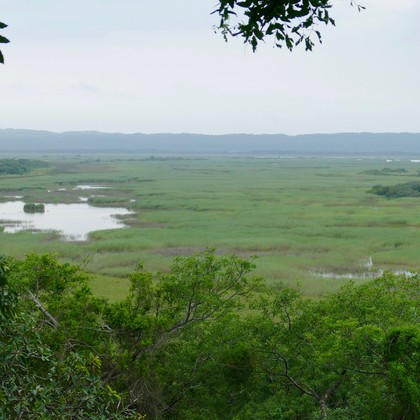
Where the bird is most at home, classified by the vegetation units of southern Africa.

Range and movements
The stronghold is the Namibian coast, especially around Walvis Bay and Swakopmund and near Lüderitz. Smaller numbers breed in southern Angola and in South Africa between Alexander Bay and the Alexandria dunefield in the Eastern Cape, where several former breeding sites have been abandoned. After breeding most birds move to the Gulf of Guinea, from Ghana to Nigeria; birds from the Eastern Cape have recently also been found wintering in southern Mozambique.
- Resident
- Summer visitor (c. Oct–Mar)
- Winter visitor (c. Apr–Sep)
- dark = core range, pale = thinly spread
How and when to look
Best from November to February along the coast between Walvis Bay and Swakopmund, where birds fish in the lagoon and over the surf. Never walk onto gravel plains where birds are alarming: eggs and chicks are well camouflaged and can be trampled or driven over. From April to August the species is almost absent.
Conservation status
Not globally threatened, but with a small total population of a few thousand adult birds. In South Africa it is listed as Endangered, with only a few dozen pairs. The main threats are disturbance and nests being driven over by off-road vehicles, mining and coastal development, and an increase in predators such as jackals and gulls around human activity.
Scientific name
Sternula balaenarum | Strickland, 1853
Strickland described the species in 1853 and placed it straight away in the genus where it still stands. The genus Sternula was introduced in 1822 by Boie. Sternula is a Latin diminutive of Sterna and so means 'little tern'. balaenarum is Latin for 'of the whales', from balaena, 'whale' — for Walvis Bay (Whale Bay) in Namibia, where the species was discovered. The specimen the first description was based on came from Damaraland, Namibia.