All species › Passerines › Waxbills › Cut-Throat Finch
Cut-Throat Finch | Amadina fasciata
Bandvink | Estrilda Degollada
The Cut-Throat Finch owes its name to the crimson band that runs across the male's throat, as if its throat had been slit. It is a stocky, finely barred estrildid of the northern and eastern savannas.

Click a thumbnail to switch the photo above.
Voice
A soft, thin eee-eee-eee and a dry chup in flight. The male's song is a quiet buzzing twitter with low humming notes, delivered with throat and belly feathers fluffed out.
Recording: Richard White — CC BY-NC-SA 4.0 · converted to mono · xeno-canto
Identification
About 12 cm, stocky, with a thick, pale horn-coloured bill. The whole plumage is pale brown to sandy with fine black barring and scaling on head, back and flanks; the wing coverts have pale terminal spots. The male has a striking crimson band across the throat from ear to ear and a chestnut patch in the centre of the belly. The female lacks the throat band and belly patch but has the same fine barring. Young males soon show a narrow, duller red throat band.
Confusion species
The male Red-Headed Finch (Amadina erythrocephala) has a wholly red head and is larger, with bold black-and-white scales on the breast rather than fine barring. The female Red-Headed Finch is greyer, with a plain head and an unbarred back. The female House Sparrow (Passer domesticus) and other sparrows lack the fine barring over the whole body. The Scaly-Feathered Weaver (Sporopipes squamifrons) is smaller, with a pink bill, black malar stripe and scaled forehead.
Habitat
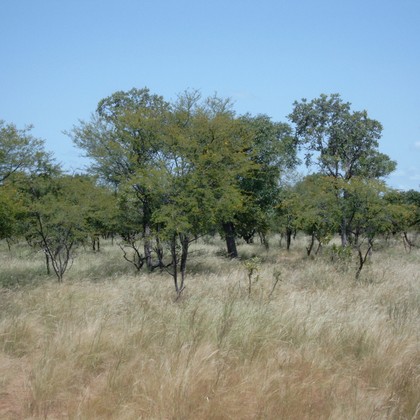
Dry acacia savanna and mixed woodland, often near water, villages and fields; less tied to open, arid plains than the Red-Headed Finch. It feeds on the ground on grass seeds, in flocks outside the breeding season, often with other estrildids and weavers. It breeds in old weaver nests or builds an untidy nest of its own, sometimes in holes or under eaves.
Where the bird is most at home, classified by the vegetation units of southern Africa.

Range and movements
In the north and east of the region: northern Namibia (Owamboland, Kavango and the Zambezi Strip), northern and eastern Botswana, Zimbabwe, Zambia, Malawi and inland Mozambique; in South Africa in Limpopo, Mpumalanga (mainly the Lowveld), North West, Gauteng and northern KwaZulu-Natal; also Eswatini. Scarce and local in Angola. Beyond the region across the savanna belt from Senegal to Ethiopia and south through East Africa.
- Resident
- Summer visitor (c. Oct–Mar)
- Winter visitor (c. Apr–Sep)
- Passage (Mar–Apr, Oct–Nov)
- dark = core range, pale = thinly spread
How and when to look
Look in Kruger, the Limpopo Valley and the Zimbabwean lowveld at waterholes and around camps among flocks of estrildids and sparrows. With females the fine barring over the whole body is decisive: the female Red-Headed Finch is larger, has a plain head and is scaled only on breast and flanks.
Conservation status
Not threatened. Fairly common, but in the south of its range scarcer than the Red-Headed Finch. Trapped for the cage-bird trade, in which the species has long been popular.
Scientific name
Amadina fasciata | (Gmelin, 1789)
Gmelin described the species in 1789 as Loxia fasciata; because it was later moved to another genus, the author and year stand in brackets. The genus Amadina was introduced in 1827 by Swainson. Amadina is a corrupted diminutive of Ammodramus, a genus of American sparrows; Swainson saw the Cut-throat Finch as a link between that genus and Estrilda. fasciata is Latin for 'banded' — for the male's red band across the throat and the fine barring of the plumage. The specimen the first description was based on came from Senegal (designated later).