All species › Woodpeckers and allies › African barbets › Crested Barbet
Crested Barbet | Trachyphonus vaillantii
Bonte baardvogel | Barbudo Crestado
The Crested Barbet is a thickset, short-tailed hole-nester with a yellow-and-red speckled face and a shaggy black crest. Its long monotonous trill is usually heard long before the bird is seen, delivered for minutes on end from a dead branch or a nest box.

Voice
A long, even trill, trrrrrrrrrrrr, sustained for tens of seconds and suggesting an old alarm clock; pairs often trill against one another. Also short nasal grunting notes and a hard tchak when agitated.
Recording: Paul Lynch — CC BY-NC-SA 4.0 · converted to mono · xeno-canto
Identification
Heavily built, about 23 cm, with a short tail and a stout pale bill fringed with bristles. Head and breast are yellow with dense red speckling; a broad black band spotted with white crosses the upper breast, and the crown carries a loose black crest. The wings are black with white speckles, the belly yellow with red-washed flanks, and the rump yellow. The sexes are alike, the female usually duller with less red.
Confusion species
Black-Collared Barbet (Lybius torquatus) has a plain red face bordered with black, no crest and a duetted call. Acacia Pied Barbet (Tricholaema leucomelas) is black and white with a white eyebrow and no yellow at all. The shaggy black crest combined with red-speckled yellow plumage makes the Crested Barbet unmistakable within the region.
Habitat
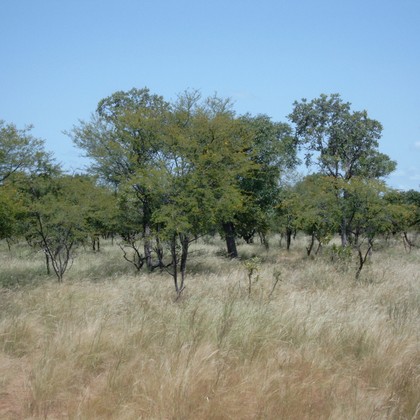
Broadleaved and riverine woodland, thornveld with large trees, parks and suburban gardens. It excavates its own cavity in dead wood, a post top or a fence pole, and readily takes nest boxes, evicting other hole-nesters in the process.
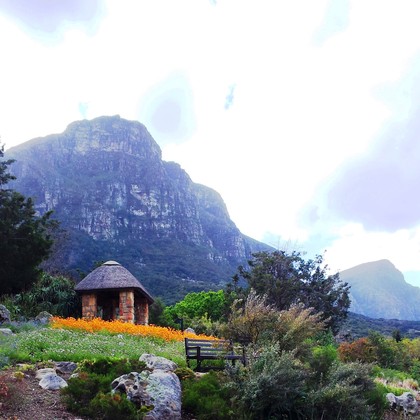
Where the bird is most at home, classified by the vegetation units of southern Africa.
Range and movements
The north-east and north of the region: north-eastern South Africa, Eswatini, Zimbabwe, northern and eastern Botswana, the Zambezi strip of Namibia, Zambia, Malawi, Mozambique and Angola. Absent from the arid western half and from southern South Africa. Beyond the region it reaches southern DR Congo and Tanzania.
- Resident
- Summer visitor (c. Oct–Mar)
- Winter visitor (c. Apr–Sep)
- Passage (Mar–Apr, Oct–Nov)
- dark = core range, pale = thinly spread
How and when to look
Track the trill, which carries best in the early morning, then look for the bird on a bare branch or post top, where it often perches high and in the open. In gardens it comes to fruit and to nest boxes. Breeding runs from September to December, when calling is most persistent.
Conservation status
Not threatened and common. The species benefits from gardens, planted trees and suburban nest boxes and has locally expanded its range as a result. Loss of standing dead wood limits nest sites in places.
Scientific name
Trachyphonus vaillantii | Ranzani, 1821
Ranzani described the species in 1821 and placed it straight away in the genus where it still stands. He introduced the genus Trachyphonus in that same work. Trachyphonus comes from the Greek trachys, 'rough', and phone, 'voice' — for the harsh, rattling call of these barbets. vaillantii honours François Levaillant (1753-1824), the French explorer and ornithologist who was among the first to publish extensively on the birds of southern Africa. The specimen the first description was based on came from south-eastern Cape Province.