All species › Ostriches › Ostriches › Common Ostrich
Common Ostrich | Struthio camelus
Afrikaanse struisvogel | Avestruz Común
The Common Ostrich is the largest and heaviest living bird. It cannot fly but runs faster than any other two-legged animal, up to about 70 km/h, and it is the only bird in the world with two toes on each foot.

Voice
The male gives a deep three-part booming boo-boo-boooh, mainly at night and in the early morning, carrying for kilometres and suggesting a distant lion. In threat both sexes hiss and growl with the bill gaping; chicks call in high whistles.
Recording: Michael Chiappone — CC BY-NC-SA 4.0 · converted to mono · xeno-canto
Identification
A flightless giant standing 175 to 275 cm tall, with a long bare neck, a small flat head and very large eyes. The male is black with white primaries and white tail plumes; neck and legs are blue-grey, turning pink to red in the breeding season. Females and immatures are uniformly grey-brown with off-white wing edges. The broad wings serve for display, for steering at speed and for shading the chicks. Each foot carries two toes, the inner one with a heavy nail.
Confusion species
No confusion is possible within the region: no other bird in southern Africa reaches this size or walks on two toes. The Somali Ostrich (Struthio molybdophanes), with blue-grey neck and legs, occurs only in the Horn of Africa.
Habitat
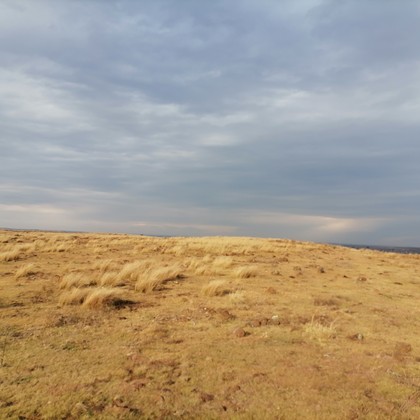
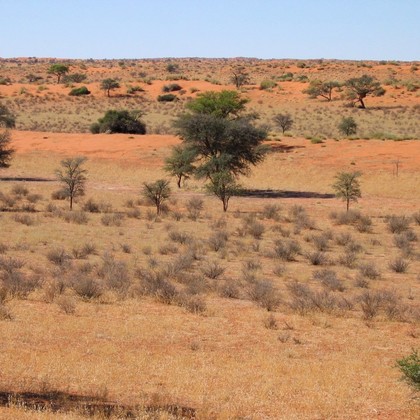
Open, short-grown country: semi-desert, arid savanna, grassy plains, Karoo, Kalahari sandveld, the fringes of the Namib and coastal flats. Dense woodland and tall scrub are avoided; the species needs a long view.
Where the bird is most at home, classified by the vegetation units of southern Africa.

Range and movements
Mainly in the dry west and north of the region: Namibia, Botswana, southern Angola, Zimbabwe and northern and western South Africa, with the largest numbers in the Kalahari, the Karoo, Etosha and Kruger. In southern South Africa many birds descend from the feather-farming stock around Oudtshoorn. Beyond the region it ranges across the savannas and steppes of sub-Saharan Africa, north to the Sahel.
- Resident
- Summer visitor (c. Oct–Mar)
- Winter visitor (c. Apr–Sep)
- Passage (Mar–Apr, Oct–Nov)
- dark = core range, pale = thinly spread
How and when to look
Early morning and late afternoon on open plains; the black-and-white male can be picked up with binoculars kilometres away. Listen for the booming at night, at its peak from August to January. Note broods trailing a single pair: they often contain young of several females, since different hens lay in the same scrape and the male incubates by night, the female by day.
Conservation status
Assessed globally as of least concern. The range is vast, but the genuinely wild population is fragmented by stock fencing, hunting and the conversion of plains to cropland. In many areas escaped or released farm birds interbreed with wild stock, altering the genetic make-up of local populations.
Scientific name
Struthio camelus | Linnaeus, 1758
Linnaeus described the species in 1758 and placed it straight away in the genus where it still stands. He introduced the genus Struthio in that same work. Struthio is Latin for 'ostrich', from the Greek strouthion, itself derived from strouthokamelos, literally 'camel-sparrow' — an ancient Greek name for the ostrich. camelus is Latin for 'camel'; the Greeks called the ostrich strouthokamelos, 'camel-sparrow', for its long neck, two-toed feet and desert life, features reminiscent of a camel. The specimen the first description was based on came from Sennar, Sudan.