All species › Cranes, rails and allies › Rails and crakes › Common Moorhen
Common Moorhen | Gallinula chloropus
Waterhoen | Gallineta Común
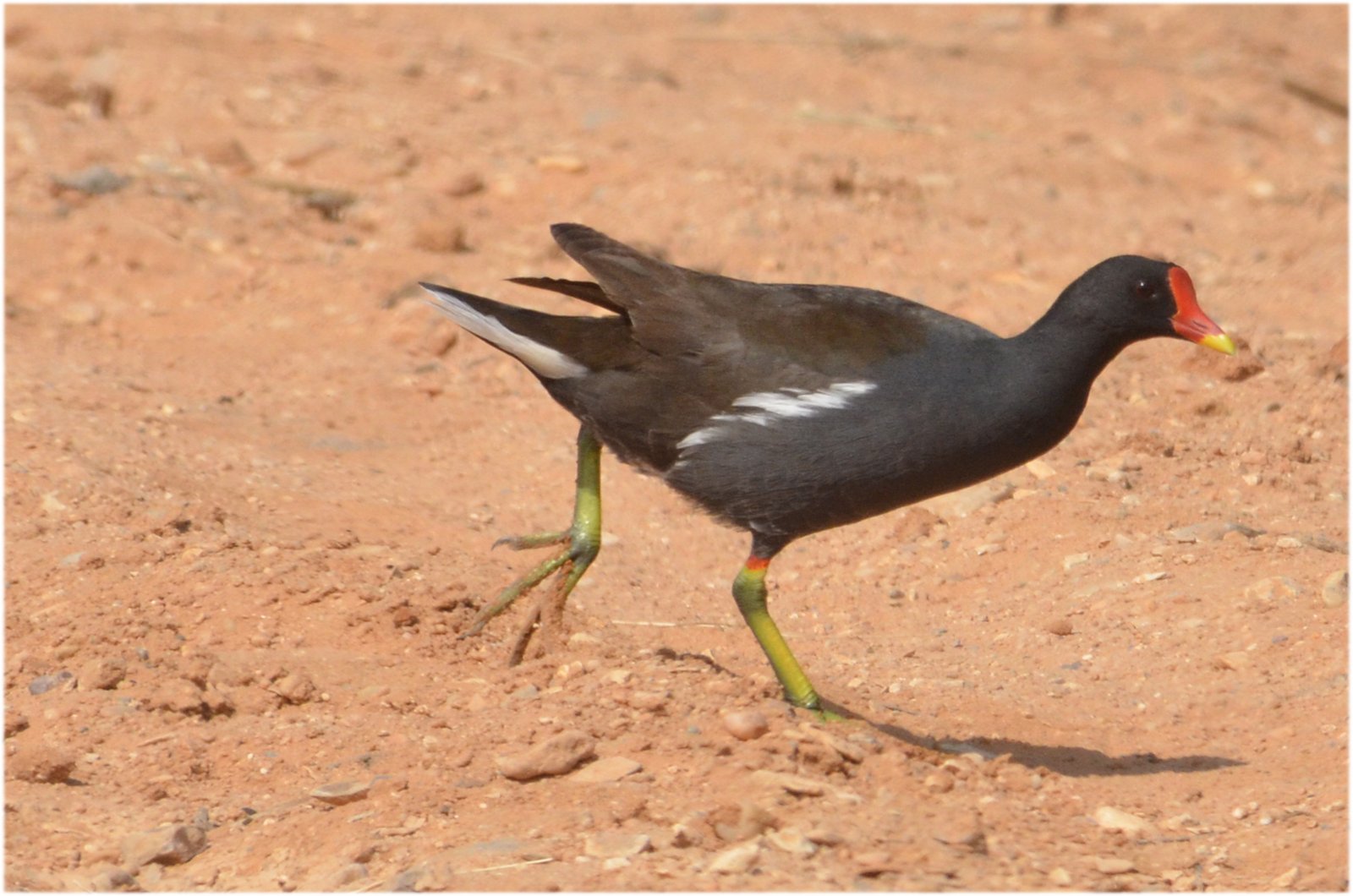
The Common Moorhen is the best-known rail of southern Africa: a dark, head-bobbing swimmer with a red frontal shield, found on almost every dam and pond with fringing vegetation. It is much less shy than most rails and also feeds openly on lawns by the water.
Voice
A loud, sudden, bubbling krrrrk or kurruk, also a sharp kittik and a string of ticking alarm calls. It calls by day and night, at night sometimes also in flight.
Recording: African Bioacoustics Community — CC BY-NC-SA 4.0 · converted to mono · xeno-canto
Identification
About 33 cm. The bill is red with a yellow tip and merges into a rounded red frontal shield. The head, neck and underparts are slate-grey to blackish, the back dark olive-brown. A broad white stripe along the flank and a white undertail with a black centre stand out, especially when the bird flicks its tail. The legs are greenish yellow with a red 'garter' above the tarsal joint, and the long toes are unwebbed. The sexes are alike. Juveniles are greyish brown with a pale throat, a dull white flank stripe and a greenish-brown bill.
Confusion species
The Lesser Moorhen (Paragallinula angulata) is clearly smaller and slimmer, with an almost entirely yellow bill with only a red ridge and a small pointed shield, and a narrower flank stripe. The Red-Knobbed Coot (Fulica cristata) is larger and wholly black with a white bill and shield, and has lobed toes. Allen's Gallinule (Porphyrio alleni) and the Purple Swamphen (Porphyrio porphyrio) are purple-blue and green with a red bill and red legs, without a white flank stripe.
Habitat
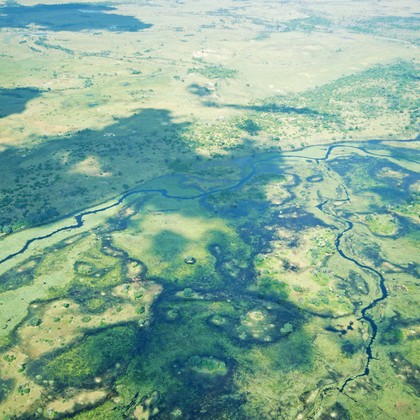
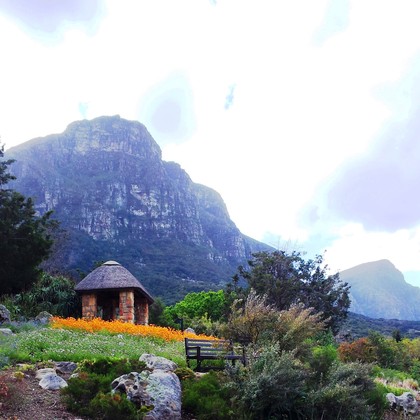
Almost any fresh water with dense fringing vegetation: dams, lakes, vleis, slow rivers, sewage works and park ponds, including in towns. It swims, walks over floating plants and grazes on banks and lawns. It eats water plants, seeds, fruit, insects, snails and worms. The nest lies among reeds or on a floating platform.
Where the bird is most at home, classified by the vegetation units of southern Africa.
Range and movements
Across almost the whole region wherever permanent fresh water with fringing vegetation occurs: commonest in South Africa, Lesotho, Eswatini, Zimbabwe and eastern Botswana, and further in Namibia, Zambia, Malawi, Mozambique and Angola. Scarce in the driest parts of the Namib, the Kalahari and the Karoo, except at dams. Beyond the region across much of Africa, Europe and Asia.
- Resident
- Summer visitor (c. Oct–Mar)
- Winter visitor (c. Apr–Sep)
- Passage (Mar–Apr, Oct–Nov)
- dark = core range, pale = thinly spread
How and when to look
All year on any dam with reeds or bulrushes, often also on town ponds and golf courses. With smaller moorhens showing a yellow bill, check carefully for Lesser Moorhen, especially in summer in the north. Juveniles in their dull plumage are sometimes mistaken for another rail.
Conservation status
Not threatened and common. The species has benefited greatly from farm dams, reservoirs and sewage works. There are local losses through the draining of vleis, pollution and predation by cats and dogs around towns, but the overall population is stable.
Scientific name
Gallinula chloropus | (Linnaeus, 1758)
Linnaeus described the species in 1758 as Fulica Chloropus; because it was later moved to another genus, the author and year stand in brackets. The genus Gallinula was introduced in 1760 by Brisson. Gallinula is Latin for 'little hen', a diminutive of gallina 'hen'. chloropus combines Greek khlōros 'green' and pous 'foot', for the greenish legs. The specimen the first description was based on came from England.