All species › Waders, gulls and terns › Buttonquails › Common Buttonquail
Common Buttonquail | Turnix sylvaticus
Gestreepte vechtkwartel | Torillo Andaluz
The Common Buttonquail, known in the region as Kurrichane Buttonquail, is a small, quail-like bird of grassland and savanna that is nearly always seen only when it flushes at one's feet. Buttonquails are not gamebirds but relatives of the waders, and sex roles are reversed: the larger, brighter female calls and displays while the male incubates and raises the young.

Voice
The female gives a low, hollow, far-carrying hoot, hoooo-hoooo-hoooo, like a distant foghorn, often at dusk or at night; the direction of the sound is unclear. Flushed birds are usually silent.
Recording: Campbell Fleming — CC BY-NC-SA 4.0 · converted to mono · xeno-canto
Identification
14–15 cm, with a rounded body, a very short tail and only three toes. The upperparts are warm brown, finely scaled and streaked with black and cream; the breast is orange-buff with bold round black spots on the sides, and the belly white. The pale, whitish eye in a pale, finely streaked head is distinctive. The bill is slender and bluish grey, the legs flesh-coloured. The female is larger and brighter orange on the breast than the male. It flies low and briefly on whirring wings: the pale sandy wing coverts contrast with the dark flight feathers, and the back and rump are brown, not black.
Confusion species
Black-Rumped Buttonquail Turnix nanus has a dark eye, a rufous-orange face and throat, and shows a blackish back and rump in flight. Common Quail Coturnix coturnix and Harlequin Quail Coturnix delegorguei are larger, with longer, more pointed wings and a stronger, straighter flight over greater distance; they lack the black breast spots and pale eye.
Habitat
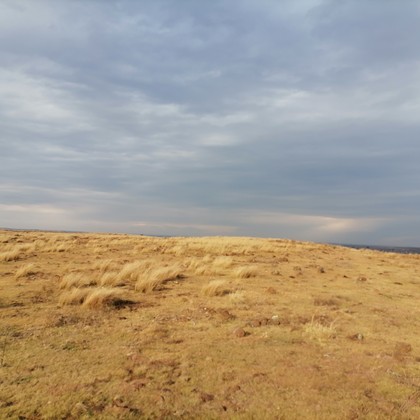
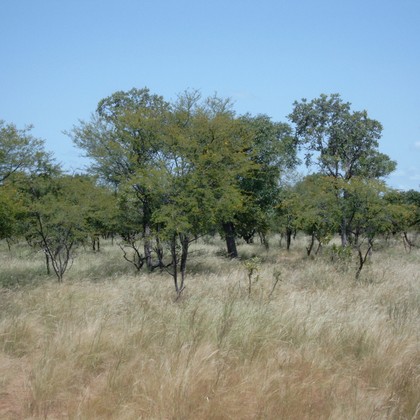
Grassland, open savanna and woodland with a dense grass layer, fallow fields and the margins of cultivation, often in long grass after good rains. It lives secretively on the ground, eating seeds and insects that it scratches out of the litter, leaving small round scrapes. The nest is a scrape under a grass tuft; at twelve to thirteen days, incubation is one of the shortest of any bird.
Where the bird is most at home, classified by the vegetation units of southern Africa.

Range and movements
Widespread in Angola, Zambia, Malawi, Mozambique, Zimbabwe, northern and eastern Botswana and northern and central Namibia. In South Africa mainly in the north and east (Limpopo, Mpumalanga, Gauteng, North West, KwaZulu-Natal and the eastern Free State), and in Eswatini; absent from the Western Cape, the Karoo and the driest parts of the west. Beyond the region across much of sub-Saharan Africa and in South and South-East Asia; the European population in southern Spain is regarded as extinct.
- Resident
- Summer visitor (c. Oct–Mar)
- Winter visitor (c. Apr–Sep)
- Passage (Mar–Apr, Oct–Nov)
- dark = core range, pale = thinly spread
How and when to look
After the rains walk slowly through long grass or fallow land in the bushveld; a flushed bird usually lands after twenty to fifty metres and then runs on. After it lands, watch the edge of the cover rather than the landing spot. At dusk the low hooting of the female gives its presence away.
Conservation status
Not threatened; globally one of the most widespread buttonquails, although the species has lost its last population in Europe. Common but inconspicuous in the region, with strong fluctuations that follow rainfall. Heavy grazing and conversion of grassland to cropland reduce habitat locally.
Scientific name
Turnix sylvaticus | (Desfontaines, 1789)
Desfontaines described the species in 1789 as Tetrao sylvaticus; because it was later moved to another genus, the author and year stand in brackets. The genus Turnix was introduced in 1791 by Bonnaterre. Turnix is an abbreviation of the genus name Coturnix, the Latin word for 'quail'. sylvaticus is Latin for 'of the woods', from silva 'wood'. The specimen the first description was based on came from near Algiers.