All species › Passerines › Vangas and helmetshrikes › Chestnut-Fronted Helmetshrike
Chestnut-Fronted Helmetshrike | Prionops scopifrons
Stekelkopklauwier | Prionopo Frentirrufo
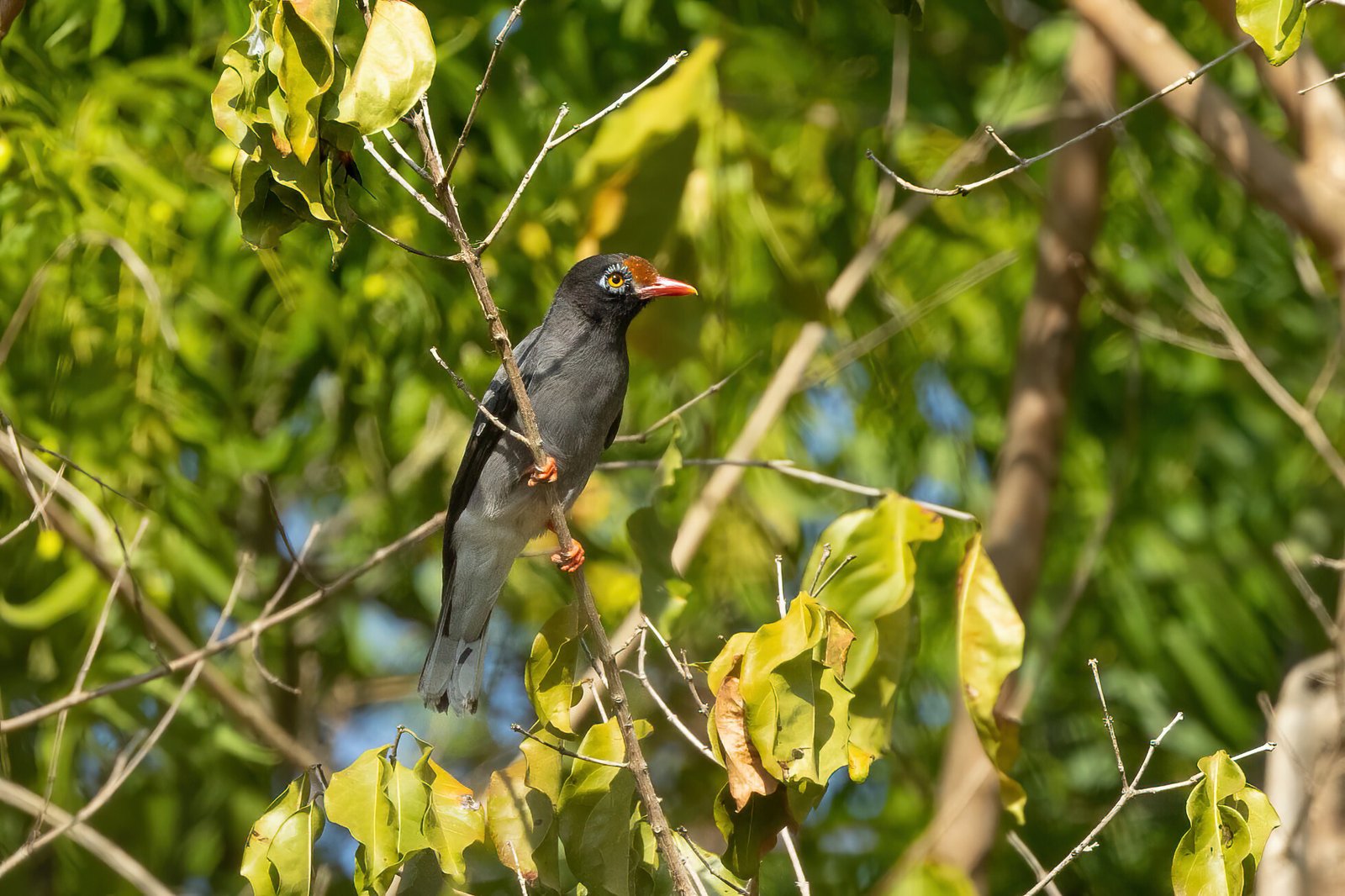
Chestnut-Fronted Helmetshrike is the smallest and least conspicuous helmetshrike of the region: grey with a white belly and a forehead of stiff, chestnut bristly feathers. It lives in groups in the canopy of Mozambique's lowland forest and is often overlooked until the group passes with chatter and bill-snapping. In southern Africa it is a scarce, little-known bird.
Voice
Groups keep contact with a soft, harsh chattering and fast, rolling calls such as cher-cher-cher, mixed with bill-snapping. The calls are thinner and less loud than those of the other helmetshrikes.
Recording: Louis A. Hansen — CC BY-NC-SA 4.0 · converted to mono · xeno-canto
Identification
18–19 cm. The forehead carries a dense pad of stiff, chestnut bristly feathers, set against a silvery-grey crown and white lores. Nape, back and scapulars are slate-grey, the wings blackish with a white patch at the base of the primaries that shows in flight. The tail is black with white tips to the outer feathers. Throat and breast are grey, the belly and undertail coverts white. An orange-red wattle surrounds the yellow eye; the bill is dark and the legs orange-red. The sexes are alike. Juveniles lack the chestnut forehead and the wattle.
Confusion species
White-Crested Helmetshrike Prionops plumatus is larger and black and white, with a white crest, black ear patch and white collar. Retz's Helmetshrike Prionops retzii is larger and black with a red bill. Black-Headed Oriole Oriolus larvatus and cuckooshrikes also move through the canopy, but do not live in close-knit, noisy groups and have no bristly forehead.
Habitat
Lowland and coastal forest, dry evergreen forest and tall, closed miombo and riverine forest. It forages in the canopy, where groups move quickly from tree to tree picking insects, caterpillars and spiders from leaves and twigs; it often joins mixed foraging flocks.
Where the bird is most at home, classified by the vegetation units of southern Africa.


Range and movements
Within the region only in Mozambique: in the lowlands of the north and centre, from the Rovuma south to about the Save, with known sites around Beira, Dondo and Inhamitanga. Beyond, along the east coast of Africa, through Tanzania to southern Kenya.
- Resident
- Summer visitor (c. Oct–Mar)
- Passage (Mar–Apr, Oct–Nov)
- dark = core range, pale = thinly spread
How and when to look
Year-round, but scarce and unpredictable. The coastal forest around Inhamitanga and the forests near Beira and Gorongosa offer the best chance. Walk a forest edge and watch for a group of grey birds moving through the canopy with bill-snapping; view them from below, where the wattle and chestnut forehead show best.
Conservation status
Not threatened, but locally scarce. In Mozambique the species depends on lowland and coastal forest, which is becoming heavily fragmented by farming, logging and charcoal production. Forest loss is the main threat here.
Scientific name
Prionops scopifrons | (Peters, 1854)
Peters described the species in 1854 as Sigmodus scopifrons; because it was later moved to another genus, the author and year stand in brackets. The genus Prionops was introduced in 1816 by Vieillot. Prionops comes from the Greek priōn, 'saw', and ōps, 'eye' — probably for the serrated eye-wattle or the stiff forehead feathers. scopifrons comes from the Latin scopae, 'broom', and frons, 'forehead' — for the stiff, bristly forehead feathers. The specimen the first description was based on came from Mozambique.