All species › Passerines › Larks › Chestnut-Backed Sparrow-Lark
Chestnut-Backed Sparrow-Lark | Eremopterix leucotis
Bruinrugvinkleeuwerik | Terrera Orejiblanca
The Chestnut-Backed Sparrow-Lark is the sparrow-lark of the savanna: a small, stocky lark that shuffles in small groups over bare or recently burnt ground. The male combines a black head and underparts with white patches on the cheek and nape and a warm chestnut back. It has the largest range of all the sparrow-larks, reaching the Sahel.

Voice
A short, dry chip-chip or cheep-chwerr, often given in flight. The song is a simple, repeated whistled phrase, delivered in an undulating song flight with slow wingbeats, after which the male drops steeply.
Recording: Andrew Spencer — CC BY-NC-SA 4.0 · shortened to the first 60 s, mono · xeno-canto
Identification
12–13 cm. Thick, pale finch-like bill. The male has a black head, throat and underparts, a large white cheek patch and a white or greyish-white nape patch; the crown is black, without a white spot. The back, scapulars and wing-coverts are bright chestnut. The female is brown and streaked, with chestnut wing-coverts, a pale cheek bordered by a dark line, and a black patch in the centre of the belly. In flight the underwings are dark.
Confusion species
Grey-Backed Sparrow-Lark Eremopterix verticalis has a grey back without chestnut and a white spot in the centre of the crown; it lives further west and south in the Karoo and Kalahari. Black-Eared Sparrow-Lark Eremopterix australis lacks any white on the head. Fischer's Sparrow-Lark Eremopterix leucopareia of East Africa has a brown crown and a grey-brown back. The female differs from Red-Capped Lark Calandrella cinerea by its thick bill and black belly patch.
Habitat
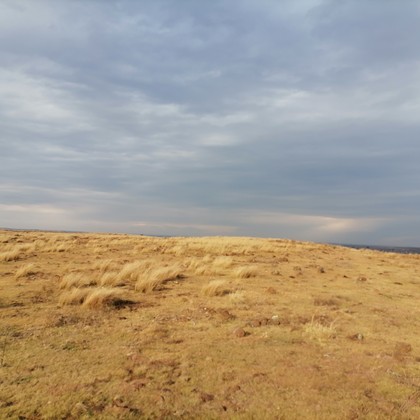
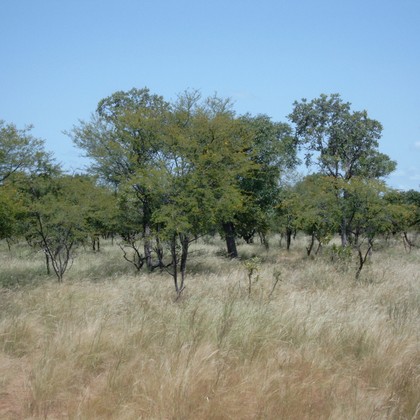
Open short grassland and bare patches in savanna and thornveld, overgrazed flats, the edges of pans and vleis, freshly burnt fields and fallow land. It favours places with plenty of bare ground and forages in small groups on the ground for seeds and insects.
Where the bird is most at home, classified by the vegetation units of southern Africa.

Range and movements
Within the region in southern and western Zambia, locally in Malawi, Zimbabwe, northern and eastern Botswana, northern Namibia (Etosha, Caprivi), southern Angola, southern Mozambique and northern South Africa (Limpopo, North West, Gauteng and the northern Free State). Beyond, from Tanzania and Kenya north to Ethiopia and west through the Sahel to Senegal.
- Resident
- Summer visitor (c. Oct–Mar)
- Winter visitor (c. Apr–Sep)
- Passage (Mar–Apr, Oct–Nov)
- dark = core range, pale = thinly spread
How and when to look
Year-round, but highly nomadic and dependent on fire and grazing. The best chance is on freshly burnt or heavily grazed flats in the dry season, and around the pans of Etosha and the Makgadikgadi. Scan groups on the ground: the male, with its chestnut back and black head, is instantly recognisable.
Conservation status
Not threatened; widespread and locally common. Overgrazing and fire create suitably open ground for this species, although intensive cultivation can remove habitat.
Scientific name
Eremopterix leucotis | (Stanley, 1814)
Stanley described the species in 1814 as Loxia leucotis; because it was later moved to another genus, the author and year stand in brackets. The genus Eremopterix was introduced in 1836 by Kaup. Eremopterix comes from the Greek erēmos, 'desert', and pterux, 'wing' — birds of dry, open country. leucotis comes from the Greek leukos, 'white', and ous (ōtos), 'ear' — for the male's white ear patch. The specimen the first description was based on came from Ethiopia (not further specified).