All species › Tubenoses › Petrels and shearwaters › Cape Verde Petrel
Cape Verde Petrel | Pterodroma feae
Gon-gon | Petrel Gon-gon
The Cape Verde Petrel is a medium-sized grey-and-white Pterodroma that breeds only on the Cape Verde Islands; its local name gon-gon comes from its call at the colony. In southern Africa it is an extremely rare vagrant, and any sighting needs careful documentation.
Voice
Silent at sea. At the colony at night a plaintive, wailing gon-gon, from which the species takes its local name.
Recording: Nicolas Martinez — CC BY-NC-SA 4.0 · converted to mono · xeno-canto
Identification
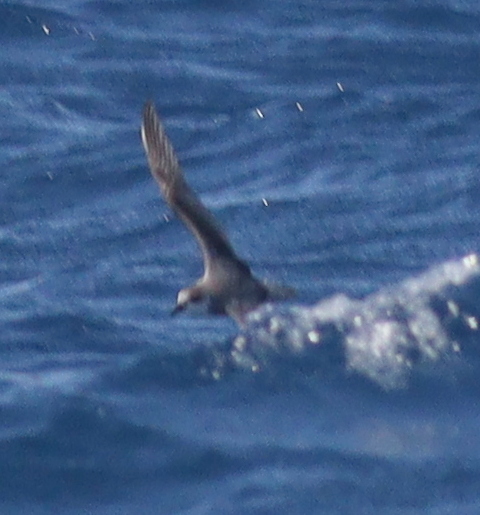
About 35 cm, slim, with long wings and a fairly heavy black bill. The upperparts are grey with a dark M-pattern across the wings; the rump and tail are paler grey and contrast with the dark primaries. Crown and hindneck are grey, with a blackish mask around and below the eye. The underparts are white, with at most a grey patch on the side of the breast. The underwing is almost wholly dark grey-brown. The legs are flesh-coloured with dark toes. The sexes and ages are alike. It flies fast, with high arcs and short bursts of wingbeats.
Confusion species
Soft-Plumaged Petrel (Pterodroma mollis) is the main pitfall: it usually has a grey breast band, darker and less contrasting upperparts, a dark tail and a slightly slimmer bill. Barau's Petrel (Pterodroma baraui) of the Indian Ocean has a white underwing with dark margins. White-Headed Petrel (Pterodroma lessonii) is larger, with a white head.
Habitat
Deep, warm open ocean, especially over seamounts and in areas of upwelling cool water. It feeds mainly on squid and small fish, picked from the surface at night. It breeds in burrows and rock crevices on steep mountain slopes of the Cape Verde Islands.
Where the bird is most at home, classified by the vegetation units of southern Africa.
Range and movements
In the region only a handful of records of birds far out at sea in the Atlantic waters off the west coast; because the similar Soft-Plumaged Petrel is common here, every case is uncertain. The species breeds only on the Cape Verde Islands and outside the breeding season ranges through the tropical and subtropical Atlantic, as far as off West Africa and Brazil.
How and when to look
There is no site where this species can be expected. On pelagic trips off the west coast, watch for a Soft-plumaged-like bird without a breast band, with a pale grey rump and tail contrasting with dark wings, and photograph the upper and lower sides as fully as possible.
Conservation status
Near Threatened, with a small world population of at most a few thousand pairs. The colonies are threatened by the harvesting of chicks and adults for food, by cats and rats, and by disturbance of the breeding slopes. On some islands the colonies are guarded.
Scientific name
Pterodroma feae | (Salvadori, 1899)
Salvadori described the species in 1899 as Oestrelata feae; because it was later moved to another genus, the author and year stand in brackets. The genus Pterodroma was introduced in 1856 by Bonaparte. Pterodroma is Greek, from pteron 'wing' and dromos 'runner', after the fast, sweeping flight. feae honours the Italian zoologist Leonardo Fea (1852–1903), who collected in the Cape Verde Islands. The specimen the first description was based on came from São Nicolau, Cape Verde.