All species › Tubenoses › Petrels and shearwaters › Bulwer's Petrel
Bulwer's Petrel | Bulweria bulwerii
Bulwers stormvogel | Petrel de Bulwer
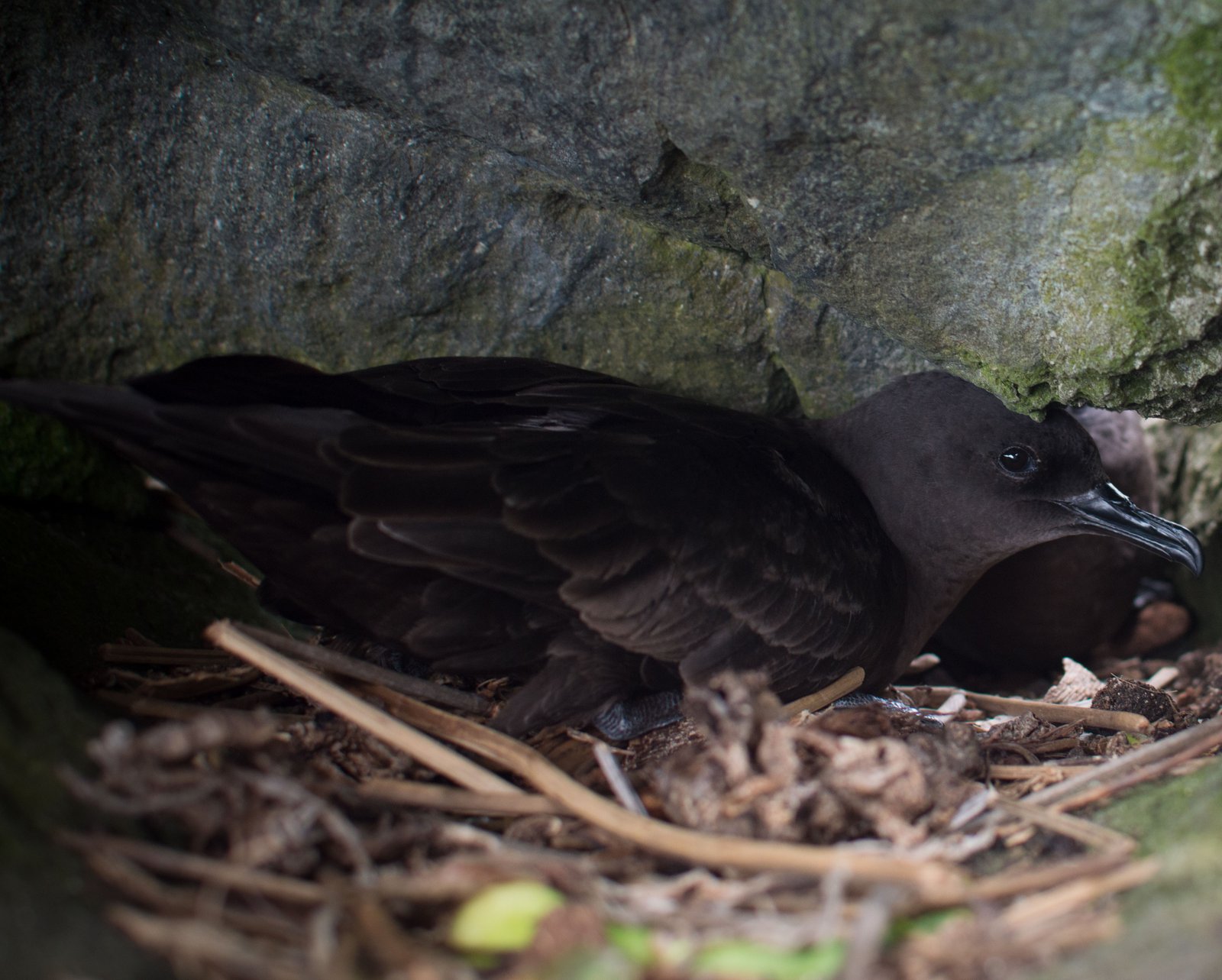
Bulwer's Petrel is a small, wholly dark petrel of tropical oceans, with long wings and a long, wedge-shaped tail. It has been recorded in southern Africa only a handful of times and ranks among the great rarities at sea.
Voice
Silent at sea. At the colony at night a low, repeated barking or knocking hroo-hroo-hroo, from burrows and rock crevices.
Recording: Marcel Gil Velasco — CC BY-NC-SA 4.0 · converted to mono · xeno-canto
Identification
26–28 cm, slim, with long, narrow wings and a long tail usually held closed and pointed in flight. Wholly dark chocolate-brown, with a paler, brown-grey diagonal bar across the upperwing along the greater coverts. The underwing is dark. The short, thick bill is black; the legs are pink with dark toes. Sexes and ages are alike. It flies low and buoyantly over the waves, with supple wingbeats and short glides, more agile than a shearwater and larger than a storm petrel.
Confusion species
Jouanin's Petrel (Bulweria fallax) of the north-western Indian Ocean is larger and more heavily built, with a stouter bill and hardly any pale wing bar. Dark storm petrels such as Band-Rumped Storm Petrel Hydrobates castro and Leach's Storm Petrel Hydrobates leucorhous are smaller and have a white rump. Kerguelen Petrel Aphrodroma brevirostris is greyer, with a bigger head and a short tail, and flies high in arcs.
Habitat
Warm, deep ocean waters far offshore, away from the continental shelf. It feeds at night mainly on small fish, squid and crustaceans that rise to the surface. It breeds in burrows and crevices on rocky oceanic islands.
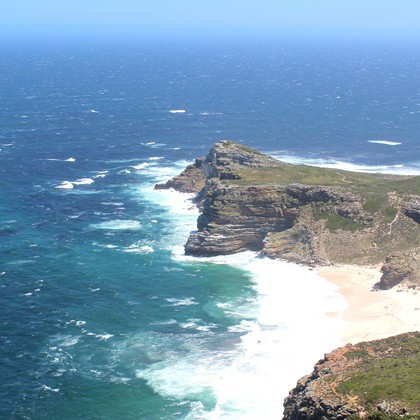
Where the bird is most at home, classified by the vegetation units of southern Africa.
Range and movements
In the region only a few accepted records off South Africa; there are almost no data from the warm waters off Mozambique and Angola. It breeds on islands in the subtropical Atlantic (Azores, Madeira, Salvages, Canary Islands, Cape Verde) and in the Pacific (from Japan and China to Hawaii and the Marquesas). Atlantic birds winter mainly in the tropical Atlantic as far as off Brazil; in the Indian Ocean the species is rare.
How and when to look
There is no site where this species can be found reliably. The best chance is on deep-water trips over warm water, for example in summer far off KwaZulu-Natal or in the Agulhas Current. Check every small dark petrel with a long tail and no white rump, and photograph the wing bar and tail shape.
Conservation status
Not threatened, with a large world population. Introduced rats and cats are the main threat at the colonies; they have been controlled on several islands, and numbers are increasing at some breeding sites.
Scientific name
Bulweria bulwerii | (Jardine & Selby, 1828)
Jardine & Selby described the species in 1828 as Procellaria bulwerii; because it was later moved to another genus, the author and year stand in brackets. The genus Bulweria was introduced in 1843 by Bonaparte. Bulweria was formed from the specific name bulwerii and so honours the same man, James Bulwer. bulwerii honours the English clergyman, artist and naturalist James Bulwer (1794–1879), who collected the type specimen on Madeira. The specimen the first description was based on came from Madeira.