All species › Waders, gulls and terns › Sandpipers and snipes › Buff-Breasted Sandpiper
Buff-Breasted Sandpiper | Calidris subruficollis
Blonde ruiter | Correlimos Canelo
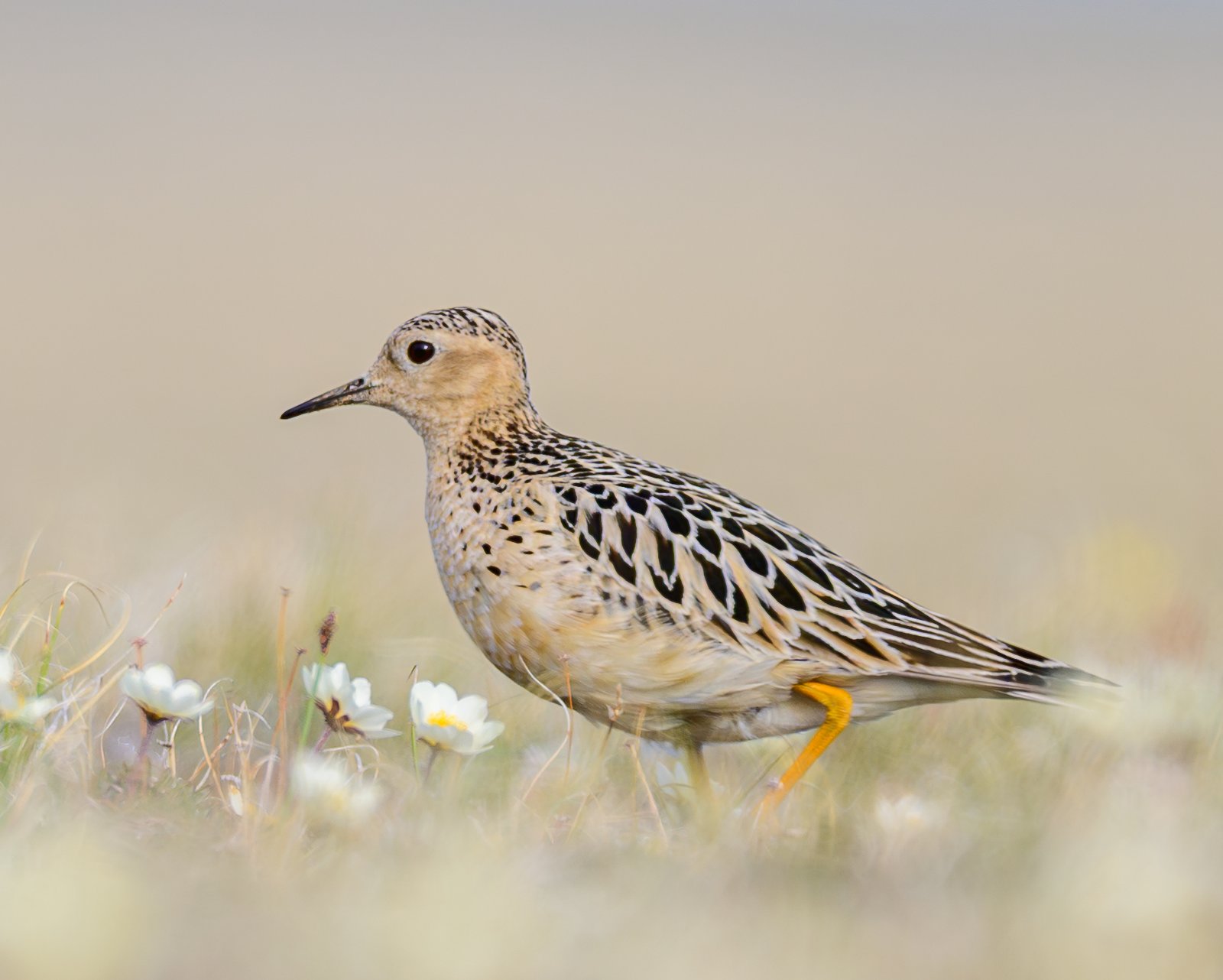
The Buff-Breasted Sandpiper is a plover-like sandpiper with a small round head, a short black bill, yellow legs and plain warm buff underparts. It breeds on the Arctic tundra of Alaska and Canada and winters on the pampas of South America; in southern Africa it is a very rare vagrant, usually on short grass near water.
Voice
Usually silent; sometimes a soft, low prrit or a ticking tik in flight.
Recording: Paul Kelly — CC BY-NC-SA 4.0 · converted to mono · xeno-canto
Identification
18–20 cm. Dark above with broad, warm buff feather fringes, giving a crisply scaled pattern, especially in juveniles. Face and underparts are plain buff and unstreaked; the large dark eye stands out in the pale, gentle face. The bill is short, thin and black; the legs are bright ochre-yellow. In flight there is no wingbar or white rump, but a striking white underwing with a dark crescent at the base of the primaries. It walks upright like a plover and picks food from the ground.
Confusion species
Ruff Calidris pugnax, especially a juvenile female, is larger, has a longer bill, often with a pale base, and in flight shows white oval patches on the tail base. Upland Sandpiper Bartramia longicauda is larger, with a long thin neck, a long tail and a streaked breast. Pectoral Sandpiper Calidris melanotos has a heavily streaked, sharply demarcated breast.
Habitat
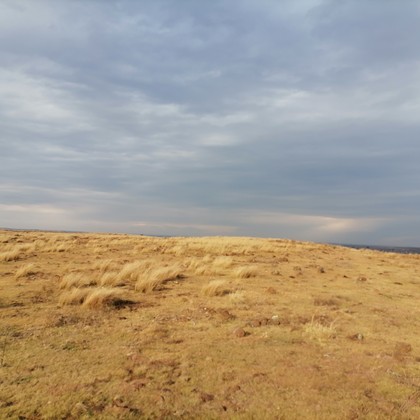
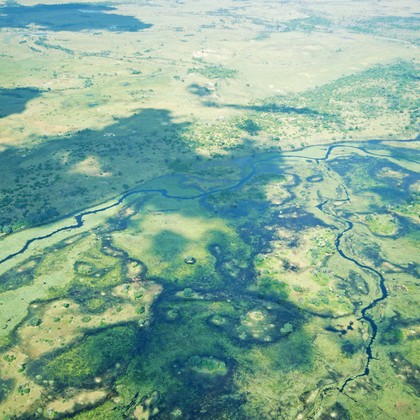
Short grassland, mown fields, airfield grass and dry, closely grazed margins of pans and dams, rather than the water itself. It feeds by walking quietly and picking like a plover, alone or among Ruffs and plovers.
Where the bird is most at home, classified by the vegetation units of southern Africa.
Range and movements
Only a few records in the region, mainly in South Africa and Zambia. Beyond the region it breeds in North America and winters in Argentina, Uruguay and southern Brazil; as a vagrant also elsewhere in Africa and regularly in western Europe.
How and when to look
A very rare find: check dry, short-grazed shores and fields near pans and sewage ponds where Ruffs feed for a smaller, plain buff bird with a round head and yellow legs. A bird approached quietly often allows close views.
Conservation status
Vulnerable: the world population is small and declining through the loss of natural grassland on the migration route and in the South American wintering areas, and possibly through changes on the tundra. The vagrants in southern Africa have no bearing on the population.
Scientific name
Calidris subruficollis | (Vieillot, 1819)
Vieillot described the species in 1819 as Tringa subruficollis; because it was later moved to another genus, the author and year stand in brackets. The genus Calidris was introduced in 1804 by Merrem. Calidris goes back to Ancient Greek kalidris or skalidris, a name Aristotle used for an unidentified grey waterside bird. subruficollis joins Latin subrufus 'reddish' — from sub 'somewhat' and rufus 'rufous' — to collum 'neck'. The specimen the first description was based on came from Paraguay.