All species › Gannets and cormorants › Gannets and boobies › Brown Booby
Brown Booby | Sula leucogaster
Bruine gent | Piquero Pardo
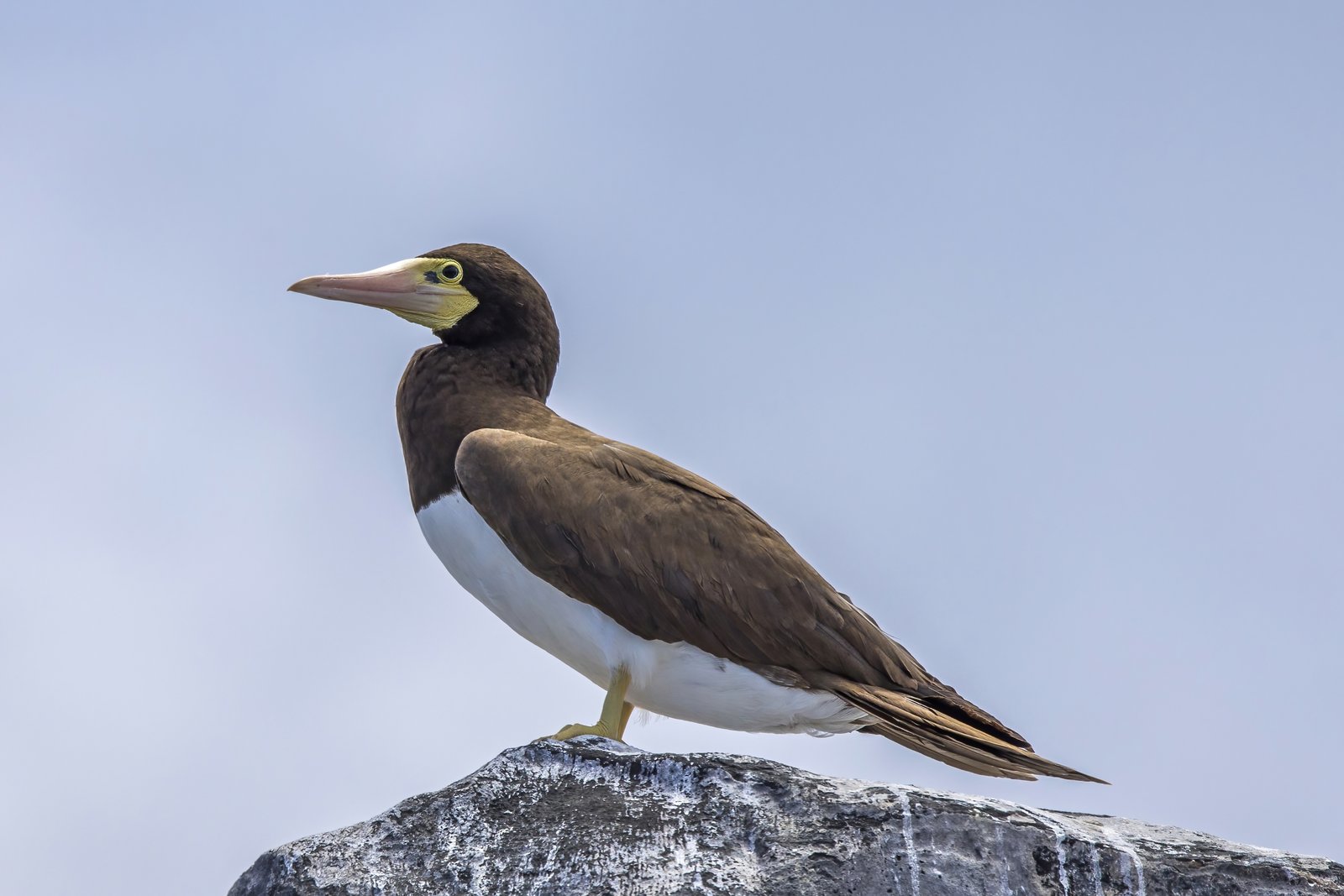
The Brown Booby is the most widespread booby of tropical seas, chocolate-brown with a sharply demarcated white belly. In the region it is a rare visitor that turns up on both the east coast and the cool west coast, and sometimes joins Cape Gannets.
Voice
Mostly silent at sea. The sexes differ: males give a high, hissing whistle, females a loud, hoarse kwaak or honk.
Recording: JAYRSON ARAUJO DE OLIVEIRA — CC BY-NC-SA 4.0 · converted to mono · xeno-canto
Identification
64–85 cm long, wingspan 132–150 cm. Head, neck, breast and upperparts are uniform dark chocolate-brown, sharply cut off from the white belly; the underwing has a white central panel with broad brown borders. Bill and feet are yellowish. In the male the bare skin around the eye is bluish, in the female yellow; the female is larger. Juveniles are duller brown with a dingy, mottled brown belly and grey bill, but already show a faint breast demarcation.
Confusion species
Young Cape Gannets (Morus capensis) are larger, wholly dark with white speckles, and have a blue-grey bill. The brown morph of Red-Footed Booby (Sula sula) is wholly brown with no white belly and has red or grey feet. Its clean two-tone pattern makes an adult Brown Booby unmistakable.
Habitat
Warm inshore waters and open sea, more coastal than other tropical boobies. Roosts on buoys, wrecks, rocks and ships. Dives at a shallow angle on shoals of small fish. Breeds on the ground on bare islands and cliffs.
Where the bird is most at home, classified by the vegetation units of southern Africa.

Range and movements
Within the region a rare visitor off the coasts of Mozambique and KwaZulu-Natal, and very rare on the west coast: a few records in Namibia and on Bird Island at Lambert's Bay, where two birds stayed in 2023–2024. Beyond the region it breeds on tropical islands around the world, in the Atlantic among others in the Cape Verde Islands, on Ascension and in the Gulf of Guinea, and in the western Indian Ocean on islands off Tanzania and in the Seychelles.
How and when to look
Check buoys, harbour piers and rocky points along the Mozambique coast, and the Cape Gannet colonies on the west coast; a Brown Booby joining the Cape Gannets stands out at once among the white birds.
Conservation status
Not globally threatened, although the population is declining because of introduced predators on breeding islands, disturbance, bycatch and overfishing of prey fish.
Scientific name
Sula leucogaster | (Boddaert, 1783)
Boddaert described the species in 1783 as Pelecanus Leucogaster; because it was later moved to another genus, the author and year stand in brackets. The genus Sula was introduced in 1760 by Brisson. Sula goes back to súla, the Old Norse and Icelandic word for the gannet; the name passed to the boobies. leucogaster is Greek, from leukos 'white' and gastēr 'belly', after the white underparts. The specimen the first description was based on came from Cayenne, French Guiana.