All species › Passerines › Chats and flycatchers › Brown-Backed Scrub Robin
Brown-Backed Scrub Robin | Cercotrichas hartlaubi
Bruinrugwaaierstaart | Alzacola de Hartlaub
The Brown-Backed Scrub Robin is a scrub robin of forest edges and rank, moist savanna in central Africa, which within the region occurs only in Angola. It closely resembles White-Browed Scrub Robin but has a plain warm brown back and an almost unstreaked breast.

Voice
The song is a loud, repeated series of short, clear whistled phrases, similar to that of White-Browed Scrub Robin but more varied, often given from a low perch in cover. The alarm is a dry, rattling tjrrr.
Recording: Jaap van der Waarde — CC BY-NC-SA 4.0 · converted to mono · xeno-canto
Identification
A scrub robin of 15 cm. The upperparts are plain warm dark brown, the rump rufous. The tail is dark with a rufous base and white tips to the outer feathers. A white supercilium and a dark eye-stripe mark the head; the throat is white, the rest of the underparts off-white with greyish-brown breast and flanks and at most faint streaking. There is a white bar or patch on the wing coverts. The sexes are alike. It keeps low in dense thicket, cocks and fans its tail and droops its wings.
Confusion species
White-Browed Scrub Robin (Cercotrichas leucophrys) occurs on the same plateaus in Angola; it has a greyer or rufous back, two clear white wing bars and a more heavily streaked breast, and favours open savanna with scattered bushes. Miombo Scrub Robin (Tychaedon barbata) of miombo woodland has orange flanks and a black-and-white malar stripe and no white in the wing. When in doubt, look for the plain back and the forest-edge and rank habitat.
Habitat
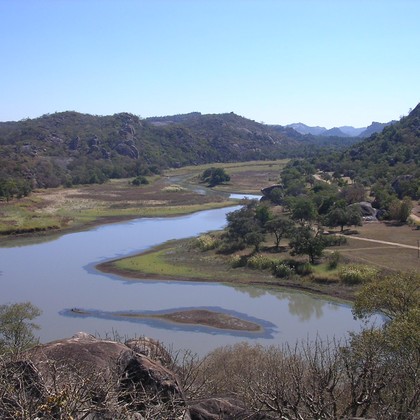
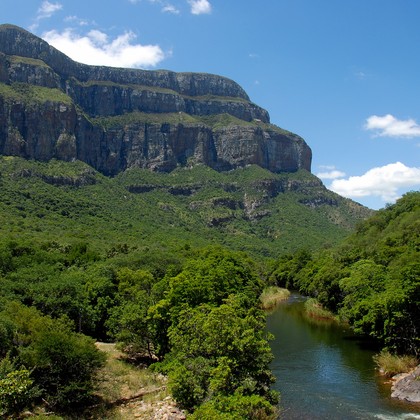
Edges of forest and gallery forest, overgrown clearings, thicket in moist savanna, abandoned cultivation and rank growth along roads and villages. Forages on the ground and in the lowest layer of the thicket for insects.
Where the bird is most at home, classified by the vegetation units of southern Africa.
Range and movements
Within the region only in Angola, in the north and west of the country, mainly on the northern plateaus and the western escarpment zone. Beyond it from Nigeria and Cameroon east through the Central African Republic and the DR Congo to Uganda, Rwanda, Burundi, western Kenya and north-western Tanzania.
- Winter visitor (c. Apr–Sep)
- dark = core range, pale = thinly spread
How and when to look
Walk forest edges and overgrown gardens in northern Angola early in the morning and listen for the repeated whistled phrases coming from the thicket. A scrub robin with a plain brown back, no obvious wing bars and a clean breast is this species here. The bird often briefly comes out onto an open track or roadside to feed.
Conservation status
Not threatened. The species is widespread in central and eastern Africa and benefits from secondary growth along forest edges and in abandoned farmland. In Angola it is poorly studied, and its numbers and distribution there are insufficiently known.
Scientific name
Cercotrichas hartlaubi | (Reichenow, 1891) (GBIF: Erythropygia hartlaubi)
Reichenow described the species in 1891 as Erythropygia hartlaubi; because it was later moved to another genus, the author and year stand in brackets. The genus Cercotrichas was introduced in 1831 by Boie. Cercotrichas is Greek, from kerkos 'tail' and trikhas 'thrush'. hartlaubi honours the German physician and ornithologist Gustav Hartlaub (1814–1900), a leading authority on African birds. The specimen the first description was based on came from Mutsora, near the Rwenzori, DR Congo.