All species › Waders, gulls and terns › Pratincoles and coursers › Bronze-Winged Courser
Bronze-Winged Courser | Rhinoptilus chalcopterus
Bronsvleugelrenvogel | Corredor Patirrojo
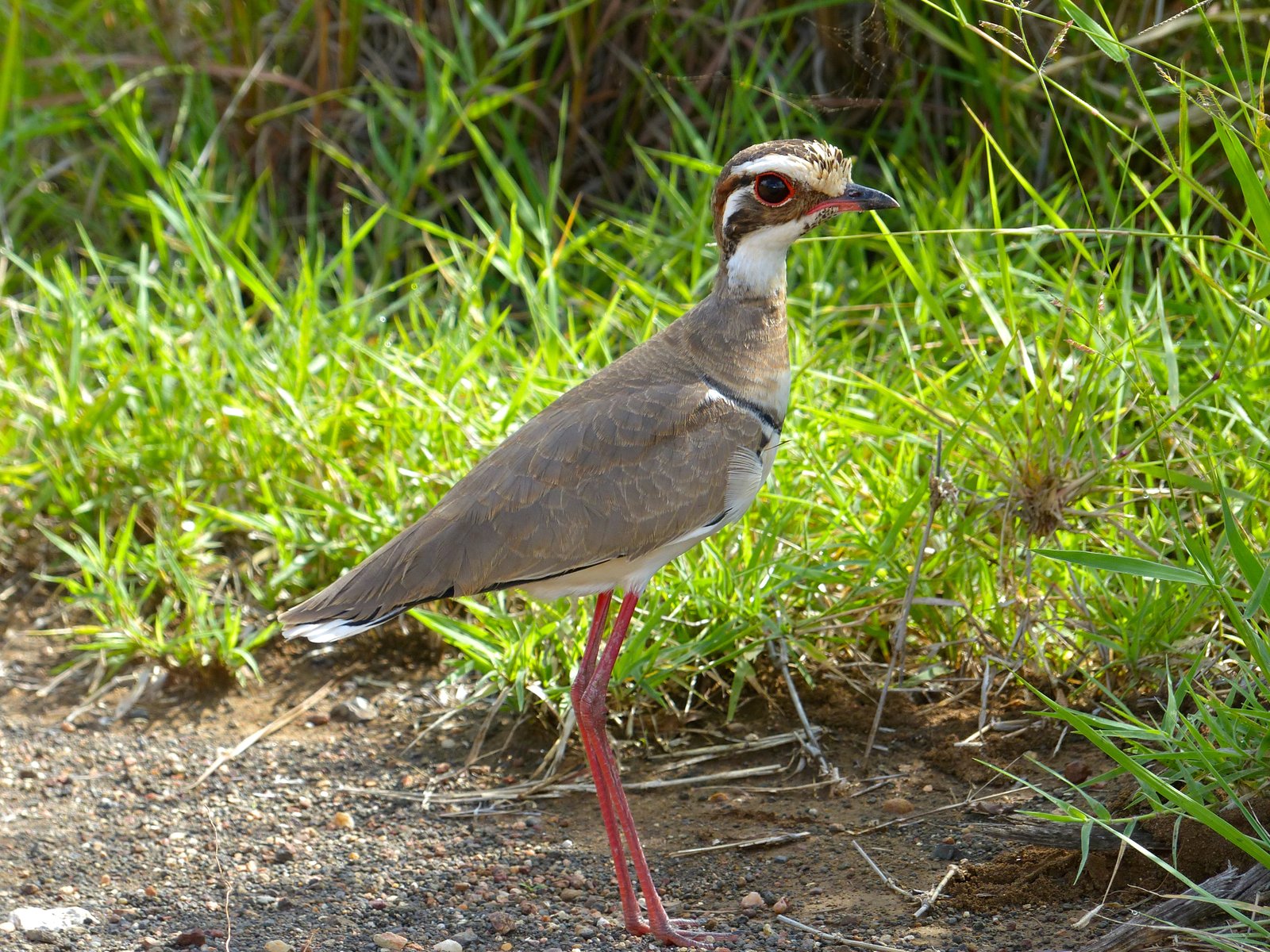
The Bronze-Winged Courser is the largest courser in the region, a nocturnal bird of woodland with a boldly patterned head, a dark breast band and striking red legs. Its name refers to the metallic violet to copper tips of the primaries, which show only in flight in good light.
Voice
Mainly at night a plaintive, whistled ki-kooi or jee-koo-eet, repeated and far-carrying; usually silent by day.
Recording: Derek Solomon — CC BY-NC-SA 4.0 · converted to mono · xeno-canto
Identification
25–29 cm. The upperparts are dark grey-brown with fine pale feather fringes. The head is boldly marked: a broad white supercilium, a dark stripe through the eye, a dark patch on the cheek and a white throat, with a striking reddish-purple eye-ring around the large dark eye. A broad grey-brown breast band is bordered below by a narrow black line; the belly is white. The bill is black with a reddish base, the legs deep red. In flight it shows a white band across the uppertail coverts, white underwings and dark flight feathers with a violet sheen at the tips. The sexes are alike.
Confusion species
Three-Banded Courser Rhinoptilus cinctus is slightly smaller and paler, with a streaked V on the neck, a rufous and black breast band and yellowish legs. Lapwings such as Blacksmith Lapwing Vanellus armatus are of similar size and underparts but are active by day and lack the striped head with red eye-ring. Spotted Thick-Knee Burhinus capensis is larger, spotted and has yellow eyes.
Habitat
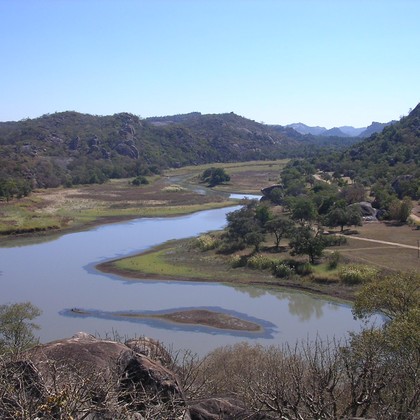
Dry and semi-arid woodland: mopane, miombo, mixed broadleaf woodland and acacia bush, often with bare or recently burnt open patches and little undergrowth. By day it rests motionless in the shade of a bush and at night forages in the open and along roads for beetles, grasshoppers and termites. It breeds in the dry season, from July to December, often on recently burnt ground; the nest is a bare scrape with two or three eggs.
Where the bird is most at home, classified by the vegetation units of southern Africa.


Range and movements
In the north and east of the region: Angola, Zambia, Malawi, Mozambique, Zimbabwe, northern and eastern Botswana and northern Namibia. In South Africa in Limpopo, Mpumalanga (including the Kruger National Park) and northern KwaZulu-Natal, and in Eswatini. Absent from the dry west and the Cape. Beyond the region from Senegal through the Sahel and West Africa to Ethiopia, Kenya and Tanzania.
- Resident
- Summer visitor (c. Oct–Mar)
- Winter visitor (c. Apr–Sep)
- Passage (Mar–Apr, Oct–Nov)
- dark = core range, pale = thinly spread
How and when to look
Drive slowly along dirt roads in woodland just after sunset, for example in the Kruger National Park (only where night drives are allowed) or in Zimbabwe; eyeshine in the headlights gives the bird away. By day it sits so still under bushes that it is found almost only by chance.
Conservation status
Not threatened and fairly common across its large range, but little noticed because of its nocturnal habits. Many birds are killed by traffic; conversion of woodland to cropland reduces habitat locally.
Scientific name
Rhinoptilus chalcopterus | (Temminck, 1824)
Temminck described the species in 1824 as Cursorius chalcopterus; because it was later moved to another genus, the author and year stand in brackets. The genus Rhinoptilus was introduced in 1852 by Strickland. Rhinoptilus comes from the Greek rhis (genitive rhinos), 'nostrils', and ptilon, 'feather' — according to Strickland (1852) for the forward-reaching frontal feathers. chalcopterus comes from the Greek khalkos, 'bronze', and pteron, 'wing' — for the violet-bronze sheen on the tips of the primaries. The specimen the first description was based on came from Senegal.