All species › Waders, gulls and terns › Sandpipers and snipes › Broad-Billed Sandpiper
Broad-Billed Sandpiper | Calidris falcinellus
Breedbekstrandloper | Correlimos Falcinelo
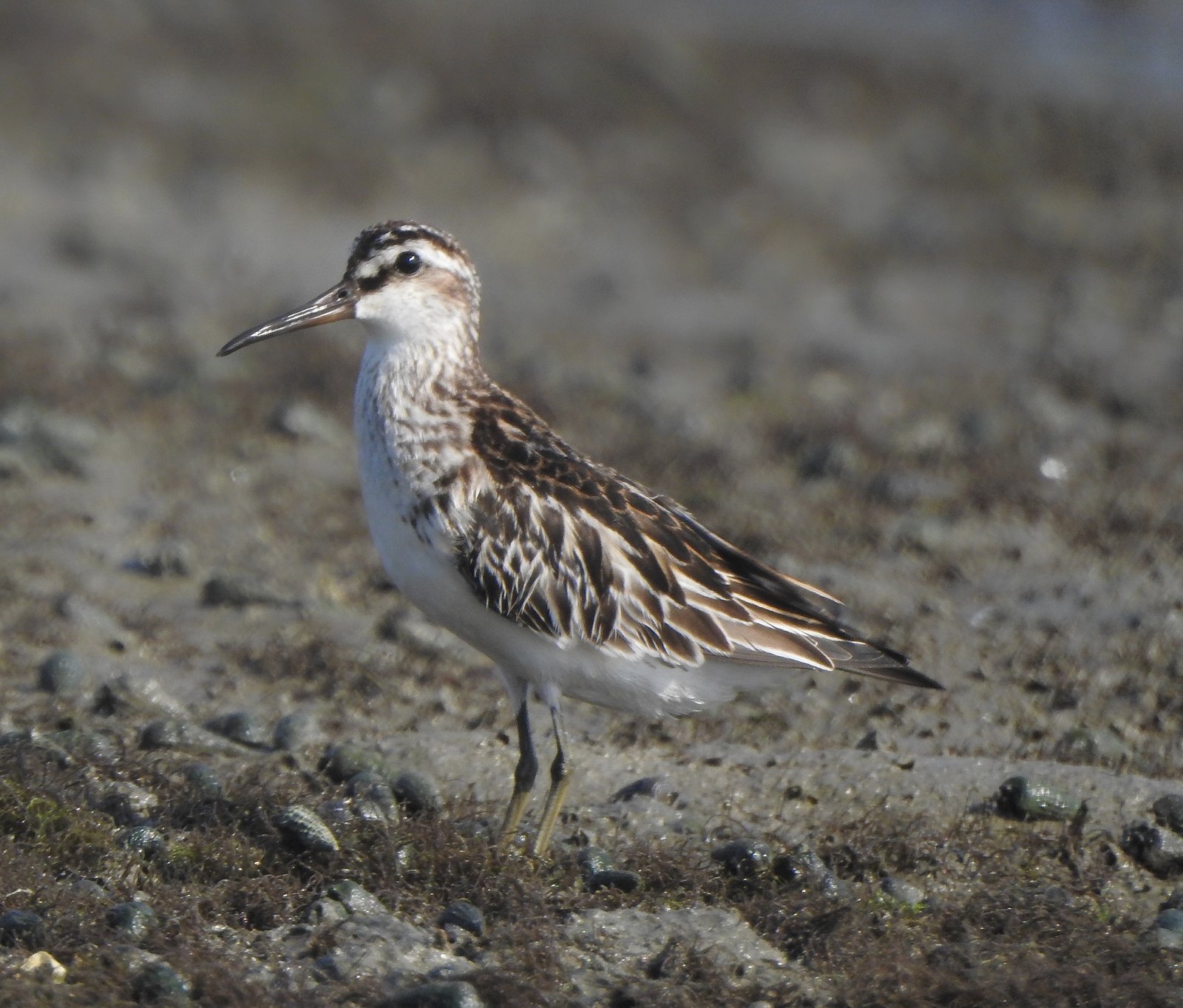
The Broad-Billed Sandpiper is a small, short-legged sandpiper with a long bill, broad at the base and distinctly kinked downwards at the tip. It breeds in bogs and marshes from Scandinavia to eastern Siberia and is a scarce non-breeding visitor to estuarine mudflats in southern Africa, mainly on the east coast.
Voice
A dry, buzzing chrreet or brrrit, especially in flight, lower and harsher than the call of Curlew Sandpiper.
Recording: Stanislas Wroza — CC BY-NC-SA 4.0 · converted to mono · xeno-canto
Identification
16–18 cm, slightly larger than a Little Stint. In non-breeding plumage grey above with dark shaft streaks and feather centres, white below with fine streaks on the breast. The head shows the characteristic pattern of a double, split supercilium: a second, narrow pale line above the main stripe, best seen in juveniles. The bill is black, fairly long, broad at the base and drooping at the tip; the short legs are dark greyish-green. Juveniles have a dark back with pale fringes forming white V-lines. It moves slowly and probes deeply into soft mud.
Confusion species
Dunlin Calidris alpina is larger and longer-legged, without a split supercilium. Little Stint Calidris minuta is smaller with a short, straight bill. Curlew Sandpiper Calidris ferruginea is larger and longer-legged, with an evenly decurved bill and a white rump.
Habitat
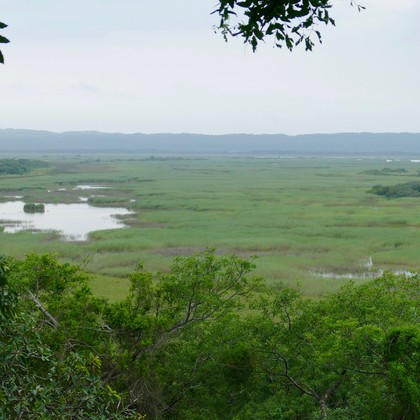
Soft, muddy tidal flats in estuaries, lagoons and mangroves, especially where the silt is fine; sometimes in saltworks and exceptionally at fresh inland waters. It often joins flocks of Curlew Sandpipers and Little Stints.
Where the bird is most at home, classified by the vegetation units of southern Africa.
Range and movements
Mainly along the east coast: estuaries and bays of Mozambique (among others Inhambane and Maputo Bay) and KwaZulu-Natal (Richards Bay, St Lucia, Durban), in smaller numbers along the south coast. Rare on the west coast, with records at Walvis Bay and in the lagoons of the Western Cape; a rare vagrant inland. Beyond the region it winters along the coasts of East Africa, the Persian Gulf, southern and South-East Asia and Australia.
- Summer visitor (c. Oct–Mar)
- Passage (Mar–Apr, Oct–Nov)
- dark = core range, pale = thinly spread
How and when to look
On a rising tide in the estuaries at Richards Bay or on the Mozambique coast, scan the flocks of small waders for a dark, compact bird with a kinked bill and a striped head. Its slow, deep probing makes it stand out among the scurrying Little Stints.
Conservation status
Vulnerable: the species is declining steeply worldwide through the loss of intertidal areas along the flyways, particularly around the Yellow Sea. In southern Africa it has always been scarce, and the east-coast estuaries are the key sites.
Scientific name
Calidris falcinellus | (Pontoppidan, 1763)
Pontoppidan described the species in 1763 as Scolopax Falcinellus; because it was later moved to another genus, the author and year stand in brackets. The genus Calidris was introduced in 1804 by Merrem. Calidris goes back to Ancient Greek kalidris or skalidris, a name Aristotle used for an unidentified grey waterside bird. falcinellus is a diminutive of Latin falx, falcis 'sickle', so 'little sickle'. The specimen the first description was based on came from Zealand, Denmark.