All species › Passerines › Bushshrikes › Bokmakierie
Bokmakierie | Telophorus zeylonus
Bokmakierieklauwier | Bubú Silbón
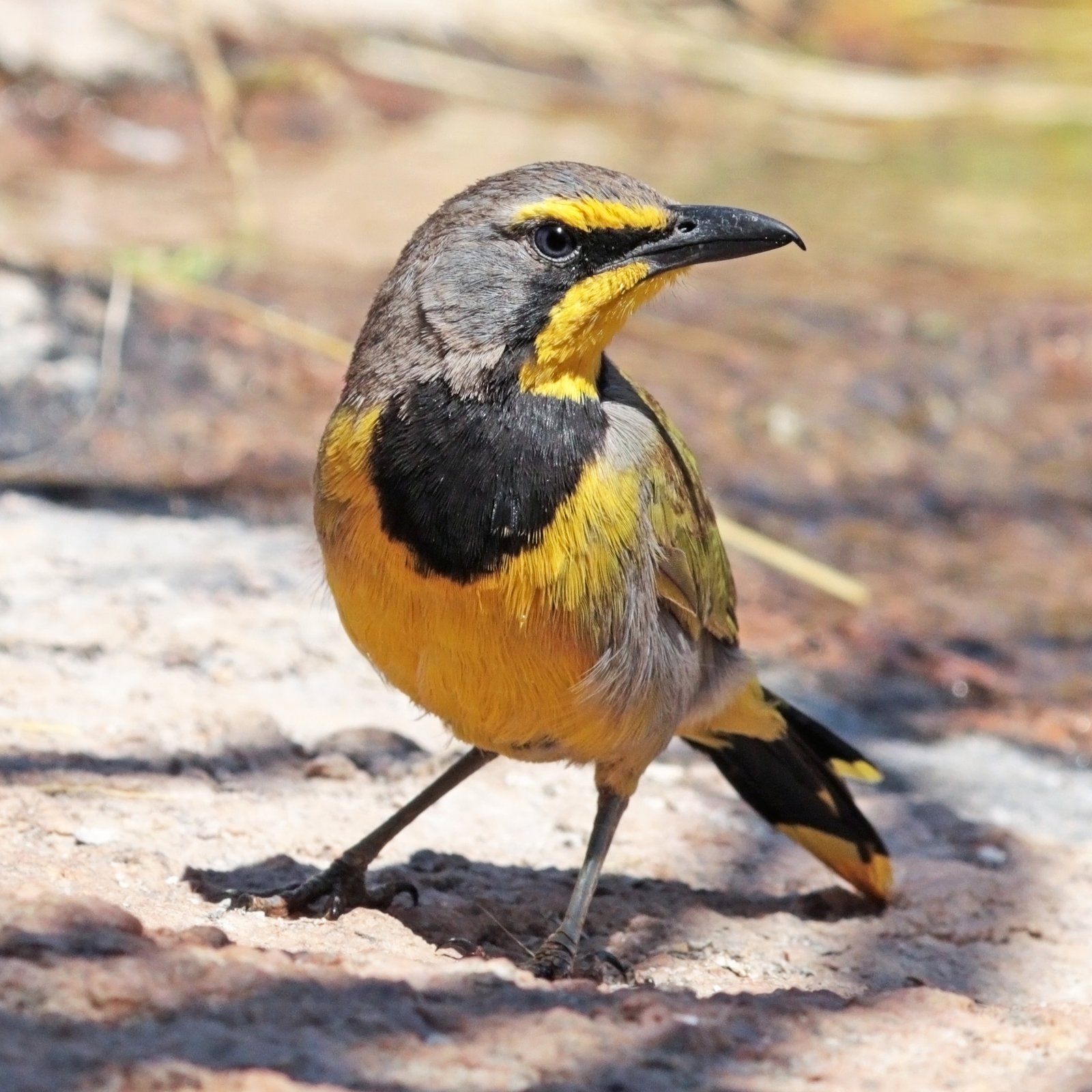
The Bokmakierie is a robust olive-green bushshrike with a bright yellow throat and a broad black gorget, and one of the most characteristic sounds of south-western Africa. Its name imitates the loud duet that pairs give from a bush or post. Unlike most bushshrikes it lives in open country and shows itself well.
Voice
Loud, clear and highly varied duets in which male and female alternate flawlessly: bok-mak-kiri, bok-bok-chit or wheet-wheet-wo. Each pair has its own repertoire, and neighbouring pairs answer one another. In alarm a hard tchak-tchak and a rasping kweeeh.
Recording: Walter Wallner — CC BY-NC-SA 4.0 · converted to mono · xeno-canto
Identification
22–23 cm. The upperparts are olive-green, the crown and nape blue-grey. A short yellow supercilium runs from the bill to above the eye. Throat and underparts are bright lemon-yellow, with a broad black band that runs from the lores down the side of the face and forms a gorget across the breast; the flanks are grey. The tail is dark green with broad yellow tips to the outer feathers, well visible in flight and when the tail is fanned. The bill is black, heavy and hooked. The sexes are alike. Juveniles lack the black gorget and are grey-green with a dull yellow throat.
Confusion species
Cape Longclaw Macronyx capensis also has a black gorget, but has an orange throat, a streaked brown back and a slender bill, and lives on the ground in grassland. Yellow-Throated Longclaw Macronyx croceus of the east has a yellow throat with a black band, but also a streaked back. Gorgeous Bushshrike Telophorus viridis has a scarlet throat and keeps hidden in dense thicket. Juveniles may suggest the olive morph of Olive Bushshrike Chlorophoneus olivaceus, but that species lives in forest.
Habitat
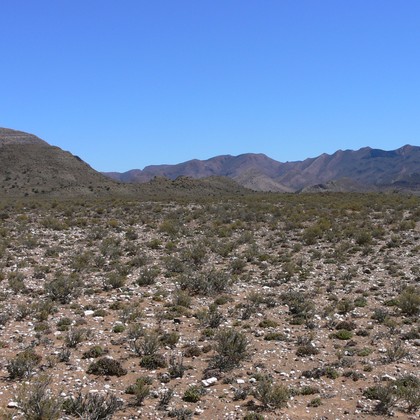
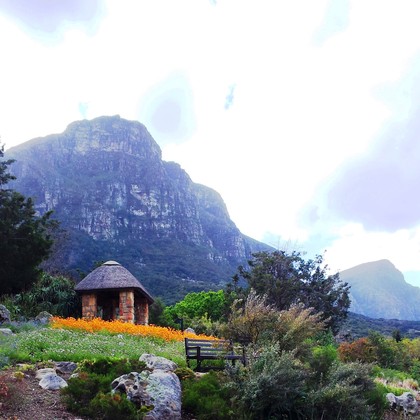
Open country with scattered bushes: fynbos, renosterveld, Karoo scrub, dry mountain slopes and rocky valleys, strandveld and dunes, and into parks, gardens and farmyards. It forages mainly on the ground, taking insects, small lizards, frogs, small birds and fruit, and sings from a high lookout.
Where the bird is most at home, classified by the vegetation units of southern Africa.

Range and movements
Widespread in South Africa, from the Western and Northern Cape through the Karoo and the Highveld to the Eastern Cape and KwaZulu-Natal, but absent from the low-lying dense bushveld of the north-east; also throughout Lesotho. Further in the south and west of Botswana, over much of Namibia except the north-east, and into south-western Angola. An isolated population lives in the eastern highlands of Zimbabwe and the adjacent part of Mozambique. The species does not occur outside southern Africa.
- Resident
- Summer visitor (c. Oct–Mar)
- Passage (Mar–Apr, Oct–Nov)
- dark = core range, pale = thinly spread
How and when to look
Present year-round in any patch of fynbos or Karoo scrub and in Western Cape gardens; in the early morning it sits calling on top of a bush or post. Listen to the duet and watch which bird gives which note: the two partners are often tens of metres apart.
Conservation status
Not threatened; common and locally numerous, and well adapted to gardens and farmland. The isolated population in the eastern highlands of Zimbabwe is small and depends on montane grassland with scrub.
Scientific name
Telophorus zeylonus | (Linnaeus, 1766)
Linnaeus described the species in 1766 as Turdus zeylonus; because it was later moved to another genus, the author and year stand in brackets. The genus Telophorus was introduced in 1832 by Swainson. Telophorus was given without explanation; possibly from the Greek telos, 'perfect', and -phoros, 'bearing', for the Bokmakierie's colourful plumage. zeylonus refers to Ceylon (Sri Lanka), an error: the early description drew on a 'Green Pye of the isle of Ceylon', but the species occurs only in southern Africa. The specimen the first description was based on came from Cape of Good Hope.