All species › Passerines › Waxbills › Blue Waxbill
Blue Waxbill | Uraeginthus angolensis
Angolees blauwfazantje | Azulito Angoleño
The Blue Waxbill is one of the commonest and most conspicuous estrildids of the savanna: a small brown bird with a sky-blue face, breast and tail, which forages in pairs or small groups around camps and along paths.

Click a thumbnail to switch the photo above.
Voice
A high, thin tsee-tsee or sree-sree contact call, and a short whistled song, wee-tsi-tsi-tseep, often with trills. Groups give themselves away by their constant high-pitched squeaking.
Recording: Rory Nefdt — CC BY-NC-SA 4.0 · converted to mono · xeno-canto
Identification
12–13 cm. Crown, back and wings grey-brown; face, throat, breast, flanks, rump and tail sky blue, the centre of the belly and undertail coverts pale buff. The bill is pinkish-grey to lilac with a dark tip. The female is clearly paler blue, with the blue more restricted to face and breast. Juveniles are paler still, with little blue and a dark bill. Neither sex has a red cheek patch.
Confusion species
The Red-Cheeked Cordon-Bleu (Uraeginthus bengalus) in northern Zambia and Angola is very similar: the male has a red cheek patch, and the female usually shows less blue on flanks and belly and a warmer brown belly. Blue extending well onto the flanks is a good feature of the Blue Waxbill. The Violet-Eared Waxbill (Granatina granatina) has blue only on the rump and forehead and is otherwise chestnut with violet cheeks.
Habitat
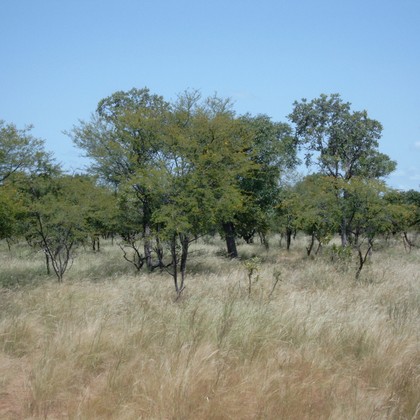
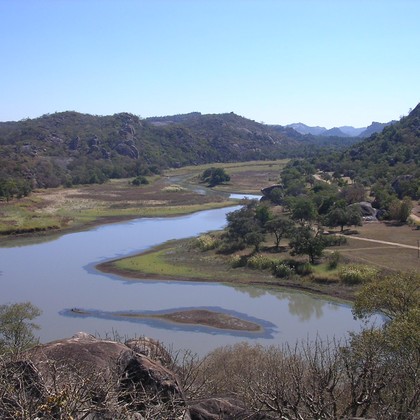
Dry acacia savanna, mixed woodland, the edges of mopane and miombo, thickets in river valleys, and also gardens, camps and villages. It feeds on the ground on grass seeds and insects, often with other estrildids such as the Red-Billed Firefinch. It builds an untidy nest in a thorn bush, often close to a wasp nest.
Where the bird is most at home, classified by the vegetation units of southern Africa.
Range and movements
Very widespread in the north and east of the region: Angola, Zambia, Malawi, Mozambique, Zimbabwe, Botswana (not the arid south-west), northern and central Namibia, and in South Africa North West, Gauteng, Limpopo, Mpumalanga and northern KwaZulu-Natal; also Eswatini. Beyond the region north to southern DR Congo and Tanzania.
- Resident
- Summer visitor (c. Oct–Mar)
- Winter visitor (c. Apr–Sep)
- Passage (Mar–Apr, Oct–Nov)
- dark = core range, pale = thinly spread
How and when to look
A good species for learning estrildids: in Kruger, Hwange, Chobe and around camps throughout the north-east of the region pairs feed within a few metres of people. In northern Zambia and Angola check the males in a group carefully: a Red-Cheeked Cordon-Bleu may be among them.
Conservation status
Not threatened. One of the commonest estrildids of the region, benefiting from settlement and disturbed vegetation.
Scientific name
Uraeginthus angolensis | (Linnaeus, 1758)
Linnaeus described the species in 1758 as Fringilla angolensis; because it was later moved to another genus, the author and year stand in brackets. The genus Uraeginthus was introduced in 1851 by Cabanis. Uraeginthus combines the Greek oura, 'tail', with aiginthos, an unidentified bird of antiquity, perhaps a finch — for the long tail of these waxbills. angolensis means 'from Angola', where the described specimen came from. The specimen the first description was based on came from Angola.