All species › Kingfishers, bee-eaters and rollers › Rollers › Blue-Throated Roller
Blue-Throated Roller | Eurystomus gularis
Blauwkeelscharrelaar | Carraca Gorgiazul
The Blue-Throated Roller is a small, stocky roller of the West and Central African rainforest, reaching the region only in northern Angola. It perches high on dead branches at the forest edge and hunts swarming insects mainly at dusk.

Voice
A hard, rasping and rattling series, krrr-kra-kra-kra, and quick harsh cries, especially at dawn and dusk when birds are actively hunting. Pairs are very noisy in display, flying with rolls and dives around the nest tree.
Recording: Rolf A. de By — CC BY-NC-SA 3.0 · shortened to the first 60 s, mono · xeno-canto
Identification
About 26 cm, with a large head, short neck and a broad, bright yellow bill. The upperparts are dark cinnamon-brown, the underparts purple-blue. A small, glossy blue-violet patch sits on the throat and shows only in good light. Flight feathers and tail are dark blue, the tail slightly forked. The sexes are alike. Juveniles are duller, with brown-mottled underparts, a dark bill tip and no throat patch.
Confusion species
Broad-Billed Roller (Eurystomus glaucurus) is larger, with lilac to purplish underparts lacking a defined blue throat patch, a pale blue undertail, and lives mainly in riverine forest and savanna. The two occur side by side in northern Angola; check size, the throat patch and the darker cinnamon upperparts of Blue-Throated Roller.
Habitat
Edges of lowland rainforest, clearings, gallery forest and secondary forest with tall dead trees as lookouts. It takes flying insects in the air, such as alate termites and ants, beetles and grasshoppers, often in short sallies from a high bare branch. It nests in cavities high in trees.
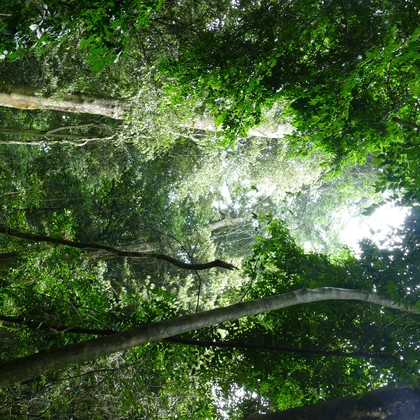
Where the bird is most at home, classified by the vegetation units of southern Africa.

Range and movements
Within the region only in northern Angola, notably in Cabinda and the forests of Uíge and Cuanza Norte. Beyond the region it ranges through the rainforest of West and Central Africa, from Guinea and Sierra Leone to Nigeria, Cameroon, Gabon, Congo, DR Congo and western Uganda.
- Resident
- dark = core range, pale = thinly spread
How and when to look
Look at dusk for birds perched high on dead trees at the edge of clearings, sallying out after swarming insects. The species is noisy and can be found by ear. For any small, dark roller with a yellow bill in northern Angola, always check the throat to rule out Broad-Billed Roller.
Conservation status
Not threatened and common across much of the rainforest; it tolerates some disturbance and also occurs in secondary forest. In Angola the small extent of suitable forest limits numbers, and logging locally threatens its habitat there.
Scientific name
Eurystomus gularis | Vieillot, 1819
Vieillot described the species in 1819 and placed it straight away in the genus where it still stands. The genus Eurystomus was introduced in 1816 by Vieillot. Eurystomus comes from the Greek eurystomos, 'wide-mouthed', from eurys, 'broad', and stoma, 'mouth' — for the short, very broad bill with which these rollers catch insects in flight. gularis comes from the Latin gula, 'throat' — for the bright blue throat patch. The specimen the first description was based on came from Senegal (originally given in error as 'Australasia').