All species › Cuckoos › Cuckoos › Blue Malkoha
Blue Malkoha | Ceuthmochares aereus
Blauwe geelsnavelmalkoha | Malcoha Africano Occidental
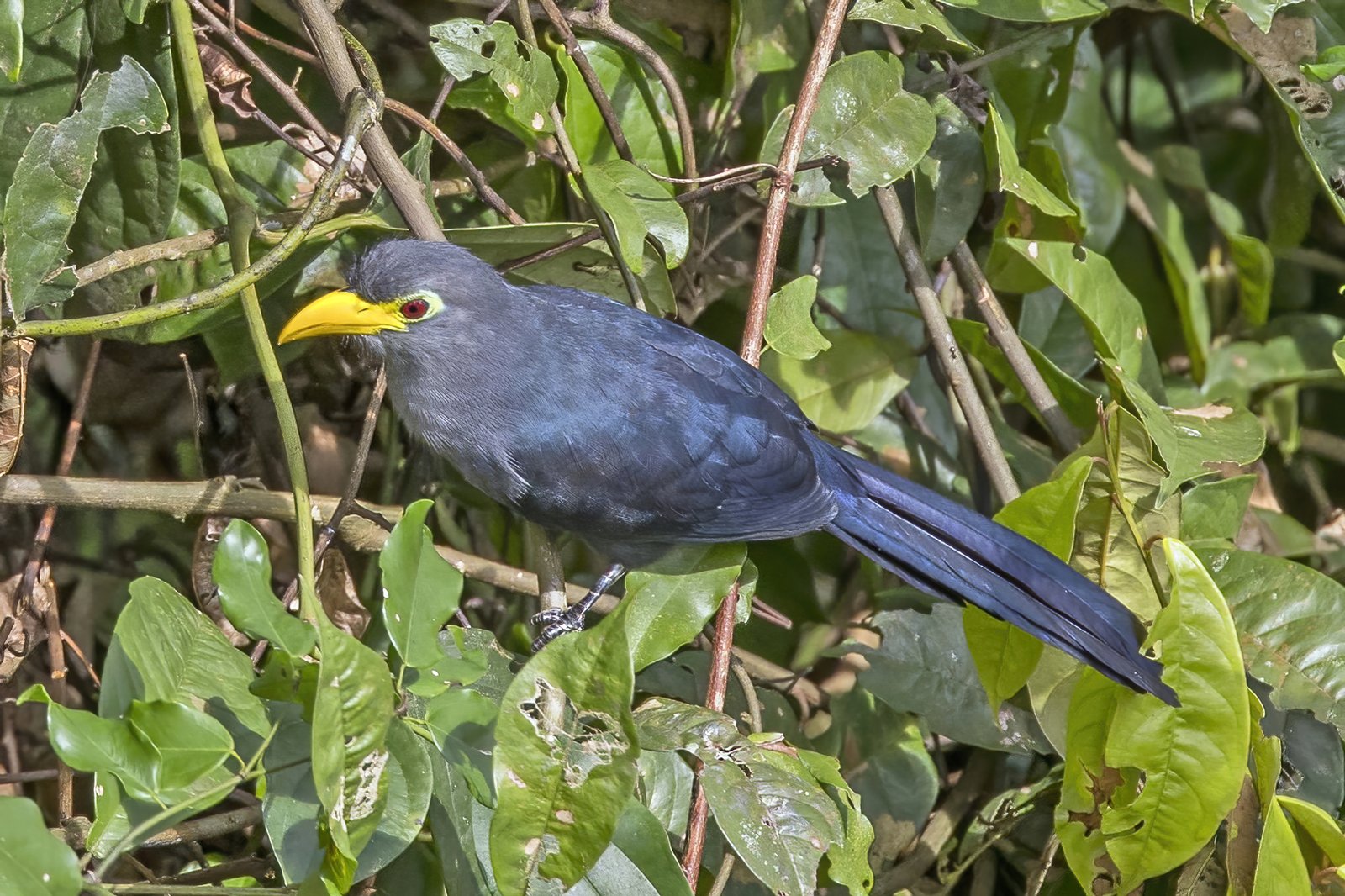
The Blue Malkoha is the western counterpart of the Green Malkoha: a dark, long-tailed cuckoo with a thick yellow bill that creeps unseen through creepers and dense canopy. Within the region it occurs only on the southern fringe of the Congo Basin, in northern Angola and north-western Zambia. This species too builds its own nest and is not a brood parasite.
Voice
A series of dry clicks that speed up into a rattle, tik ... tik ... tik-tik-tiktiktrrrr, virtually the same as that of Green Malkoha. Also a thin, plaintive whistled kyeew and single sharp clicks.
Recording: Paul Lenrumé — CC BY-NC-SA 4.0 · converted to mono · xeno-canto
Identification
32–35 cm, with a very long, broad tail. The upperparts, wings and tail are dark slate-grey with a distinct steel-blue to violet-blue gloss. Head and underparts are dark grey, slightly paler on the throat, becoming almost black on the belly and undertail. The bill is thick, curved and bright yellow, with yellow bare skin before the eye; the iris is red. The sexes are alike; juveniles are duller and browner with a darker bill. It clambers and creeps through dense foliage and flies only short distances.
Confusion species
Green Malkoha Ceuthmochares australis of the east of the region has a green to blue-green gloss on the upperparts and paler grey underparts; in the field the two are best separated by range. No other dark forest bird in the region has such a thick yellow bill.
Habitat
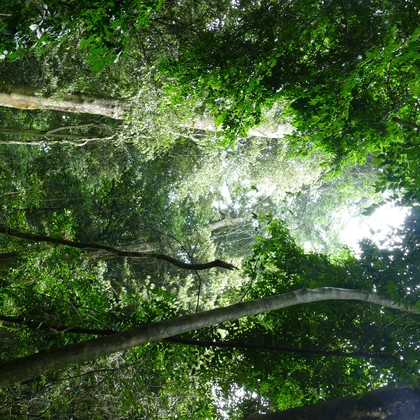
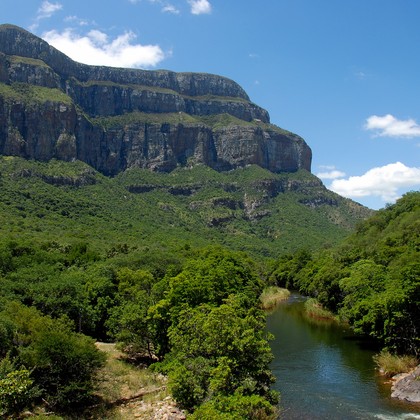
Humid lowland forest, gallery forest along rivers, forest edges rich in creepers, secondary forest and overgrown clearings; in northern Angola also the coffee forests of the escarpment zone. It forages in the mid-stratum and canopy for caterpillars and other large insects, often with mixed parties.
Where the bird is most at home, classified by the vegetation units of southern Africa.
Range and movements
Within the region only in northern and north-western Angola (including Cabinda) and the extreme north-west of Zambia, mainly in the gallery forests around Mwinilunga. Beyond the region through the forest zone of West and Central Africa, from Senegal and Guinea east to Uganda and western Kenya.
- Resident
- Summer visitor (c. Oct–Mar)
- Winter visitor (c. Apr–Sep)
- Passage (Mar–Apr, Oct–Nov)
- dark = core range, pale = thinly spread
How and when to look
Search the gallery forests of north-western Zambia or the forest belt of northern Angola and listen for the accelerating ticking from the foliage. The bird usually stays high and hidden; a brief moment on a bare branch or a crossing between two crowns is often all you get, with the yellow bill as the key feature.
Conservation status
Not threatened and widespread over a large range in West and Central Africa. On the southern edge of its range, in Angola and Zambia, it is confined to gallery and lowland forest and therefore vulnerable to clearing and fire.
Scientific name
Ceuthmochares aereus | (Vieillot, 1817)
Vieillot described the species in 1817 as Cuculus aereus; because it was later moved to another genus, the author and year stand in brackets. The genus Ceuthmochares was introduced in 1863 by Cabanis & Heine. Ceuthmochares comes from the Greek keuthmos, 'hiding place', and chairō, 'to rejoice' — 'delighting in hiding', for its secretive life in dense foliage. aereus is Latin for 'bronze, copper' — for the metallic sheen of the plumage. The specimen the first description was based on came from Malembo, Cabinda (Angola).