All species › Kingfishers, bee-eaters and rollers › Bee-eaters › Blue-Cheeked Bee-Eater
Blue-Cheeked Bee-Eater | Merops persicus
Groene bijeneter | Abejaruco Persa
The Blue-Cheeked Bee-Eater is a large, grass-green bee-eater with long streamers and blue-and-white facial markings that migrates to the region in the austral summer from North Africa, the Middle East and Central Asia. It is closely tied to water and often hunts in groups over marshes and floodplains.
Voice
A rolling prrrip or diririp, slightly fuller and hoarser than the liquid calls of European Bee-Eater; flocks often give it in flight.
Recording: David Darrell-Lambert — CC BY-NC-SA 4.0 · converted to mono · xeno-canto
Identification
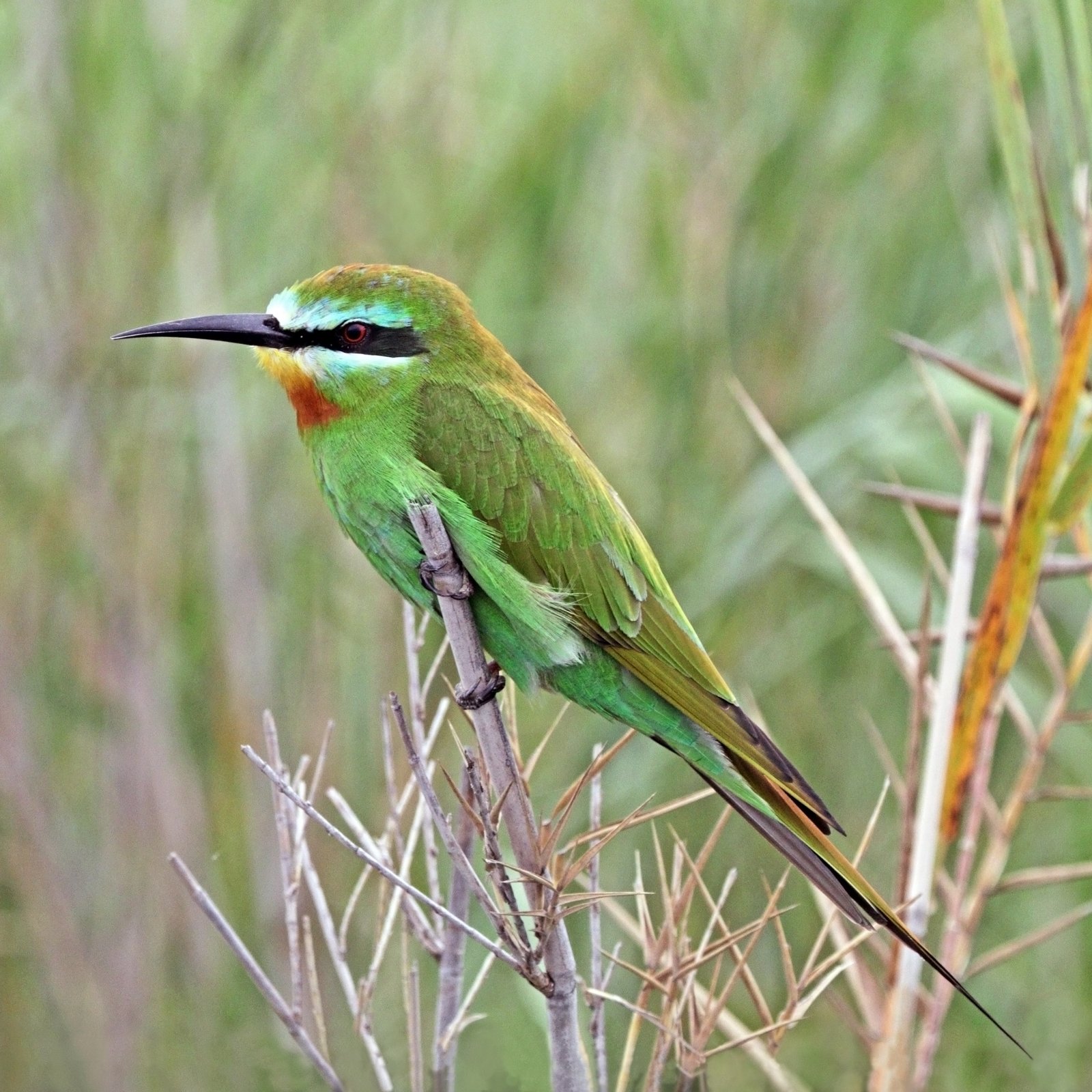
The body is 23–26 cm, with elongated central tail feathers projecting 6–8 cm. The plumage is mostly bright grass-green, including the crown and nape. Forehead and supercilium are white and pale blue, and a blue-and-white cheek stripe runs below the black mask. The chin is yellow, the throat rufous. In flight the underwings are rufous with a dark trailing edge. The sexes are alike; juveniles are duller, with a pale throat and shorter or no streamers.
Confusion species
Olive Bee-Eater (Merops superciliosus) is most similar, but has an olive-brown crown, a duller olive-green plumage and a white rather than blue cheek stripe. European Bee-Eater (Merops apiaster) has a yellow throat and chestnut upperparts. Juveniles without streamers are told from Little Bee-Eater (Merops pusillus) by their much larger size and the lack of a black throat band.
Habitat
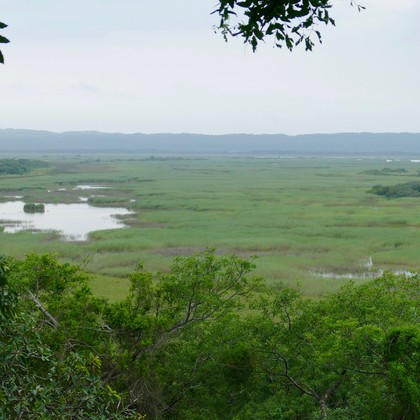
Marshes, floodplains, banks of rivers, lakes and dams, coastal plains and mangroves, usually with bare branches, reed stems or wires as lookouts over water or open ground. It hunts from a perch or in long gliding flights for dragonflies, bees, wasps and other flying insects; dragonflies form a large part of the diet.
Where the bird is most at home, classified by the vegetation units of southern Africa.

Range and movements
Mainly in the north and east of the region: the Okavango Delta, Chobe and Caprivi, the Zambezi valley and the floodplains of Zambia, Lake Malawi and the Shire, and the coast and rivers of Mozambique; also in Angola. Scarce in northern South Africa (Limpopo, Kruger, northern KwaZulu-Natal) and a vagrant further south. It breeds in North Africa, the Middle East and western and central Asia; it winters in sub-Saharan Africa.
- Summer visitor (c. Oct–Mar)
- Passage (Mar–Apr, Oct–Nov)
- dark = core range, pale = thinly spread
How and when to look
From November search the Okavango, Chobe or the Zambezi for large green bee-eaters on dead branches over the water, often in the company of other bee-eaters. Always check the crown and cheek stripe to rule out Olive Bee-Eater; in Mozambique and at Lake Malawi the two species occur side by side.
Conservation status
Not threatened and widespread over a large range. In winter it depends on marshes and floodplains, which are declining in parts of the region through drainage and dams.
Scientific name
Merops persicus | Pallas, 1773
Pallas described the species in 1773 and placed it straight away in the genus where it still stands. The genus Merops was introduced in 1758 by Linnaeus. Merops is Greek and means 'bee-eater'. persicus is Latin for 'Persian', after the eastern part of the breeding range. The specimen the first description was based on came from the shores of the Caspian Sea.