All species › Waders, gulls and terns › Avocets and stilts › Black-Winged Stilt
Black-Winged Stilt | Himantopus himantopus
Steltkluut | Cigüeñuela Común
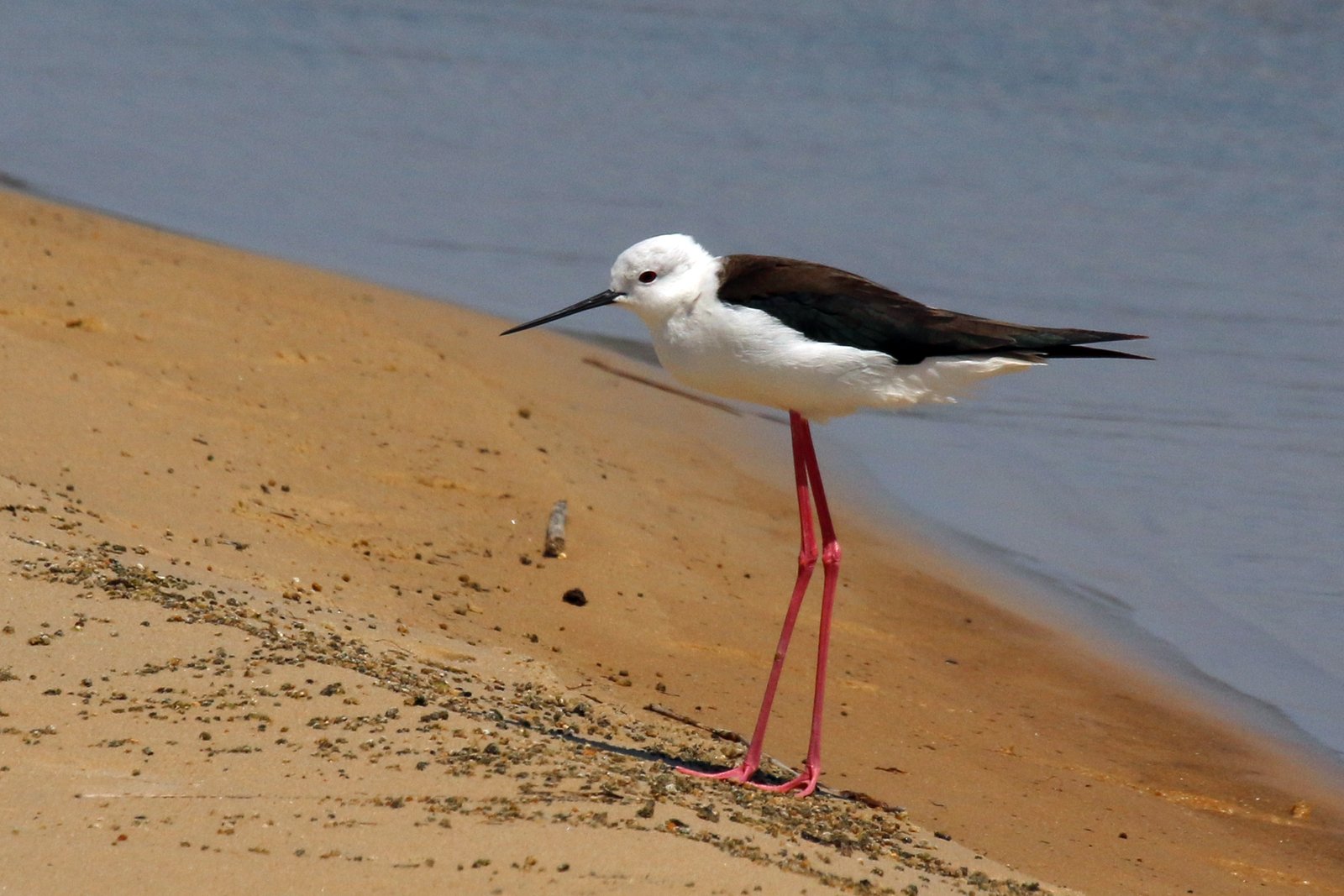
The Black-Winged Stilt is a slender black-and-white wader with extravagantly long red legs, which let it wade deeper than any other wader of its size. It is widespread and common at shallow fresh and brackish water, and anyone approaching a nest is greeted with loud yelping.
Voice
A sharp, repeated kik-kik-kik or a yelping kek, sustained and high when disturbed; birds defending a nest circle calling above the intruder.
Recording: Swann Terrier — CC BY-NC-SA 4.0 · converted to mono · xeno-canto
Identification
35–40 cm. The mantle and wings are wholly black above and below, glossed green in the male and brownish-black in the female. The head, neck and underparts are white; the crown and hindneck vary from pure white to grey or blackish. The thin, straight bill is black and the legs long and red to pink. In flight the pointed black wing stands out above a white back, with the legs trailing far beyond the tail. Juveniles have a brownish mantle with pale fringes, a white trailing edge to the wing and pink to greyish-pink legs.
Confusion species
Pied Avocet Recurvirostra avosetta has an upcurved bill, a black cap, much white in the wing and blue-grey legs. Marsh Sandpiper Tringa stagnatilis and Common Greenshank Tringa nebularia are grey-brown above, with greenish legs and a white wedge on the back. No other wader in the region combines a black wing with red stilts.
Habitat
Shallow fresh, brackish and saline water: dams, pans, vleis, sewage works, saltworks, estuaries, rice and irrigation fields and flooded pasture. It picks insects, larvae, small crustaceans and molluscs from the water surface and from shallow water. It breeds singly or in loose colonies; the nest is a scrape or a raised heap of plant material on an islet or shore, sometimes in shallow water.
Where the bird is most at home, classified by the vegetation units of southern Africa.

Range and movements
Across almost the whole region wherever shallow water stands: South Africa, Lesotho, Eswatini, Namibia, Botswana, Zimbabwe, Mozambique, Zambia, Malawi and Angola; common on the highveld, in the Cape provinces, the Okavango and along the Namibian coast, scarcer in the driest parts of the Kalahari and the Namib. Beyond the region over much of Africa, Madagascar, southern Europe and tropical and temperate Asia; European birds winter in the Sahel and East Africa.
- Resident
- Summer visitor (c. Oct–Mar)
- Winter visitor (c. Apr–Sep)
- Passage (Mar–Apr, Oct–Nov)
- dark = core range, pale = thinly spread
How and when to look
At almost any shallow dam, pan or sewage works, year-round. Watch the feeding action: the stilt picks carefully and precisely from the surface, whereas the avocet sweeps sideways. In the breeding season after the rains, pairs betray their nest with loud, incessant yelping.
Conservation status
Not threatened; common and locally increasing with the construction of dams, sewage works and irrigation. Nests are lost to flooding and drying of pans, to livestock and to disturbance; the draining of vleis is locally harmful.
Scientific name
Himantopus himantopus | (Linnaeus, 1758)
Linnaeus described the species in 1758 as Charadrius Himantopus; because it was later moved to another genus, the author and year stand in brackets. The genus Himantopus was introduced in 1760 by Brisson. Himantopus is Greek, from himas 'strap, thong' and pous 'foot': 'strap-foot', after the long thin legs. The specific name repeats the genus name. The specimen the first description was based on came from southern Europe.