All species › Waders, gulls and terns › Sandpipers and snipes › Black-Tailed Godwit
Black-Tailed Godwit | Limosa limosa
Grutto | Aguja Colinegra
The Black-Tailed Godwit is a long-legged wader with a long, straight bill, instantly recognisable in flight by its broad white wingbar and black tail with a white base. In southern Africa it is a scarce and irregular non-breeding visitor, more often at inland fresh water than on the coast.

Voice
Mostly silent in Africa. On taking flight a fast, nasal weeka-weeka-weeka or a short kek; in flocks a soft chatter.
Recording: Jens Schöller — CC BY-NC-SA 4.0 · converted to mono · xeno-canto
Identification
40–44 cm; the female is larger and longer-billed. In non-breeding plumage plain grey-brown on the upperparts, pale grey on the neck and breast and white on the belly, with a short pale supercilium in front of the eye. The bill is long and nearly straight, orange-pink at the base with a dark tip. The legs are long and dark and project well beyond the tail in flight. In flight a broad white wingbar, a white rump and a black terminal tail band. In breeding plumage the head, neck and breast are orange-brown with black barring on the flanks.
Confusion species
Bar-Tailed Godwit Limosa lapponica has shorter legs, a slightly upturned bill, streaked upperparts, no wingbar and a barred tail. Hudsonian Godwit Limosa haemastica, an extremely rare vagrant, has a narrower wingbar and black underwing coverts. Common Greenshank Tringa nebularia is smaller, with a shorter, slightly upturned bill and greenish legs.
Habitat
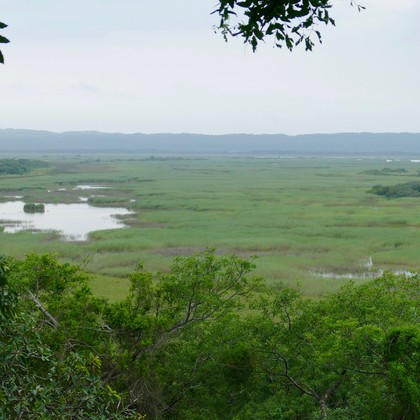
Shallow freshwater marshes, floodplains, pans, dams and sewage works with muddy margins, less often estuaries and coastal lagoons. It wades up to its belly and probes with the whole bill, and sometimes the head, underwater for larvae, worms and molluscs; in rice fields it also eats seeds.
Where the bird is most at home, classified by the vegetation units of southern Africa.

Range and movements
Scarce and irregular: most frequent in Zambia (Kafue Flats, Bangweulu), Malawi, Zimbabwe, northern Botswana and northern Namibia; elsewhere in small numbers or as a vagrant in Mozambique, South Africa and Angola, both inland and on the coast. It breeds in temperate Europe and Asia, from Iceland and the Netherlands to eastern Siberia, and winters mainly in West Africa, the Sahel, East Africa and southern Asia to Australia.
- Summer visitor (c. Oct–Mar)
- Passage (Mar–Apr, Oct–Nov)
- dark = core range, pale = thinly spread
How and when to look
Check groups of waders at sewage works and floodplains in the north of the region, especially after good rains. A flushed flock of Ruffs and sandpipers may contain a godwit: the broad white wingbar and black tail band then catch the eye.
Conservation status
Near Threatened. Breeding populations in western Europe, including the large Dutch population, have declined steeply through intensified grassland management and drainage. In southern Africa numbers are small and irregular, so trends here are poorly known.
Scientific name
Limosa limosa | (Linnaeus, 1758)
Linnaeus described the species in 1758 as Scolopax Limosa; because it was later moved to another genus, the author and year stand in brackets. The genus Limosa was introduced in 1760 by Brisson. Limosa is Latin for 'muddy', from limus 'mud'. The specific name repeats the genus name. The specimen the first description was based on came from Sweden.